Introduction to Red Beryl
Most people recognize diamonds, rubies, and emeralds; however, very few individuals have ever seen a Red Beryl in person. There is a scientifically solid reason for this scarcity. Specifically, the Utah Geological Survey estimates that miners find only one Red Beryl crystal for every 150,000 gem-quality diamonds. This staggering statistic makes it one of the rarest gemstones on Earth. Because it is so scarce and typically small, you will rarely encounter it in a standard local jewelry store. Even so, understanding this mineral helps you avoid fakes and appreciate its true market value. Consequently, this guide covers everything you need to know in plain language. You should also read our guide on gemstone buying mistakes to ensure you protect your investment when hunting for such rare treasures.
The Geographical Origins of Red Beryl
Red Beryl has a fascinating and relatively recent origin story. Maynard Bixby, an American mineralogist, first discovered the species in 1904 in the Thomas Range of Utah. Initially, the world knew very little about its commercial potential. However, in 1958, Lamar Hodges discovered the main commercial source—the Ruby-Violet Claim in the Wah Wah Mountains of Beaver County, Utah—while he was prospecting for uranium.
Geologically, the stone forms in a highly specific and unusual setting. Unlike most beryl varieties, which grow in coarse-grained rocks called pegmatites, this gem crystallizes inside topaz-bearing rhyolite. During formation, superheated gases rise through fractures in the volcanic rock and mix with mineral-rich groundwater descending from above. This precise chemical meeting triggers crystal growth. Because this combination of conditions is so rare in nature, gem-quality material exists essentially in only one place on Earth. For a deeper geological explanation, you can visit Geology.com’s overview of Red Beryl.
The Chemistry Behind Red Beryl Color
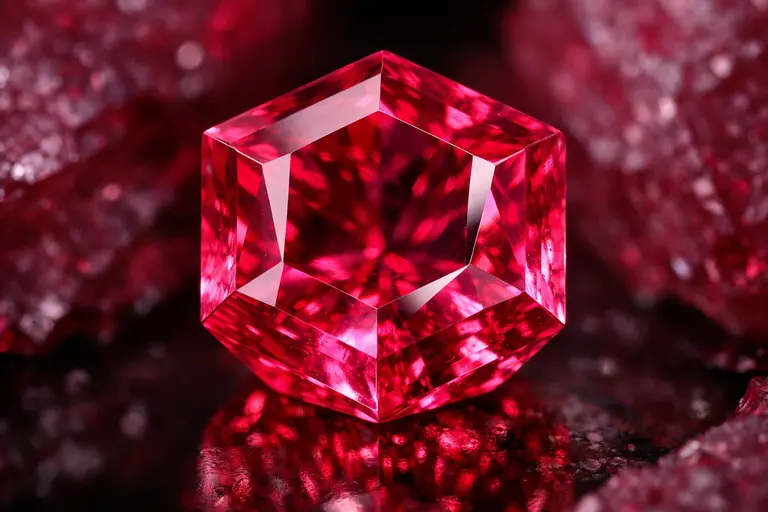
The rich raspberry-red to purplish-red color comes primarily from manganese ions. During the growth of the crystal, manganese replaces aluminum inside the beryl structure. This substitution effectively acts as the color engine for the stone. Furthermore, the gem shows pleochroism, meaning the stone can appear in slightly different shades depending on the angle from which you view it.
In addition, almost all natural specimens contain visible inclusions. Specifically, you will find tiny fractures, feather-like wisps, and mineral traces such as quartz or bixbyite. As a result, perfectly clean stones are extremely uncommon. Consequently, buyers should expect characteristic internal patterns rather than flawless clarity. To understand how these inclusions affect value, refer to the Gemological Institute of America.
Modern Mining of Red Beryl
At present, Red Emerald Inc. controls the Ruby-Violet Claim after purchasing the rights in 2020. This company represents the only confirmed commercial source of gem-quality Red Beryl in the world. While other minor occurrences exist in New Mexico and Mexico, those locations typically produce crystals that are too small or poor in quality for jewelry.
Due to these tight supply constraints, technicians cut fewer than 10,000 stones annually. Moreover, more than 95% of those pieces are tiny “melee” accent stones. Larger, high-quality faceted gems enter the market in very limited numbers. Therefore, serious collectors often wait months or even years for a worthy stone to become available. You can also check our guide on Understanding BIS Hallmark to see how certification standards apply to the metal settings used for these rare gems.
Detecting Fakes of Utah Red Beryl
As the popularity of the stone grows, buyers must stay alert for imitations. On the treatment side, some natural stones receive fracture filling with oil or resin to improve apparent clarity. Sellers must disclose this process, and a professional lab report will clearly flag it.
Spotting Synthetic Red Beryl
On the synthetic side, Russian laboratories have produced hydrothermal Red Beryl since the 1990s. These lab-grown stones often display chevron-like growth zoning under magnification. Furthermore, they may contain trace metals such as cobalt, which do not occur in natural Utah specimens. Consequently, you should treat any stone offered without a reputable lab certificate with serious caution.
Comparing Red Beryl to Look-Alikes
Beyond synthetics, several natural imitations circulate in the market. Pezzottaite—a mineral from Madagascar—is one of the most convincing look-alikes. However, it contains cesium and has different optical properties. In addition, some sellers pass off red glass or pink tourmaline as the real thing. Therefore, you must always request a report from a respected laboratory like the GIA.
Jewelry Styling and Red Beryl Care
Red Beryl works well as a jewelry stone, but its small crystal size limits design options. The largest known faceted stone weighs only about 8 carats, and most finished gems are well under 1 carat. Jewelers most often set the stone as a center piece in a ring or pendant.
Because internal fractures make the stone somewhat brittle, protective settings matter enormously. A bezel setting wraps the edges of the stone and shields it from impact. For cleaning, use only warm soapy water and a soft brush. Ultimately, you must avoid ultrasonic cleaners and harsh chemicals, as those methods can worsen fractures or disturb clarity-enhancing fillers.
FAQ: Understanding Red Beryl
Is Red Beryl really rarer than a diamond?
Yes. Geologists find one Red Beryl crystal for every 150,000 gem-quality diamonds. Its limited geographic occurrence makes it one of the scarcest minerals on the planet.
Why is it sometimes called “Red Emerald”?
Both stones belong to the beryl family. However, the term “Red Emerald” is technically incorrect and misleading. The correct trade and scientific name is Red Beryl.
Can I find this stone outside of Utah?
While tiny crystals have appeared in New Mexico and Mexico, the only commercial source for gem-quality stones is the Wah Wah Mountains in Utah, USA.
How much does it cost per carat?
Prices vary by quality. Specifically, small stones start around $1,500 per carat, while exceptional pieces over one carat can exceed $20,000 per carat.
Is it durable for daily wear?
It has a hardness of 7.5 to 8, which is good. However, its brittle nature means you should wear it in a protective setting and avoid hard knocks.
Disclaimer
This article is for general educational purposes only and reflects published gemological and market information available up to April 2026. Prices, availability, and ownership details may change over time. Always consult a qualified gemologist or trusted jewelry professional before making any purchase, appraisal, or investment decision involving red beryl or other gemstones.