Introduction to Phenakite vs Diamond
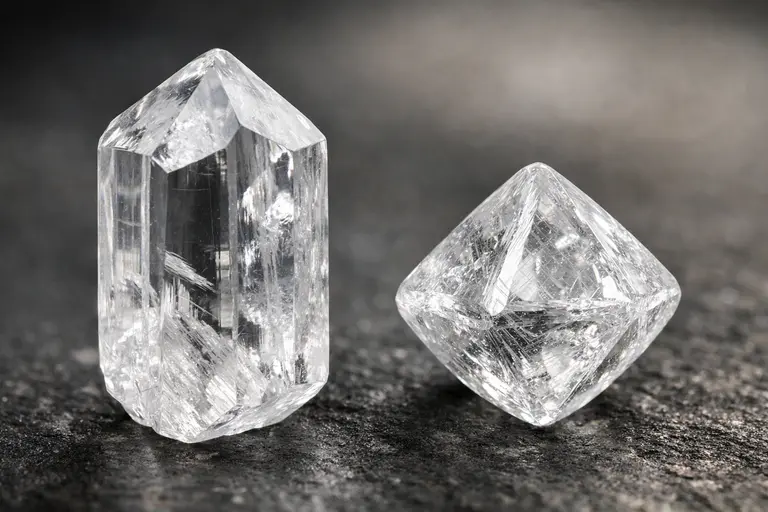
Rough Nigerian phenakite fools even the most experienced gem lovers. In fact, mineralogists originally named the stone after the Ancient Greek word phénax, meaning “deceiver.” They chose this name because the stone so closely resembles common quartz. However, modern gem dealers often use that nickname for a different reason. Specifically, rough Nigerian phenakite can look strikingly similar to rough diamond. Both stones appear clear, bright, and irregularly shaped, which makes accidental confusion very easy for buyers. Fortunately, Phenakite vs Diamond comparisons reveal big differences in hardness, weight, and light behavior. Therefore, before you buy or sell both stones, you must learn a few simple diagnostic checks. You should also read our guide on gemstone buying mistakes to avoid common pitfalls in the rare gem market.
Why Phenakite and Diamond Appear Identical
At first glance, you will notice that phenakite and diamond share several visual traits. Nigerian phenakite rough is often water-clear or pale yellow, which matches the appearance of many high-quality rough diamonds. In addition, both stones produce bright surface reflections that catch the eye instantly. Because rough Nigerian crystals often develop in irregular, water-worn shapes, they look rounded or distorted—exactly like many rough alluvial diamonds found in riverbeds.
Furthermore, surface markings increase the potential for confusion. Some phenakite crystals show etch patterns that closely resemble the growth marks found on diamond surfaces. Consequently, buyers who rely only on a quick visual inspection can easily misidentify them. In mixed parcels of rough stones, phenakite can slip in among real diamonds without the seller or buyer noticing. Therefore, you must understand that appearance alone is never enough to separate these two stones.
Geological Origins of Phenakite vs Diamond
Although they look similar, these stones grow in completely different environments. Diamonds form deep inside the Earth’s mantle under extreme heat and pressure. They then travel upward through volcanic rock channels called kimberlite pipes. On the other hand, phenakite grows in granite pegmatites and mica-rich metamorphic rocks. Specifically, Nigerian pegmatites produce the very clear crystals that cause the most confusion in the market today.
Because of this geological difference, the location of the find gives you a useful clue. For example, finding a clear crystal alongside beryl or topaz in a pegmatite strongly points to phenakite rather than diamond. Similarly, rough diamonds often appear with indicator minerals like garnet or chromite. You can learn more about professional diamond formation and recovery from the Gemological Institute of America (GIA). Consequently, always pay attention to the “mother rock” or surrounding minerals when evaluating a new find.
Three Tests to Compare Phenakite vs Diamond
Fortunately, you do not always need a laboratory to spot major differences. You can perform several checks to verify a stone’s identity.
Hardness in Phenakite vs Diamond
Diamond scores a perfect 10 on the Mohs scale, making it the hardest natural substance. Phenakite, meanwhile, sits between 7.5 and 8. Consequently, a diamond resists scratching far better than phenakite does. However, you should perform hardness tests carefully, as they can permanently damage a stone. If a mystery stone scratches easily against a known sapphire or topaz, it is certainly not a diamond.
Weight Differences: Phenakite vs Diamond
Second, you should check the weight. Diamond is significantly denser than phenakite, with a specific gravity of about 3.52. Phenakite typically ranges between 2.93 and 3.00. Therefore, for two stones of the same size, the diamond will feel noticeably heavier in your hand. If a stone looks large but feels unexpectedly light, treat that as a major warning sign.
Optical Fire in Phenakite vs Diamond
Third, you must watch for “fire.” Diamond bends light powerfully and scatters it into vibrant rainbow flashes. Phenakite, however, produces a colder, whiter sparkle with very little fire. This happens because phenakite has a much lower dispersion value than diamond. According to expert studies, cut phenakite shows much lower brilliance than diamond. For additional identification tips, you can refer to the Gem Identification Methodology Made Simple.
Care for Phenakite and Diamond Jewelry
Phenakite looks beautiful in jewelry, but it does not match the legendary toughness of a diamond. Although phenakite scores well on the hardness scale, it possesses cleavage planes. These planes make the stone more prone to chipping under a sharp impact. For this reason, jewelry designers must protect the stone carefully. A bezel setting, which fully surrounds the stone’s edge, provides much better protection than exposed prongs.
Phenakite works especially well in pendants and earrings because these pieces face less direct impact during daily activities. When a skilled cutter shapes the stone well, it delivers a clean, icy-white brilliance. However, because its fire is weaker than that of a diamond, you should not expect dramatic rainbow flashes. Therefore, phenakite suits buyers who prefer subtle, refined elegance over flashy fire. You can explore more about durable jewelry settings on Halstead’s main site.
FAQ: Phenakite vs Diamond Common Questions
Why is phenakite called “the deceiver”?
The name comes from the Greek word phénax. Originally, it referred to its similarity to quartz, but today it refers to its ability to mimic rough diamonds.
Does phenakite sparkle as much as a diamond?
No. While it is bright, it lacks the “fire” or rainbow flashes that characterize a diamond. Its sparkle is generally whiter and more muted.
Can a jeweler tell the difference easily?
Yes. A professional jeweler uses a refractometer or a thermal conductivity probe. These tools distinguish Phenakite vs Diamond in a matter of seconds.
Is phenakite a good investment?
Phenakite is a collector’s stone. While rare, it does not have the same liquid resale market as diamonds. Its value lies in its rarity and appeal to mineral enthusiasts.
Which stone is more expensive?
Diamonds are significantly more expensive per carat. Phenakite offers a much larger look for a fraction of the price, making it an attractive alternative for those on a budget.
Disclaimer
This article provides general educational information only. It does not replace professional gemological testing or legal advice. Always rely on certified laboratories and qualified gemologists before making any important buying, selling, or investment decisions involving gemstones.