Introduction
The Porsche Design Business Model is a masterclass in turning a legendary car brand into a legitimate Swiss watchmaker. In the luxury world, ‘Brand Licensing’ is common. Ferrari puts its name on Puma shoes; Bentley puts its name on luggage. However, Porsche Design does not simply put its name on a watch and call it done. Instead, the brand actively engineers, manufactures, and distributes every timepiece through a tightly controlled strategy that mirrors its automotive parent.
Understanding the Porsche Design Business Model reveals a masterclass in vertical integration and customer-first personalization. Furthermore, the brand’s approach to exclusivity and profitability sets it apart from traditional Swiss watchmakers. As an expert in luxury assets, I find their transition from a design studio to a full “Manufacture” fascinating. In this article, we will explore each of its core pillars in detail—from manufacturing control to the custom configurator that lets you match your watch to your car. You can compare this automotive crossover to the Girard-Perregaux Business Model (Aston Martin).
Manufacturing Control in the Porsche Design Business Model
Historically, Porsche Design did not manufacture its own watches. For many years, the brand relied on licensing partnerships with established Swiss makers such as IWC and Eterna. In fact, their partnership with IWC produced the world’s very first Titanium Chronograph in 1980—a monumental achievement in horology.
However, in 2014, the company made a decisive strategic shift. It established Porsche Design Timepieces AG in Solothurn, Switzerland, bringing full development and production under its own roof. As a result, the brand gained complete control over quality and design language. Moreover, it eliminated the margin-sharing that comes with third-party agreements. This transition transformed them into a genuine Swiss manufacturer—a significant credential. Read more about the power of in-house manufacturing in the Jaeger-LeCoultre Business Model.
Production Philosophy of the Porsche Design Business Model
One of the most distinctive features of the Porsche Design Business Model is its “Made-to-Order” (Just-in-Time) production. Rather than producing watches in bulk and storing them in a vault, the brand assembles each timepiece only after a customer places an order.
This approach, borrowed directly from automotive logistics, eliminates waste and reduces overhead costs significantly. Additionally, this sequential model allows the brand to offer a level of personalization that mass-market brands simply cannot match. Because each watch is built to order, customers influence the final product, leading directly into the brand’s flagship customization program.
The Configurator: 1.5 Million Combinations
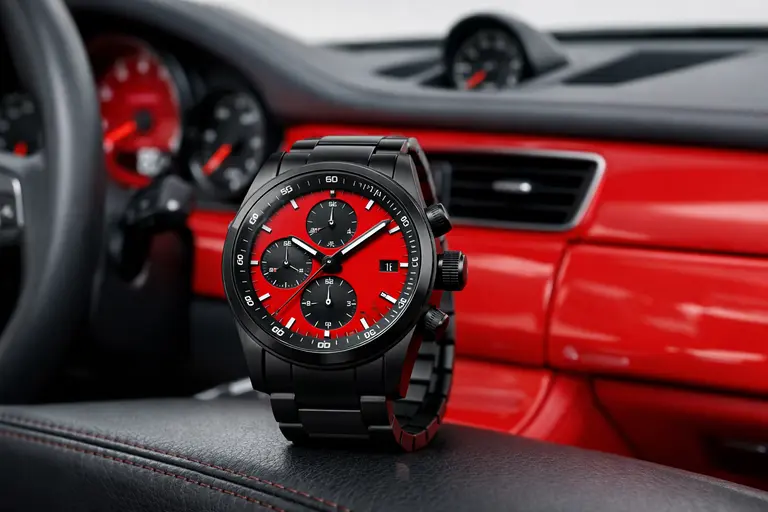
In 2020, Porsche Design launched a custom-built timepiece program. It allows buyers to configure their watch with more than 1.5 million possible combinations. Importantly, this program draws directly from the Porsche car configurator experience. You can choose the exact leather used in your car’s seats for the watch strap and choose the exact rotor design to match your car’s alloy wheels.
Even more impressively, you can choose from 163 genuine Porsche paint colors for the dial ring. This level of customization creates an emotional connection between the watch and the vehicle. Consequently, buyers who purchase a new Porsche often view a matching timepiece as a natural extension of their investment. Therefore, the configurator reinforces brand loyalty and increases the transaction value. Compare this hyper-customization to the Sartory Billard Watches approach.
R&D and Profitability in the Porsche Design Business Model
As a subsidiary of the Porsche Group, the watch division operates under clear financial expectations. Specifically, it targets a 20% Return on Sales—a demanding benchmark that most standalone watch brands struggle to meet. How do they achieve this? Through a smart structural advantage.
They integrate watch development early into the vehicle design cycle. Because the watch and car teams share a three-year design pipeline, the watch division benefits from shared R&D resources and materials research (like Titanium and Carbon). Thus, the cost of developing new watch models is substantially lower. This integration is a key reason the brand can maintain strong margins while keeping production volumes intentionally low (around 5,000 units annually).
Sales Channels of the Porsche Design Business Model
Porsche Design sells its watches through a carefully selected set of channels. First, Porsche Centers (Car Dealerships) serve as the primary sales environment. Sales associates present watches as part of the vehicle consultation process. Remarkably, limited-edition models achieve a roughly 50% “Take Rate” among new car buyers. This is an exceptionally high conversion figure.
Second, exclusive boutiques and high-end department stores extend the brand’s reach to watch enthusiasts who may not be active car buyers. Third, the official online store provides an omnichannel presence. Nevertheless, the digital channel maintains the same luxury standards as the physical retail experience. Read about successful digital luxury in the Cartier Business Model.
Representative Models and Indian Pricing
To understand the brand’s positioning, it helps to review its key models in the Indian market. Each watch reflects the “sports car for the wrist” philosophy through its use of Titanium and precision engineering.
- 1919 Chronotimer Flyback: Features a titanium case, flyback chronograph function, and the in-house WERK 01.200 movement. Priced at approx. ₹9,40,000.
- Monobloc Actuator GMT: A limited edition built with integrated rocker-arm pushers (no traditional buttons). Priced at approx. ₹12,80,000.
- Porsche Design Worldtimer: A 45mm titanium watch offering dual-time zones. Priced at approx. ₹4,99,000.
Collectively, these models target serious collectors and High-Net-Worth Porsche owners in cities like Mumbai and Bangalore. Moreover, the consistent use of Titanium underscores the brand’s commitment to high-performance materials.
Conclusion: Beyond the Steering Wheel
In summary, the Porsche Design Business Model proves that a car company can build a legitimate, highly respected Swiss watch brand. By refusing to simply license their logo and instead building a factory, they earned the respect of the horology world. Ultimately, it is the perfect accessory for the driver who wants the precision of Stuttgart on their wrist.
FAQ: Porsche Design Business Model
Who manufactures Porsche Design watches?
Since 2014, Porsche Design has manufactured its own watches through Porsche Design Timepieces AG, a subsidiary established in Solothurn, Switzerland. Before this, they relied on licensing partnerships with IWC and Eterna.
How many watches do they produce each year?
The brand intentionally limits annual production to approximately 5,000 units. This selective approach preserves exclusivity and supports the premium pricing strategy of the Porsche Design Business Model.
Can you customize a Porsche Design watch?
Yes. They offer a custom configuration program with over 1.5 million combinations. Buyers can choose authentic vehicle leather and one of 163 official Porsche paint colors for the dial details to match their car perfectly.
What is their profitability target?
As a subsidiary of the Porsche Group, the watch division targets a 20% return on sales. Crucially, it achieves this by sharing R&D costs with the automotive division during the 3-year vehicle design cycle.
What materials do they use?
They primarily use aerospace-grade Titanium for their watch cases. Historically, they were the first brand to create a Titanium chronograph (with IWC). They also use Carbon and proprietary ceramics.