
Introduction
The beginning of India’s E-Waste Revolution places the country at a remarkable crossroads in 2026. On one hand, the country generates over 3.2 million metric tons of electronic waste every year. On the other hand, India imports billions of dollars’ worth of precious metals annually.
The irony is stark: the gold, silver, and copper that India desperately needs may already be sitting in landfills, discarded inside old smartphones. This growing field—known as Urban Mining—is rapidly reshaping how the world thinks about waste. As an expert in the jewelry trade, I can tell you that the gold recovered from these phones is identical to the gold mined from the earth. In this article, we will explore India’s E-Waste Revolution, how the metals are extracted, and why this is the future of sustainable luxury.
What Is Urban Mining?
To begin with, Urban Mining refers to the process of recovering valuable metals from discarded electronic devices. Unlike traditional mining—which requires blasting through mountains and digging deep into the earth—Urban Mining targets waste streams that already exist in our cities. In India’s context, this means recovering precious metals from millions of dead phones and laptops.
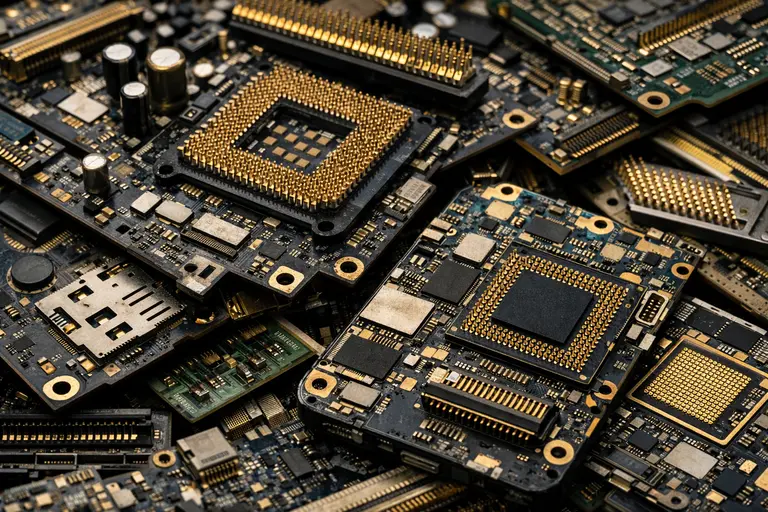
Remarkably, the concentration of metals in e-waste is far higher than in natural ore deposits. A single metric ton of circuit boards can contain 40 to 800 times more gold than a metric ton of mined ore. Why? Because electronics engineers deliberately pack highly conductive, corrosion-resistant metals (Gold, Silver, Palladium) into compact spaces. Therefore, recovering these metals is economically compelling. To learn about the government framework, visit the Central Pollution Control Board (CPCB).
The Scale of India’s E-Waste Revolution
Next, let’s look at the numbers. The world generates more than 53 million metric tons of electronic waste annually. Yet, shockingly, less than 20% of this receives formal, safe recycling.
To understand the scale, consider an individual device. An average smartphone contains approximately 0.034 grams of Gold and 0.35 grams of Silver. At first glance, a few hundred rupees per phone seems modest. However, the math becomes extraordinary when aggregated. Recycling just one million cell phones yields approximately 34 kilograms of Gold and 350 kilograms of Silver. Given that India sells over 150 million smartphones a year, the potential locked inside is staggering. You can read about the impact of raw materials in my Lab-Grown Gold Explained guide.
High Prices Drive India’s E-Waste Revolution
Furthermore, the financial case for urban mining has grown dramatically. Gold currently trades at record highs (over ₹1 Lakh per 10 grams in 2025/2026). Meanwhile, natural metal deposits around the world are becoming harder to access.
Mines must dig deeper and process lower-grade ore. As a consequence, the cost gap between traditional mining and urban mining continues to narrow. Indeed, for certain rare metals, e-waste already represents the most cost-effective recovery source available. Thus, the economic argument for investing in India’s E-Waste Revolution has never been more persuasive for domestic jewelers.
Environmental Benefits of India’s E-Waste Revolution
Beyond the financial upside, Urban Mining delivers urgent environmental benefits. Traditional mining consumes enormous quantities of water and energy, generating serious disruption (deforestation, soil erosion). In contrast, recovering metals from electronics drastically reduces greenhouse gas emissions.
Additionally, proper e-waste recycling keeps toxic substances—like lead and mercury—out of India’s soil and groundwater. For India’s agricultural heartlands, this protection is invaluable. This focus on ethical sourcing aligns perfectly with the trends I discussed in Future of Single Mine Origin Gold.
Challenges in the Recycling Sector
Despite the opportunity, India’s E-Waste Revolution faces serious hurdles.
The Informal Sector
First and foremost, the collection infrastructure is deeply fragmented. Informal waste pickers (Kabadiwallas) collect a significant share. However, they typically sell it to unorganized dismantlers in hubs like Moradabad (UP) or Seelampur (Delhi). Unfortunately, these workers often burn cables or dissolve circuit boards in acid baths without protective equipment, harming human health and destroying valuable materials.
The Cost of Formalization
Furthermore, extracting precious metals safely requires specialized hydrometallurgical facilities that demand massive capital investment. Encouragingly, the Government has strengthened the Extended Producer Responsibility (EPR) rules, forcing brands like Samsung and Apple to fund recycling.
The Jewelry Connection: Recycled Gold
As a buyer, you are already participating in this revolution. Many major Indian jewelry brands now explicitly use “Recycled Gold” in their collections. Crucially, once the gold from a motherboard is refined to 24K purity, it is chemically identical to gold from a mine. Therefore, the ring you buy today might contain gold that was inside a laptop yesterday. Read my guide on 14K Gold Jewellery for Indian Buyers to learn more about gold alloys.
Conclusion on India’s E-Waste Revolution
In summary, the numbers leave little room for doubt. India’s landfills hold billions of rupees’ worth of gold. Ultimately, the gold mine of the future is not in the hills of Kolar or the mountains of Africa—it is right here, in the discarded devices in our desk drawers. It is time to mine it safely.
FAQ: India’s E-Waste Revolution
What is Urban Mining?
It is the process of recovering valuable metals (Gold, Silver, Copper) from discarded human-made waste streams, primarily electronic devices, rather than excavating the earth.
How much gold drives India’s E-Waste Revolution?
Massive amounts. Because a ton of circuit boards contains 40 to 800 times more gold than a ton of natural ore, the total value embedded in India’s annual e-waste is estimated in the thousands of crores.
Is e-waste recycling legal in India?
Yes. India regulates it under the E-Waste (Management) Rules (updated 2022). It requires electronics manufacturers to channel waste to authorized recyclers under the EPR framework.
Why is only 20% of e-waste formally recycled?
Due to the informal sector. In India, unorganized Kabadiwallas offer quick cash for old devices. They use cheap, hazardous methods (like acid burning) to extract metals, making it hard for formal, safe recycling plants to get enough raw material.
Are jewelry brands using e-waste gold?
Yes, indirectly. E-waste gold is refined to 99.9% purity (24K) and sold to bullion banks. Jewelers buy this “Recycled Gold” to craft new ornaments, promoting it as an eco-friendly option.