Introduction
To understand the Graff Watches Business Model, one must ask: what does it take to build the world’s most expensive watch? For Graff Diamonds, the answer lies in a strategy that defies convention. While most luxury brands outsource components or rely on third-party suppliers, Graff has spent decades constructing an end-to-end ecosystem. Specifically, they transform raw stones from the African earth into wrist-worn masterpieces worth tens of millions of dollars.
In 2026, the Graff Watches Business Model remains not only intact but sharper than ever. It offers a compelling case study in how Graf engineers, rather than simply marketing, create true exclusivity. Moreover, in an era where brands compete on social media reach, Graff continues to chart a different course—one defined by scarcity, craftsmanship, and quiet confidence. As a Gemologist, I see Graff not as a watchmaker, but as a “Diamond Engineer.” In this article, I will break down their core pillars and explain why they set the benchmark for ultra-luxury.
Vertical Integration in the Graff Watches Business Model
At the heart of the Graff Watches Business Model is an extraordinary degree of vertical integration. Arguably, it is the most complete of any luxury brand in the world. Through its strategic stake in the South African Diamond Corporation (SAFDICO), Graff maintains direct access to some of the rarest rough diamonds on the planet.
Rather than purchasing polished stones on the open market, the company sources, cuts, and polishes its gems in-house. This vertical structure translates into a competitive advantage that cannot be replicated. Because Graff controls what goes into every timepiece, it can guarantee that each watch features only the finest stones. Furthermore, this control eliminates reliance on external suppliers, insulating the brand from market volatility. Compare this to the supply chain challenges of Natural Diamonds Over Lab-Grown.
The “Hallucination” Strategy of the Graff Watches Business Model
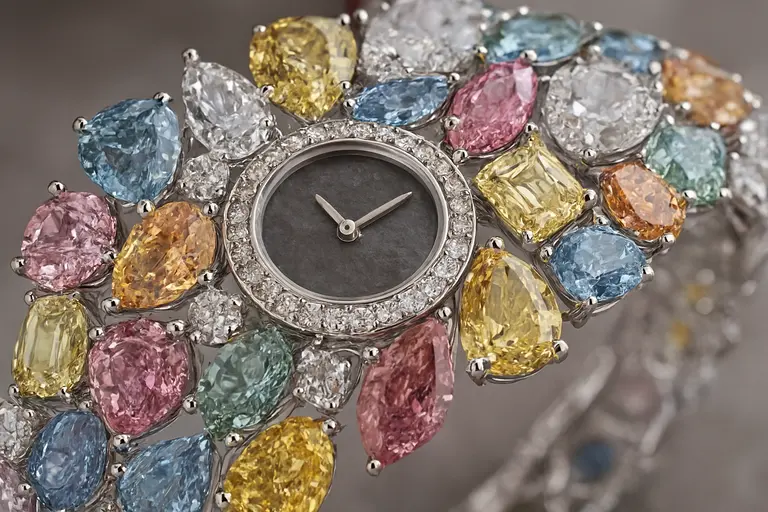
Perhaps no single piece better encapsulates the strategy than the iconic Hallucination Watch. Unveiled in 2014, this timepiece features over 150 carats of rare colored diamonds and carries a price tag of $55 million. Similarly, the Fascination Watch, valued at $40 million, exemplifies what industry observers call the “Hallucination Strategy.”
The goal is the deliberate creation of singular, record-setting pieces that function as brand statements. When the Hallucination made its debut, it didn’t just set a world record—it permanently repositioned Graff in the global consciousness. As a result, even clients purchasing pieces at the lower end of the Graff range ($20,000) do so with the understanding that they are buying into a lineage of mastery. To understand the value of colored gems, check my Colored Stone Grading guide.
Family Governance in the Graff Watches Business Model
Unlike many of its peers (like those in LVMH or Richemont), Graff operates as a privately held, Family-Run Business. Founded by Laurence Graff and now led by his son Francois, this structural choice profoundly shapes its strategy. Without the pressure of quarterly earnings reports, the house is free to pursue long-term brand prestige above all else.
Its selective retail footprint—more than 60 boutiques globally—reflects this philosophy. Importantly, this controlled distribution model ensures that Graff never dilutes its brand equity. Graff designs each boutique to deliver a private experience for Ultra-High-Net-Worth (UHNW) individuals. In contrast to mass-market luxury, Graff’s model reinforces that its clientele is being inducted into an exclusive club.
Hybrid Design: Jewelry Meets Horology
One of the most distinctive aspects of the 2026 approach is the commitment to blurring the boundary between Haute Joaillerie and Haute Horlogerie. The brand crafts collections such as the Graff Lace and the Yellow Diamond series not merely to tell time, but to function as wearable jewelry.
In some cases, artisans engineer convertible pieces—transforming from a watch into a bracelet or ring. This hybrid design philosophy allows Graff to appeal simultaneously to collectors of fine jewelry and aficionados of serious watchmaking. Additionally, by centering each design around the gemstones rather than the movement, Graff ensures that its watches remain timeless. Unlike a purely mechanical watch that might go out of fashion, a diamond watch is forever.
Rarity and Provenance: The GIA Guarantee
Underpinning all of the above is Graff’s unwavering commitment to documented rarity. Every significant stone used in a Graff timepiece is GIA-Certified and laser-engraved. This ensures full traceability and authentication. This approach speaks directly to the concerns of the modern UHNW buyer, who demands proof of quality.
In this sense, the Graff Watches Business Model anticipates a key tension in retail: The question of trust. By removing all ambiguity around the origin, the brand transforms every purchase into a guaranteed asset. Furthermore, Graff strictly adheres to the Kimberley Process, ensuring all stones are conflict-free. If you are worried about ethics, read my Future of Single Mine Origin Gold guide.
Conclusion on the Graff Watches Business Model
Ultimately, the Graff Watches Business Model in 2026 is a masterclass in sustainability. Through vertical integration, record-breaking flagships, and family governance, Graff has built an architecture that is as durable as the diamonds it sets. For collectors and investors alike, it remains one of the most instructive examples in the industry today.
FAQ: Graff Watches Business Model
What makes Graff watches so expensive?
They command premium prices due to the use of exceptionally rare, GIA-certified diamonds sourced and processed entirely in-house. The brand’s vertical control ensures that only the top 1% of stones are used.
How many Graff boutiques exist?
As of 2026, Graff operates more than 60 boutiques globally, located exclusively in prestigious locations like London, New York, Hong Kong, and Dubai.
What is the most expensive Graff watch?
Experts value Graff Hallucination (2014) at $55 million. It features over 110 carats of rare colored diamonds set in a platinum bracelet.
Is Graff publicly traded?
No. Graff Diamonds is a privately held, family-run business. This allows them to prioritize prestige over short-term financial pressures.
What is SAFDICO?
SAFDICO (South African Diamond Corporation) is a diamond processing company in which Graff holds a stake. This partnership gives Graff direct access to rough diamonds from mines, bypassing middlemen.