Introduction
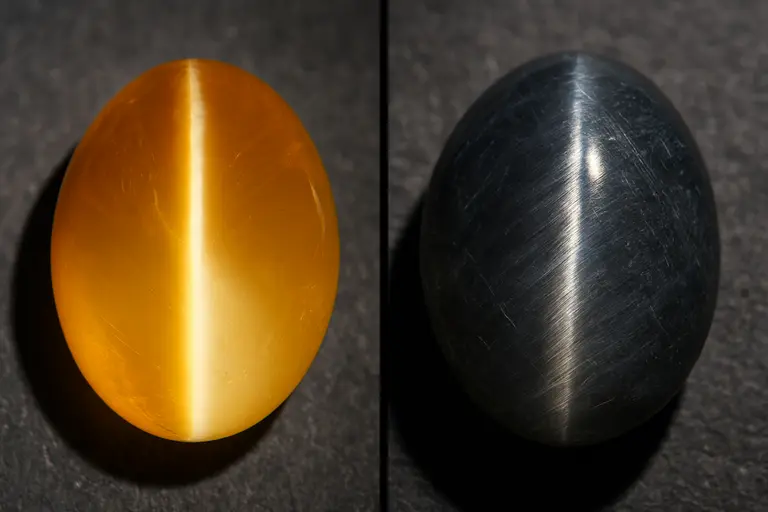
When it comes to gemstones that captivate with a single sweeping band of light, few rival the drama of the “Cat’s Eye” effect. Known formally as Chatoyancy, this optical phenomenon gives select cabochon-cut stones the appearance of a living feline iris. However, in the gem market, two stones dominate this category, often confusing buyers. Chrysoberyl and Sillimanite Cat’s Eye are visually similar but mineralogically distinct.
While Chrysoberyl holds historic prestige as the true “Cymophane,” Sillimanite offers a compelling, affordable alternative. Particularly in Indian markets where they are sold as Lahsuniya (for the planet Ketu), knowing the difference is critical. As a Gemologist, I often see traders passing off soft Sillimanite as hard Chrysoberyl. In this guide, we will explore their origins, identification secrets, and why one costs ten times more than the other.
Similarities of Chrysoberyl and Sillimanite Cat’s Eye
First, let’s look at what they have in common. Despite their distinct mineral identities, Chrysoberyl and Sillimanite Cat’s Eye share characteristics that make them easy to confuse.
The Eye
First and foremost, both display Chatoyancy—the sharp, luminous band that glides across the dome of the stone. In both cases, this results from dense concentrations of parallel needle-like inclusions within the crystal. When light hits these needles, it reflects in a single concentrated line perpendicular to the inclusions.
The Shape and Purpose
Furthermore, lapidaries typically fashion both stones into oval cabochons. This cut maximizes the visibility and sharpness of the eye. In Vedic Astrology, practitioners use both to represent the shadow planet Ketu (“The Tail of the Dragon”). They are worn for protection and spiritual grounding. However, while they serve the same function, their power and durability differ.
Geographic Origins: Ceylon to Burma
Understanding where each stone originates helps trace authenticity and quality.
Chrysoberyl Sources
Miners primarily source Chrysoberyl Cat’s Eye from Sri Lanka (Ceylon). Here, the finest specimens with strong honey color and sharp eyes have been mined for centuries. Additional sources include Brazil, India (Orissa), and Madagascar. Sri Lankan stones are especially prized for their classic “Honey-Yellow” tones. Read more about Sri Lankan gems in Nil Manel and Taaffeite.
Sillimanite Sources
By contrast, miners find Sillimanite Cat’s Eye in more limited localities. It is notably sourced from the Mogok Stone Tract in Myanmar (Burma) and Sri Lanka. Because gem-quality chatoyant Sillimanite is comparatively rare, it remains obscure outside of specialized gemological markets.
Visuals of Chrysoberyl and Sillimanite Cat’s Eye
While they share a palette, their expressions differ.
- Chrysoberyl: Ranges from Greenish-Yellow to Golden-Honey. The most coveted specimens exhibit the “Milk and Honey” effect. This means one side of the stone glows milky white while the other deepens to honey-brown when a light source moves across it.
- Sillimanite: Tends toward deeper, darker tones—commonly Deep Brown, Blackish-Gray, or Blue-Gray. Moreover, the texture often looks more “Fibrous” or silky compared to the sharp, glassy look of Chrysoberyl.
Identifying Chrysoberyl and Sillimanite Cat’s Eye
Because the two stones look similar, professional testing is essential. Fortunately, several measurable properties differ significantly.
1. Hardness (The Scratch Test)
This is the biggest giveaway.
- Chrysoberyl: Scores 8.5 on the Mohs scale. It is the third hardest natural gem (after Diamond and Corundum). It is virtually scratch-proof.
- Sillimanite: Scores 6.5 to 7.5. It is softer. Over time, a Sillimanite ring will develop scratches and lose its polish.
2. Refractive Index (RI)
- Chrysoberyl: High RI (1.746–1.755). It is very brilliant.
- Sillimanite: Lower RI (1.65–1.68). It looks slightly duller.
3. Specific Gravity (Density)
Chrysoberyl is denser (3.7). Sillimanite is lighter (3.2). Therefore, a 5-carat Chrysoberyl will look smaller than a 5-carat Sillimanite.
Treatments of Chrysoberyl and Sillimanite Cat’s Eye
Gem dealers do not routinely treat high-quality Cat’s Eye gems as a general rule. However, be vigilant about imitations.
- Glass Fiber Optic: Common fake. It has a distinctive “Honeycomb” structure under magnification from the side.
- Quartz Cat’s Eye: Softer and lighter than both.
- The Swap: Unscrupulous sellers often sell Sillimanite as “Natural Cat’s Eye” without specifying the species, implying it is the more expensive Chrysoberyl. Always check the lab report. It must say “Natural Chrysoberyl” to command the premium price. For more on fakes, check my Gemstone Buying Mistakes guide.
Jewelry Applications for Chrysoberyl and Sillimanite Cat’s Eye
The hardness difference dictates usage.
Chrysoberyl
With its 8.5 hardness, it is perfect for Rings. It can withstand daily wear, doorknobs, and desk surfaces without scratching. This makes it the ideal astrological ring.
Sillimanite
While beautiful, it is best reserved for Pendants or Earrings. If set in a ring, the jeweler should ideally place it in a protective bezel setting. Despite these limitations, its lower price makes it an appealing option for collectors who want a large, dramatic eye without the cost.
Conclusion on Chrysoberyl and Sillimanite Cat’s Eye
Ultimately, Chrysoberyl and Sillimanite Cat’s Eye are both wonders of physics. They remind us that nature loves symmetry. In summary, if you want an investment-grade, durable stone, choose Chrysoberyl. If you want an affordable, unique specimen, choose Sillimanite. Just make sure you know which one you are paying for.
FAQ: Chrysoberyl and Sillimanite Cat’s Eye
Is Sillimanite as powerful as Chrysoberyl for Astrology?
Traditionally, no. Vedic astrologers consider Chrysoberyl (Cymophane) the primary stone for Ketu. Astrologers consider Sillimanite a secondary “Uparatna” (Substitute). It works, but practitioners believe it is less potent.
Can I visually tell Chrysoberyl and Sillimanite Cat’s Eye apart?
Not reliably. While Sillimanite is often darker, high-quality specimens can mimic the honey color of Chrysoberyl. You need a Refractometer or a Density test to be sure.
What is the “Milk and Honey” effect?
It is a rare optical effect in fine Chrysoberyl where the stone appears to split into two colors (Milky White and Honey Gold) when the light source is positioned at a 90-degree angle to the eye.
Are Chrysoberyl and Sillimanite Cat’s Eye treated?
Generally, no. They are usually natural. However, sometimes they are irradiated to improve color (turning greenish-yellow stones into honey-brown). Lab reports will disclose this.
Which is better for everyday wear?
Chrysoberyl. It is significantly harder (8.5) and tougher than Sillimanite (6.5-7.5), meaning it will retain its sharp “Eye” and polish for decades.