Introduction
In the lush landscapes of Manipur, a quiet revolution is taking place. Manipur Lotus Silk and Indian Jewelry may seem like different worlds—one is a fabric, the other is metal. However, both crafts weave stories of heritage, painstaking craftsmanship, and immense economic value.
For instance, Manipuri entrepreneur Bijiyashanti Tongbram transforms delicate lotus stems into luxurious fabric using age-old techniques. Similarly, India’s jewelry artisans craft Traditional Rajasthani Jewellery that blends gold, gems, and enamel. As an expert in Indian luxury, I see a profound connection here. Both are “Slow Luxury” products that reject the speed of modern machines. In this article, we will explore their deep-rooted similarities in labor, rarity, and sustainability. By the end, you will understand why a scarf made of stems can cost as much as a gold ring.
Manual Labor in Manipur Lotus Silk and Indian Jewelry
First, let’s look at the process. Both Manipur Lotus Silk and Indian Jewelry demand extraordinary manual effort, setting them apart from mass-produced goods.
The Lotus Process
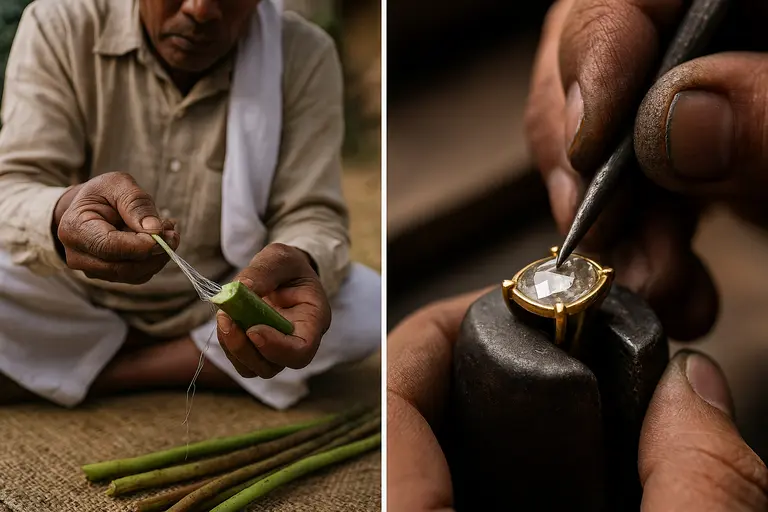
To begin with, producing a single lotus silk scarf requires about one full month of dedicated work. Artisans must harvest the stems from Loktak Lake (famous for its floating islands or Phumdis). Then, they snap the stem and pull out the thin, sticky fibers by hand. Crucially, these fibers must be rolled together within 24 hours before they dry out. It is a race against time.
The Jewelry Process
In the same way, crafting traditional Indian jewelry involves hundreds of hours of precision. Take Thewa Jewelry from Rajasthan. Artisans must etch gold foil with a tiny chisel, a process that takes weeks for a single pendant. Similarly, Kundan jewelry requires polishing uncut diamonds into foils and securing them with lac. Consequently, buyers cherish the human touch that elevates these items to heirloom status.
Rarity of Manipur Lotus Silk and Indian Jewelry
Furthermore, rarity defines both crafts. Manipur Lotus Silk and Indian Jewelry are positioned as exclusive luxuries.
Lotus Silk stands as one of the world’s rarest fibers. Because it takes thousands of stems to make a small amount of thread, it commands prices 10 times higher than regular Mulberry silk. For example, a single scarf from Sanajing Sana Thambal—Tongbram’s venture—can fetch premium rates due to limited yield. In addition, its ethereal sheen and lightweight drape make it breathable and soft, often compared to the wings of a dragonfly.
Traditional Indian jewelry mirrors this exclusivity. Beyond the intrinsic value of gold, the artistry in Polki or Jadau styles derives worth from scarcity. A single necklace might incorporate rare Basra Pearls, handset by master Karigars. As a result, these pieces dominate bridal markets in India, where exclusivity signals status.
Sustainability in Manipur Lotus Silk and Indian Jewelry
Both products also fit the growing trend toward eco-conscious ethics. Lotus Silk is the ultimate “Ahimsa” (Non-Violent) fabric. Unlike traditional silk, where silkworms are boiled alive to extract the thread, Lotus silk is plant-based and vegan. Moreover, it uses the “Waste” product (stems) of the lotus plant, which would otherwise rot in the lake. Therefore, it cleans the ecosystem of Loktak Lake while creating beauty.
Likewise, innovative Indian jewelers pivot toward green practices. They incorporate Future of Single Mine Origin Gold and Lab-Grown Diamonds to reduce environmental impact. For example, pairing a Lotus Silk saree with a Recycled Gold necklace creates a fully sustainable fashion statement. In this manner, both crafts attract global buyers focused on responsible luxury.
Heritage of Manipur Lotus Silk and Indian Jewelry
In addition, heritage preservation unites these traditions. Bijiyashanti Tongbram revives Manipuri weaving on centuries-old frames, passing skills to local women. This mirrors the jewelry world, where families in places like Jaipur or Thrissur train apprentices in specific techniques. For instance, the Nagercoil Temple Jewellery artisans maintain secrecy around their gold-leaf techniques to prevent machine replication.
Moreover, globalization threatens both. Yet dedicated artisans adapt. In Manipur, lotus silk revives forgotten pond-based practices. Similarly, Indian jewelers blend tradition with contemporary designs, like lightweight Men of Platinum Jewelry. Thus, these crafts not only preserve history but also evolve.
Conclusion on Manipur Lotus Silk and Indian Jewelry
Finally, community empowerment forms the bedrock of these enterprises. Tongbram’s venture employs over 40 rural women in Manipur. In parallel, India’s jewelry clusters—like those in Hupari India Silver Capital—sustain entire villages. Ultimately, Manipur Lotus Silk and Indian Jewelry prove that rural India is the powerhouse of luxury. Whether it is a thread or a wire, the hands that make it are the hands that build the nation.
FAQ: Manipur Lotus Silk and Indian Jewelry
What makes Lotus Silk from Manipur so rare?
It is ultra-rare due to the labor-intensive extraction. You need thousands of lotus stems to create just a few grams of thread, and the entire process must be done by hand.
How does Indian jewelry compare in craftsmanship?
Both require months of hard work. Just as a weaver spins fibers, a Kundan setter presses gold foil. Both require “High Touch” skills that machines cannot replicate.
Is Lotus Silk sustainable?
Yes. It is 100% biodegradable, vegan, and zero-waste. It uses stems that are usually discarded, helping to keep the waterways of Loktak Lake clean.
Where can I buy authentic Manipuri Lotus Silk?
You should buy directly from Sanajing Sana Thambal or recognized government handicraft emporiums in Imphal to ensure the money goes to the artisans.
Are there jewelry designs inspired by Lotus Silk?
Absolutely. The “Lotus” (Padma) is a central motif in Indian jewelry. Wearing a Padparadscha Sapphire (Lotus Color) with a Lotus Silk scarf is the ultimate thematic pairing.