Introduction
In the world of vivid reds, few natural wonders captivate like Kissabel Rouge Apples vs Mozambique Rubies. Specifically, one is a modern agricultural marvel from France; the other is an ancient geological treasure from Africa. At first glance, both boast an intense, deep crimson hue that draws collectors and connoisseurs alike. For example, think of the luxurious “Pigeon’s Blood” red prized in jewelry markets—it is mirrored perfectly in the apple’s berry-like flesh.
However, while one grows in orchards and the other in deep mines, their color similarities spark endless fascination. As a Gemologist who appreciates rare produce, I see a connection here. Both rely on complex chemistry to achieve their look. In this guide, we will explore their origins, treatments, and identification cues. Whether you are sourcing rare gems for Indian jewelry designs or discovering exotic produce, understanding these parallels elevates your appreciation.
Discovering Kissabel Rouge Apples vs Mozambique Rubies
First, let’s look at the fruit. To begin with, originating from an innovative breeding program, Kissabel Rouge apples emerged from the IFORED international project in France. Over two decades, scientists naturally crossbred wild, red-fleshed varieties (like ancient crabapples) with premium sweet apples. The result? A modern marvel available since 2023, now cultivated in select regions including Europe and Australia.
Crucially, what sets them apart is their completely natural vibrancy. Unlike dyed imports, these non-GMO fruits derive their rouge hue from Anthocyanins (genetics), with no artificial colors. This purity appeals to health-conscious consumers worldwide, including in India, where exotic fruits command premium prices at urban markets like Lulu Hypermarket in Kochi.
Identifying the Real Deal
Transitioning to identification, spotting a true Kissabel Rouge requires more than a glance. Initially, they resemble everyday red apples—smooth skin with a subtle sheen. But check for official Kissabel® stickers. Inside, the magic unfolds: slice one open to reveal flesh saturated red from rind to core. Taste-wise, it offers a tangy-sweet burst reminiscent of strawberries. Moreover, beware of imitations. Notably, fake “Red-Fleshed” apples often show uneven, washed-out pink interiors. If you love colorful fruits, compare this to the Allahabad Surkha Guava.
Uncovering Kissabel Rouge Apples vs Mozambique Rubies
Shifting gears to the gem world, let’s look at the stone. Specifically, Mozambique Rubies hail from the mineral-rich Montepuez region in northeastern Mozambique. Originally discovered around 2009, these Corundum gems form in Amphibolite host rock, thrust up from deep Earth over billions of years.
Today, they dominate global supply, accounting for over 50% of traded rubies. Notably, companies like Gemfields are the primary miners.
Treatments and Enhancements
Most undergo Heat Treatment to unlock their potential. This process intensifies the deep red while improving clarity by dissolving silk. However, lower-grade stones might receive Glass-Filling or Flux Healing to mask fractures. As a buyer, you must be vigilant. Untreated pieces command massive premiums. Read more about treatments in my Gemstone Buying Mistakes guide.
Identifying the Ruby
Typically, identification starts visually: genuine Mozambique rubies glow with a deep, velvety red. Often, they are tinged with pink or purple due to Iron traces. Under magnification, seek signature Mica inclusions or pseudo-hexagonal “fingerprints” unique to this origin. Unlike Burmese rivals, which have strong fluorescence (glow), Mozambique stones show weaker fluorescence due to the iron content. Compare this to the Kempu Ruby: Tamil Nadu vs Kerala varieties.
Color of Kissabel Rouge Apples vs Mozambique Rubies
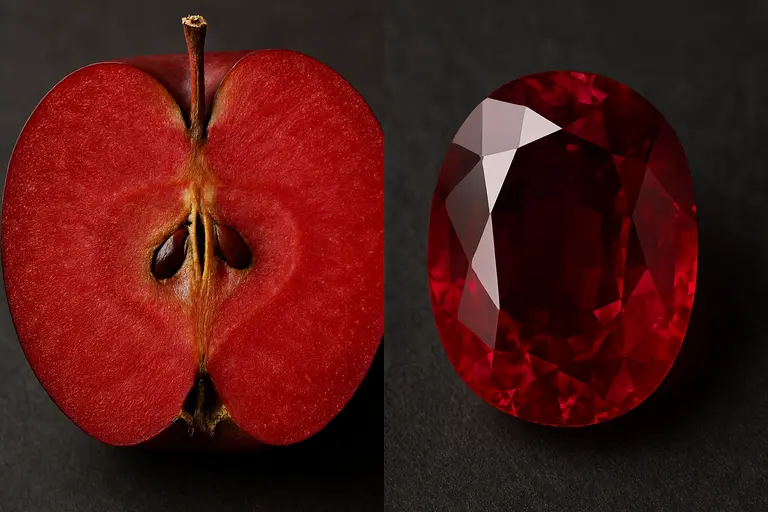
At the heart of their allure lies color. Remarkably, the Kissabel Rouge core mirrors the specific “Pigeon’s Blood” red of top Mozambique rubies.
- The Pigment:
- Apple: Technically, colored by Anthocyanins (Organic).
- Ruby: Colored by Chromium (Inorganic).
- The Saturation:
- Apple: 100% natural saturation.
- Ruby: Often 90-95% saturation (post-heat).
Realistically, if you hold a sliced Kissabel next to a faceted ruby, the parallels stun. However, significant differences emerge under scrutiny. Apples offer juicy translucency. Rubies refract light with fire (Refractive Index 1.76). Marketwise, a premium Kissabel fetches 5-10 per kg. A ruby fetches 5,000-$50,000 per carat. For Indian consumers, this duo symbolizes luxury—pair Ruby jewelry with Rouge apples for a festive gift hamper.
Fakes: Kissabel Rouge Apples vs Mozambique Rubies
Unfortunately, scams exist in both markets.
Fake Rubies
Unfortunately, imitations abound, from synthetic Lab-Grown Rubies (Flame Fusion) to glass composites. Often, fakes appear “too perfect”—bubble-free, overly bright, or orangey. Therefore, Pro tip: Use a loupe. Natural rubies have “Silk” or zoning. Synthetics have curved lines. Consult certified labs like IGI India, GIA, or GII for reports.
Fake Apples
Similarly, some markets inject dye into regular apples or sell genetically inferior pink apples as “Rouge.” To ensure authenticity, source from verified suppliers and verify via taste tests—genuine ones balance acidity with sweetness (Brix 15-17).
Conclusion on Kissabel Rouge Apples vs Mozambique Rubies
In summary, the comparison of Kissabel Rouge Apples vs Mozambique Rubies highlights nature’s artistry across kingdoms. While one feeds the body, the other adorns it. Ultimately, both remind us that true beauty lies beneath the skin (or the crust). Whether you are biting into the crisp flesh of the apple or admiring the fire of the gem, you are enjoying the color of life: Red.
FAQ: Kissabel Rouge Apples vs Mozambique Rubies
Are Kissabel Rouge apples genetically modified (GMO)?
No. Actually, they are non-GMO. Instead, they were achieved through natural crossbreeding techniques (pollination) over 20+ years in France.
How do I spot fake Mozambique rubies?
Look for natural inclusions like Mica or crystals. Avoid stones that look “glassy” or have gas bubbles (which indicate glass filling). Always get a GIA or IGI certificate.
What is the best way to store Kissabel Rouge apples?
Ideally, keep them chilled at 0-4°C in perforated bags. This retains their crunch and prevents the red flesh from oxidizing (browning) too quickly.
Do Mozambique rubies fluoresce strongly?
Minimally. Unlike Burmese rubies, which glow bright red under UV light (due to low iron), Mozambique rubies have higher iron; consequently, this dampens the fluorescence.
Can I find Kissabel apples in India?
Yes, seasonally. Fortunately, high-end importers bring them to metro cities like Mumbai, Delhi, and Kochi during the European harvest season (Autumn/Winter).