Introduction
In the lush homesteads of Kerala, there is a fruit that defies expectation. Most Jackfruits are yellow. However, the Sindoor Jackfruit glows with the fire of a sunset. Also known as Sindoor Varikka or Chemparathy Varikka, this fruit captivates with its vivid red-orange flesh.
For instance, its arils mimic the glow of Sindoor powder, the traditional vermilion cosmetic. As a Gemologist, I see something else: I see the electric orange of a Spessartite Garnet. In this guide, we will explore its origins in Kollam, its unique flavor profile, and why it is considered the “Ruby” of the Jackfruit family. Whether you are a farmer looking for a high-yield crop or a food lover seeking rare tastes, read on to learn why this is a Kerala favorite.
Origins of Sindoor Jackfruit in Kerala
To begin with, let’s trace the roots. Sindoor Jackfruit is native to Kerala and was popularized by the Farming Systems Research Station in Sadanandapuram, Kollam District. Experts there identified this high-yielding type from local mutations. As a result, it gained fame across the region for its color and resilience.
Kerala, known as “God’s Own Country,” boasts ideal tropical conditions. For example, the state’s humid climate and laterite soil support fast growth. Additionally, farmers graft Sindoor Jackfruit plants for quick results. Remarkably, grafted trees often fruit in just 1.5 to 3 years, compared to 7-10 years for seedling trees. Therefore, it is perfect for both small homesteads (Parambu) and large-scale operations. Commercially, appeal runs high. In fact, a single tree can yield up to 250 fruits annually.
Appearance: The “Spessartite” of Fruits
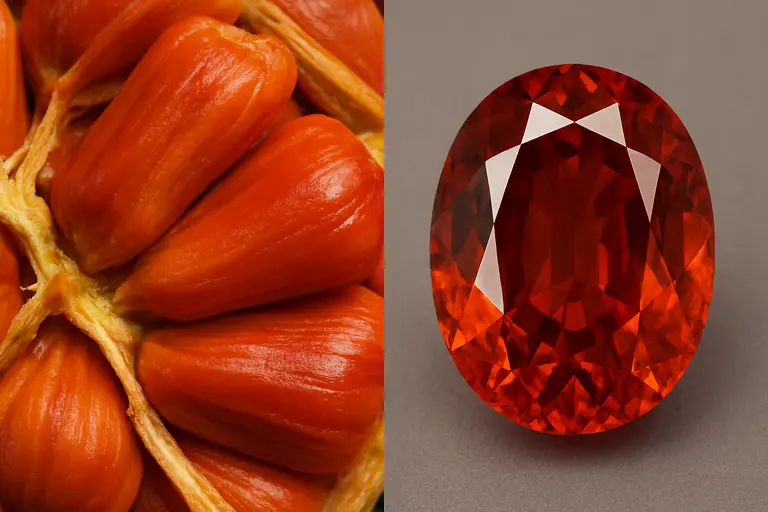
What sets Sindoor Jackfruit apart? Primarily, it’s striking color. The arils (bulbs) display a deep orange-red hue. Visually, this mirrors the Mandarin Fruit vs Mandarin Garnet comparison I wrote about earlier. The specific shade is “Tangerine” to “Brick Red.”
The Gemstone Comparison
As an expert, I compare this color to Spessartite Garnet (Mandarin Garnet). Both evoke warmth, energy, and fire. Similarly, Fire Opal shares this glow. Thus, Sindoor Jackfruit becomes a “gem” of the orchard. Unlike the common “Varikka” (Firm) or “Koozha” (Soft), which are yellow, the Sindoor variety demands attention on the plate. Imagine serving these jewel-like bulbs at an Onam Sadhya; they look like cut gems.
Flavor and Texture: The “Crunch”
However, looks aren’t everything. Taste matches the appeal. The flesh stays firm yet juicy. It has a “Crunchy” texture (Varikka means firm). Unlike watery varieties that turn mushy, Sindoor Jackfruit offers a satisfying bite.
Moreover, its sweetness is intense but balanced with a floral aroma. It is ideal for:
- Fresh Eating: Like a crunchy apple.
- Desserts: Like Chakka Pradhaman (Pudding).
- Preserves: The firm flesh holds up well in jams or Chakka Varatti. If you are interested in healthy eating, read my Healthy Living and Diet page.
The Science: Lycopene vs. Manganese
Why is it red? It comes down to chemistry.
- The Fruit: The red color comes from Lycopene, the same antioxidant pigment found in Tomatoes and Watermelons. It is excellent for heart health.
- The Gem: The orange color of Spessartite Garnet comes from Manganese.
Therefore, nature uses organic pigments to color the fruit and inorganic metals to color the stone. Both are masterpieces of chemistry. You can read about gem chemistry in my Colored Stone Grading guide.
The Ritual of Cutting: Handling the “Rough”
As with any gemstone, the beauty of the Sindoor Jackfruit is hidden inside a tough, unpolished exterior. Processing a jackfruit requires a specific ritual, much like lapidary work. First, the outer skin is spiky and protective, similar to the “crust” on a rough diamond. Next, there is the challenge of Latex (called Ara in Malayalam). This sticky white sap can ruin tools if you are not careful.
The Solution? Pure Coconut Oil (Velichenna). Just as we use oil or water to lubricate a diamond saw, we must coat our hands and knives with oil before slicing the fruit. This preparation ensures a clean cut. Once opened, the contrast between the white latex and the red bulbs is visually stunning. Ultimately, the effort of “mining” the bulb from the fibrous rags is part of the experience, making the reward taste even sweeter.
Benefits for Farmers
Why choose Sindoor Jackfruit for your garden?
- High Yield: A single mature tree creates significant income.
- Early Fruiting: Saves years of waiting.
- Compact Size: It doesn’t grow as massive as wild jack trees, making it suitable for smaller plots.
Furthermore, disease resistance adds value. For tips on grafting, check the guides from Kerala Agricultural University. Additionally, the export potential is massive. With the large Malayali diaspora in the Middle East and Europe, the demand for nostalgic, high-quality fruit is skyrocketing. Sindoor Jackfruit travels well because of its firm flesh. It does not squash or leak during air freight like softer varieties. Consequently, farmers in Kerala are now branding this specific “Red” variety as a premium exotic fruit for international supermarkets, fetching prices far higher than the local market rate.
In short, it combines beauty, taste, and economics seamlessly.
Conclusion: A Treasure in the Backyard
Ultimately, the Sindoor Jackfruit is more than just food; it is a cultural treasure. It represents the biodiversity of Kerala. Just as we treasure a Kempu Ruby for its red fire, we should treasure this fruit for its red flesh. In summary, if you have a patch of land in Kerala, plant a Sindoor. It is an investment that grows sweeter every year.
FAQ: Sindoor Jackfruit
What makes Sindoor Jackfruit unique?
Its vivid red-orange arils resemble Sindoor powder. Additionally, it has a firm, crunchy texture (Varikka) that does not become mushy when ripe.
Where is Sindoor Jackfruit originally from?
It is native to Kerala, India. It was scientifically identified and promoted by the Farming Systems Research Station in Sadanandapuram, Kollam.
How many fruits does one tree yield?
Up to 250 per year. This makes it one of the most productive varieties available for commercial farming.
When do grafted Sindoor Jackfruit trees fruit?
Typically, they start bearing fruit in 1.5 to 3 years. This is much faster than seed-grown trees.
Does its color match any gemstones?
Yes. It is a near-perfect match for Mandarin Spessartite Garnet and Fire Opal, due to the intense orange-red saturation.
Author Bio
P.J. Joseph, also known as Saju Elizamma, Gemstone & Gold Consultant serving Kerala, Tamil Nadu, and Karnataka.