Introduction
In the vast dictionary of nature, some words bridge the gap between the living and the mineral. Rhododendron and Rhodolite may seem like unlikely neighbors—one is a bush that covers mountains, the other is a crystal mined from the earth. However, they share a vivid color lineage and a naming tale that ties them together forever.
Their connection isn’t just about hue; it rests on a historical link to the same linguistic root—the Greek word for “Rose.” As a Gemologist who loves the flora of the Himalayas, I find this overlap fascinating. In this article, we will trace their colors, origins, and symbolic meanings. By the end, you will understand how a flower inspired the name of one of the world’s most beautiful garnets.
Etymology of Rhododendron and Rhodolite
To begin with, let’s look at the language. Both the Rhododendron and Rhodolite owe their names to the Ancient Greek word “Rhodon,” which translates to Rose.
- Rhododendron: Means “Rose Tree” (Rhodon + Dendron). It describes the tree-like bushes covered in rose-colored blooms.
- Rhodolite: Means “Rose Stone” (Rhodon + Lithos). It was named to evoke the specific rose-raspberry hue that distinguishes it from common red garnets.
Thus, the etymology does more than label; it signals a shared chromatic character. Interestingly, this naming convention is similar to how we compare Mandarin Fruit vs Mandarin Garnet based on color.
Color Matching in Rhododendron and Rhodolite
Next, the color correspondence between Rhododendron and Rhodolite is the central point of their kinship.
The Flower’s Spectrum
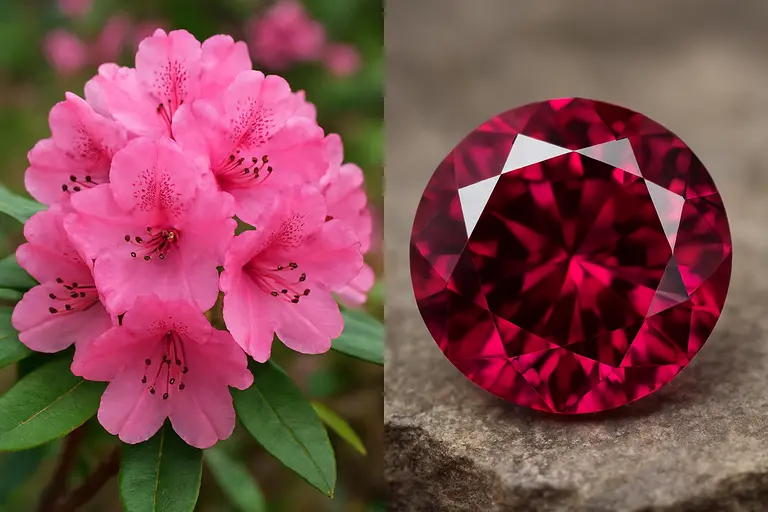
Rhododendron flowers, especially those found in the Indian Himalayas (Sikkim, Uttarakhand), transition from soft pinks to rich magentas and deep purples. Visually, they have a soft, velvety texture that absorbs light.
The Gem’s Spectrum
Similarly, the Rhodolite Garnet is famous for its “Grape” or “Raspberry” tone. Unlike the dark, rusty red of a standard Almandine Garnet, Rhodolite has a lighter, pinkish-violet glow. According to mineralogists William Earl Hidden and Pratt (who discovered it), the gem possessed a “pale rose-pink” brilliance that perfectly mirrored the mountain flowers blooming nearby. Consequently, this color dialogue spans living flora and mineral beauty. If you like violet gems, compare this to Kashmir Sapphire vs Grandala.
The Gemological Science: What is Rhodolite?
As an expert, I must clarify the chemistry. Rhodolite is not a distinct mineral species. It is a Hybrid. Specifically, it is a mixture of two other garnets:
- Pyrope (Magnesium Aluminum Silicate) – Usually Red.
- Almandine (Iron Aluminum Silicate) – Usually Dark Red/Black.
When nature mixes roughly two parts Pyrope with one part Almandine, the iron-to-magnesium balance creates that magical Pink/Purple hue. Therefore, Rhodolite is often cleaner and brighter than other red garnets. Read more about gem classification in my Colored Stone Grading guide.
Geography of Rhododendron and Rhodolite
Geography reinforces the connection. The Rhodolite Garnet was first discovered in North Carolina, USA, in the late 19th century. Remarkably, this same region is famous for its wild mountain Rhododendrons. The discoverers looked at the stone and the flower and saw the same soul.
In India, we see a similar landscape. The Himalayas are the home of the Rhododendron (the state flower of Himachal Pradesh). While India produces many garnets (in Rajasthan and Odisha), the connection between the mountain flower and the mountain stone resonates deeply with our heritage. For more on Indian minerals, check my guide on Panna Diamond Mining.
Symbolism of Rhododendron and Rhodolite
Beyond specific hues, both present a versatile palette. This range allows both Rhododendron and Rhodolite to symbolize a spectrum of human emotions.
- The Flower: Symbolizes caution and danger (due to toxins in the leaves) but also elegance.
- The Gem: Symbolizes inspiration and emotional healing.
Together, they reinforce a shared symbolism that enhances their appeal to lovers of nature. For instance, a brooch designed like a Rhododendron flower, set with Rhodolite garnets, is a perfect marriage of concept and material. You can read about such motifs in Quantum Couture GJEPC.
Practical Considerations for Buyers
Finally, how do you choose? While the color story binds them, their material natures diverge.
Gardening vs. Collecting
For a living display, the Rhododendron is a timeless choice for a cool-climate garden. However, for a jewelry repertoire, Rhodolite Garnet offers enduring color. Crucially, Rhodolite is untreated. Unlike Rubies which are heated, the color of a Rhodolite is 100% natural. Therefore, it is an excellent investment for those who value authenticity. Read more about avoiding treatments in Gemstone Buying Mistakes.
Conclusion on Rhododendron and Rhodolite
In summary, Rhododendron and Rhodolite stand as a distinctive pair. They share a rose-focused name, a vivid color range, and a geographic history. Ultimately, whether you plant the bush or wear the stone, you are celebrating the color of the Rose (Rhodon).
FAQ: Rhododendron and Rhodolite
Are Rhododendron colors and Rhodolite colors exactly the same?
Not always. The gem typically ranges from pale rose-pink to deep purplish-red (Raspberry). The flower shows a broader range, including white and red. However, the “Rose-Purple” overlap is where they meet.
Why is the name Rhodolite associated with the Rhododendron?
The gem’s discoverers in North Carolina chose the name because the stone’s color mirrored the mountain Rhododendron blooms found in the same region.
Is Rhodolite Garnet expensive?
Moderately. It is more expensive than standard Red Garnet but much more affordable than Ruby or Pink Spinel. Fine, large stones can fetch premium prices.
Can I use these colors interchangeably in design?
Yes. Designers often use the “Rhodolite Palette” (Purples and Pinks) to create floral-inspired jewelry that mimics the look of a Rhododendron bouquet.
How do I care for Rhodolite Garnet?
It is durable (Mohs 7-7.5). Simply clean with mild soap and warm water. Avoid ultrasonic cleaners if the stone has many inclusions.
Author Bio
P.J. Joseph, also known as Saju Elizamma, Gemstone & Gold Consultant serving Kerala, Tamil Nadu, and Karnataka.