Introduction
In the vibrant village of Vadasery near Nagercoil, Tamil Nadu, a centuries-old tradition thrives. Nagercoil Temple Jewellery represents an artistry that captivates with its divine elegance. For generations, artisans here have crafted these pieces to adorn temple idols and graceful Bharatanatyam dancers.
Significantly, in 2007, this exquisite craft earned a prestigious Geographical Indication (GI) Tag, safeguarding its authenticity. But what sets it apart from the solid gold jewelry of Kerala? It is a unique blend of Silver, Gold Foil, and Wax. As a certified gemologist with deep roots in South Indian culture, I have always admired how this craft mimics the look of royal gold at a fraction of the weight. In this article, we will explore the unique materials, the intricate designs, and where to find genuine pieces in 2026.
What Makes Nagercoil Temple Jewellery Unique?
First and foremost, authentic Nagercoil jewelry is a masterpiece of illusion and engineering. Unlike the solid gold ornaments described in my Traditional Maharashtrian Jewellery guide, these pieces are built on a Silver Base.
The Materials
- Pure Silver: Forms the skeleton of the jewelry.
- Gold Leaf: Specifically, artisans do not just “plate” the silver. They overlay it with high-quality 24kt Gold Leaf.
- Vadasery Wax: This is the secret. A natural wax core creates a bond between the silver and the gold foil, allowing for intricate shaping without the heavy cost of solid gold.
This process not only enhances beauty but also protects the silver beneath. Consequently, the jewelry glows with a “Reddish-Yellow” antique finish that defines the classical dance aesthetic.
Kemp Stones in Nagercoil Temple Jewellery
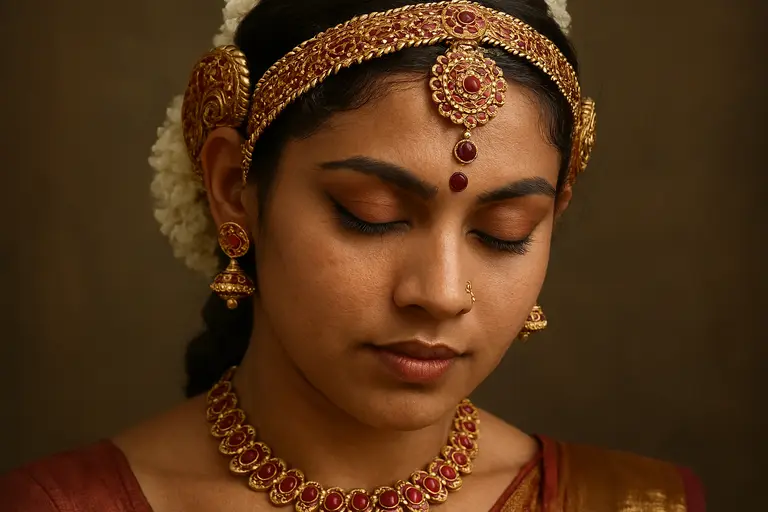
Next, the star feature is the Kemp Stones, locally known as Kuchu Kal. Historically, these were uncut Rubies or Spinels sourced from riverbeds. However, in modern times, artisans often use high-quality tinted glass or synthetic stones to keep costs accessible for dancers.
As a Gem Expert, I must clarify: Even if they are glass, the value lies in the Cutting and Setting. Technically, the stones are set using a closed-back technique that reflects light, creating a deep, internal fire. Therefore, no two pieces are exactly alike. Moreover, the motifs draw inspiration from nature—peacocks, parrots, and lotuses. You can read more about the significance of red stones in my Kempu Ruby: Tamil Nadu vs Kerala guide.
Types of Nagercoil Temple Jewellery
Transitioning to the varieties, Nagercoil Temple Jewellery offers diverse pieces for complete adornment.
The Headset (Thalaisaman)
Starting with headgear, the Thalaisaman serves as a crown-like ornament representing the Sun and Moon (Suryapirai and Chandrapirai). Additionally, the Rakkodi adorns the bun, while the Jada-set creates a snake-like trail down the braid.
Necklaces and Accessories
For the neck, the long Haram drapes gracefully. In contrast, the shorter Addigai choker hugs the neck. Meanwhile, accessories like the Vanki (Armlet) and Ottiyanam (Waist Belt) accentuate the dancer’s silhouette. In essence, these types blend functionality with artistry. They are designed to move with the body.
Buying Authentic Nagercoil Temple Jewellery
Now, where can you source these treasures? Vadasery remains the epicenter. Visiting the village supports local artisans directly. However, online options make it accessible too.
Trusted Manufacturers:
- Silver Sparkler: Specializes in customizable sets for dancers.
- SR Temple Jewellery: Established in 1990, known for wholesale.
- Supreme Temple Jewellery: A veteran since 1971.
Crucially, look for the GI Tag. Unfortunately, the market is flooded with cheap plastic imitations from China. Thus, whether shopping locally or virtually, prioritize GI verification. If you are building a bridal trousseau, pair these with the solid gold pieces mentioned in my North vs South Indian Jewelry guide.
History of Nagercoil Temple Jewellery
Delving into its origins, the craft dates back to the 9th-century Chola Dynasty. Later, the Travancore Kingdom provided royal patronage. Historically, these jewels were reserved for deities and royalty. Over time, their role evolved. Classical dances popularized them beyond temples.
Today, they grace South Indian bridal trousseaus, merging heritage with contemporary fashion. As a result, owning a piece of Nagercoil Temple Jewellery is like owning a piece of history. Explore royal patronage in my Padmanabhaswamy Temple Treasures article.
Conclusion: A Legacy of Devotion
Ultimately, this jewelry is not just for decoration; it is for devotion. Whether worn by a bride seeking blessings or a dancer portraying a goddess, the piece carries the energy of Vadasery. In summary, it is a craft that turns silver into divine gold.
FAQ: Nagercoil Temple Jewellery
What is the GI Tag for Nagercoil Temple Jewellery?
The Geographical Indication (GI) Tag, awarded in 2007, certifies that the jewelry originates specifically from Vadasery. It protects the unique technique of using silver, wax, and gold foil.
Are Kemp stones real gems?
Originally, yes (Rubies/Spinels). Today, most commercial pieces use high-quality glass or synthetic stones to maintain affordability, though custom pieces can still be made with real gems.
Can I wear Temple Jewellery daily?
No. It is delicate. The gold foil can peel if exposed to excessive sweat, water, or perfume. It is strictly “Occasion Wear” for weddings and performances.
How do I spot authentic pieces?
Check the base. Authentic Vadasery jewelry is made of Silver covered in gold leaf. Cheap imitations are made of copper or brass. Always ask for the material composition.
Where is the best place to buy?
Vadasery Village in Nagercoil is the source. However, reputable websites like GI Heritage also ship authentic certified pieces worldwide.
Author Bio
P.J. Joseph, also known as Saju Elizamma, Gemstone & Gold Consultant serving Kerala, Tamil Nadu, and Karnataka.