Introduction
In the crowded luxury watch world, the De Bethune Business Model stands out because it looks to the stars, not the past. This Swiss independent brand follows a high-end, low-volume strategy that borders on obsession.
Founded in 2002 by David Zanetta and the horological genius Denis Flageollet, De Bethune operates as an “Independent Manufacture.” This means it controls every step of creation. Moreover, it prioritizes research over rapid growth. In this article, I will explore the pillars of the De Bethune Business Model. As a Gemologist, I am particularly fascinated by how they treat Titanium like a precious gemstone, using heat to change its color just as we do with Tanzania’s Cloves and Tanzanite.
Vertical Integration in the De Bethune Business Model
First, De Bethune builds its success on Vertical Integration. It produces almost everything in-house at its facility in L’Auberson, a small village in the Swiss Jura mountains. As a result, the brand creates its own movements, cases, and even balance springs. Unlike many competitors who buy parts from suppliers, De Bethune avoids outsourcing. Therefore, quality remains consistent and exceptional.
Additionally, De Bethune caps production at 150 to 350 watches per year. This scarcity drives exclusivity. For instance, collectors wait years for pieces like the DB25 Starry Varius. However, this limit prevents overproduction. It ensures each timepiece meets the highest standards. Consequently, resale values stay strong. You can compare this strategy to the scarcity model of Richard Mille Business Model.
R&D Strategy of the De Bethune Business Model
Research drives this approach. Remarkably, De Bethune invests about 20% of its budget in Research & Development (R&D). Over time, this has yielded over 30 proprietary calibers in just 20 years—a feat that takes big brands a century to achieve.
Furthermore, it holds dozens of patents. Notable innovations include:
- The Silicon Balance Wheel: For perfect aerodynamics.
- Floating Lugs: For ergonomic comfort.
- Triple Parachute Shock Absorber: For durability. In short, small-scale production fuels technical superiority. It is a laboratory that sells watches.
The Art of Blue Titanium (A Gemologist’s View)
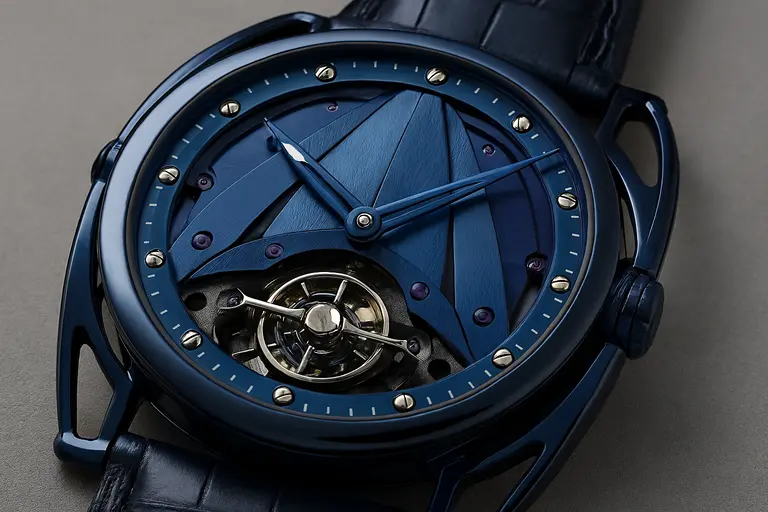
As an expert, I must highlight their signature: Heat-Blued Titanium. Most brands paint their dials blue. De Bethune burns them. Technically, they heat Grade 5 Titanium to exactly 700°C. At this temperature, the metal oxidizes and turns a vibrant, electric blue.
This process is incredibly difficult. If you heat-treat it for one second too long, it turns purple or brittle. Comparison: This reminds me of how we heat-treat Tanzanite to remove the brown axis, or how Kashmiri Saffron and Padparadscha rely on trace elements for color. Thus, De Bethune treats metal with the respect usually reserved for precious gems.
Partnerships in the De Bethune Business Model
Partnerships bolster De Bethune’s stability. In 2021, a major shift occurred. WatchBox (now rebranded as The 1916 Company) bought a majority stake. This move linked De Bethune to a secondary market giant. As a result, it gained access to global collectors and real-time data on what buyers want.
Moreover, this partnership protects resale values. Pre-owned De Bethune watches now retain high prices. For example, models like the DB28 often sell for 80-90% of retail (or more) on platforms like Chrono24. Therefore, owners feel confident in their investments. This connects to the concept of “Asset Value” I discussed in Rolex Business Model.
Selective Distribution and Customization
De Bethune serves a specific crowd. Its watches start at 45000 and climb past 300,000. Therefore, it targets connoisseurs and art collectors. These buyers value innovation over brand hype. Unlike Rolex, which is a status symbol for the masses, De Bethune is a “Secret Handshake” for the elite.
Distribution stays lean—the brand partners with just 25 retailers worldwide. Customization adds appeal. About 20% of output is bespoke. For instance, clients can request a “Starry Sky” dial where the gold pins (stars) are arranged to match the constellation of their birth date. Hence, De Bethune fosters loyalty among high-net-worth individuals. This customization mirrors the bespoke services of Bamford Watch Department.
De Bethune 2.0: A Philosophy of Reinvention
Finally, let’s look at the leadership. A pivotal change came in 2017 when CEO Pierre Jacques returned. He shifted the brand back to ultra-exclusivity. Previously, higher volumes diluted focus. Now, “De Bethune 2.0” emphasizes sustainability and art.
At its core, the philosophy is “Watchmaking Art for the 21st Century.” Rather than copying the past (like Breguet), it pushes boundaries. Ultimately, it positions De Bethune as a forward-thinking leader.
Conclusion on the De Bethune Business Model
In summary, the De Bethune Business Model proves that you don’t need to be big to be powerful. By combining the soul of an 18th-century watchmaker with the materials of a 21st-century spacecraft, they have created a new category of luxury. For the investor, it is a smart buy. For the dreamer, it is a masterpiece.
FAQ: De Bethune Business Model
How many watches does De Bethune produce yearly?
De Bethune limits output to 150-350 pieces annually. This extremely low volume keeps exclusivity high and allows Denis Flageollet to oversee quality personally.
What makes the De Bethune Business Model unique?
It is a “Horizontal-Vertical” hybrid. While they manufacture movements in-house (Vertical), they have partnered with a pre-owned dealer (The 1916 Company) for distribution, which is a unique modern strategy.
Who owns De Bethune now?
The 1916 Company (formerly WatchBox) holds a majority stake since 2021. However, Denis Flageollet and CEO Pierre Jacques retain significant stakes and operational control.
Can you customize a De Bethune watch?
Yes. About 20% of their watches are bespoke. The most popular request is the “Starry Varius” dial, where the stars are mapped to a specific date and location chosen by the client.
Why is their Titanium blue?
It is Thermal Oxidation. They heat the Titanium to roughly 700°C. This creates a stable, corrosion-resistant oxide layer that is a vivid blue, purely through physics, not paint.
Author Bio
P.J. Joseph, also known as Saju Elizamma, Gemstone & Gold Consultant serving Kerala, Tamil Nadu, and Karnataka.