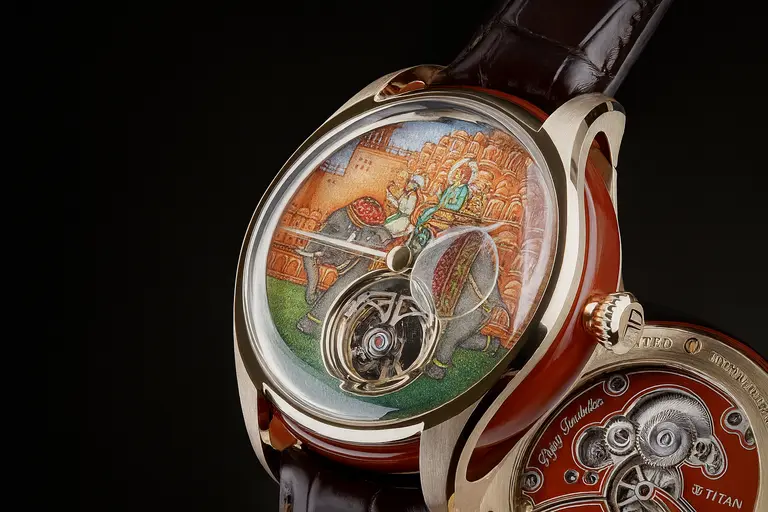
Introduction
In the conservative world of Swiss watchmaking, Hublot is the loud, colorful rebel. While brands like Patek Philippe rely on 180 years of history, Hublot relies on the shock of the new. The Hublot Business Model has revolutionized the industry with its innovative philosophy: “The Art of Fusion.”
This approach masterfully blends traditional Swiss craftsmanship with cutting-edge materials, including rubber, ceramic, and sapphire. As a proud member of the LVMH Group (alongside Bamford Watch Department Partners like Zenith), Hublot fuels its growth through high-volume marketing and limited editions. In this article, I will delve into the strategy behind the brand. As an expert in materials, I will also explain why their “Magic Gold” is a metallurgical miracle.
Genesis of the Hublot Business Model
To begin with, we must acknowledge the architect. Hublot was a quiet brand until Jean-Claude Biver took over in 2004. He injected a simple, powerful concept into the Hublot Business Model: Combine materials that never go together—for instance, putting a gold watch on a rubber strap. Before Hublot, this was considered a fashion crime. Today, it is the industry standard.
Consequently, revenue skyrocketed from 24 million CHF to over 500 million CHF in a decade. This proves that in luxury, “Perceived Value” often matters more than heritage.
The Art of Fusion in the Hublot Business Model
At the heart of Hublot’s success lies the “Art of Fusion.” Unlike traditional brands that stick to steel and gold, Hublot functions like a chemistry lab.
Magic Gold
This is a proprietary alloy. Hublot fuses 24K Gold with Boron Carbide (ceramic). The Result: 18K Gold that is scratch-proof. As a Gemologist, I find this fascinating. Standard gold has a Vickers hardness of 400. Magic Gold is near 1,000. It is gold you can hit with a hammer.
Sapphire Cases
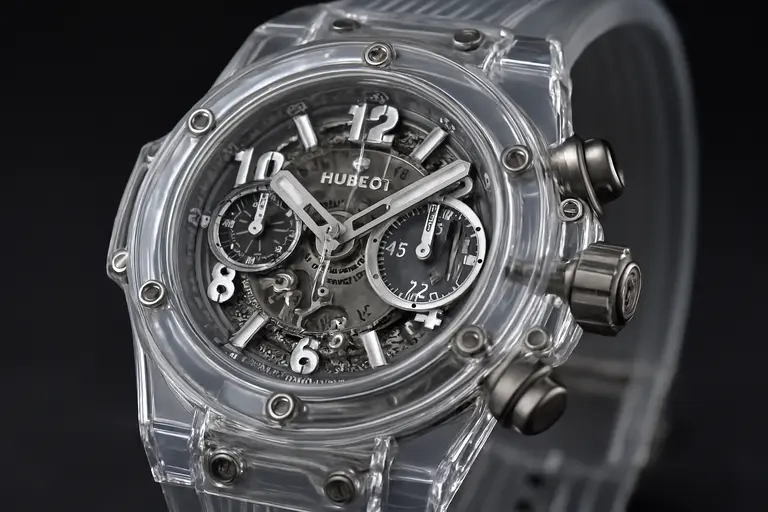
Furthermore, Hublot is a pioneer in Synthetic Sapphire in Watches. They don’t just use it for the glass; they machine the entire case out of sapphire blocks. Because sapphire is brittle (Mohs 9), machining it requires diamond tools and immense patience. Therefore, these watches command prices over $50,000, creating a “Halo Effect” for the cheaper models.
Marketing Strategy of the Hublot Business Model
Next, let’s look at visibility. Hublot shuns conventional advertising in favor of “Experiential Marketing.” Instead, the brand invests in partnerships that generate buzz.
- Football: They were the first luxury brand to sponsor the FIFA World Cup. Now, the referee board is shaped like a Hublot watch.
- Formula 1: Their partnership with Ferrari resulted in some of the most complex engine-inspired watches ever made.
Consequently, these collaborations expose the brand to millions of “New Money” buyers who may not care about history but care about status. You can compare this high-visibility strategy to the subtle approach of Van Cleef & Arpels.
The Limited Edition Strategy
Although Hublot maintains core collections (Big Bang, Classic Fusion), Limited Editions are the cornerstone of the Hublot Business Model. Each piece ties into a narrative—a specific artist (Takashi Murakami), a specific event, or a specific material.
This Scarcity Principle creates urgency. For example, a blue ceramic Big Bang released for the Cricket World Cup becomes an instant collector’s trophy for fans. However, critics argue this dilutes the brand. Yet the sales numbers disagree. By constantly refreshing the catalog, Hublot stays relevant on social media feeds, driving the “Hype Cycle.”
Vertical Integration in the Hublot Business Model
Crucially, Hublot is not just a marketing machine; it is a serious manufacturer. Their facility in Nyon, Switzerland, handles everything from R&D to movement assembly.
Notably, they developed the UNICO calibre in-house. Why? To reduce reliance on suppliers and allow for “Open-Work” dials where the movement is visible from the front. Moreover, the facility produces its own high-tech ceramics. Therefore, in 2026, the Hublot Business Model rests on a foundation of genuine technical independence, silencing critics who call it a “fashion brand.”
Retail Strategy: The Hublotista
Leveraging LVMH’s vast network, Hublot prioritizes immersive boutique experiences. These spaces foster the “Hublotista” community. Increasingly, a digital-first strategy enhances accessibility. For example, virtual tours allow a client in Kerala to inspect a watch in Geneva.
Key markets like the U.S., Japan, and India receive targeted expansion. Thus, this omnichannel model drives sales while building lasting relationships. If you are interested in how brands target Indian buyers, read my guide on Luxury Watch Collectors India.
Conclusion on the Hublot Business Model
In summary, the Hublot Business Model proves that you don’t need 200 years of history to lead the market. You need audacity. By fusing the durability of rubber with the prestige of gold, and the science of sapphire with the passion of football, Hublot has carved its own lane. Ultimately, it is the watch for the person who lives in the future, not the past.
FAQ: Hublot Business Model
What is Hublot’s “Art of Fusion”?
It is the brand philosophy of blending contrasting materials (Gold + Rubber, Carbon + Ceramic) and contrasting concepts (Traditional Craft + Modern Design).
Why are Hublot watches expensive?
Primarily due to R&D costs for materials like Magic Gold and Sapphire, the complexity of in-house movements (UNICO), and the massive global marketing footprint.
Is Hublot owned by Rolex?
No. Hublot is owned by LVMH (Moët Hennessy Louis Vuitton), the same group that owns Tag Heuer, Zenith, and Bulgari.
Why does Hublot make so many limited editions?
To drive “FOMO” (Fear of Missing Out). Limited runs create immediate demand and allow the brand to target very specific niches (e.g., Cricket fans, Art collectors).
Is Magic Gold real gold?
Yes. It is certified 18K gold (75% gold, 25% ceramic). However, unlike normal 18K gold, which scratches easily, Magic Gold is hard enough to resist almost any scratch.
Author Bio
P.J. Joseph, also known as Saju Elizamma, Gemstone & Gold Consultant serving Kerala, Tamil Nadu, and Karnataka.