Introduction
Imagine a delicate flower blooming in serene waters alongside a rare gem sparkling in ancient gravels. Surprisingly, the island of Sri Lanka unites these two wonders: the Nil Manel flower and the Taaffeite gemstone. Although one thrives in ponds and the other forms deep in the earth, they share stunning aesthetic traits, origins, and extreme rarity.
As a Gemologist, I have always been fascinated by how nature repeats its colors. The specific “Lilac-Blue” of the flower is almost identical to the “Mauve” of the stone. In this article, we will explore the Nil Manel and Taaffeite connection. We will uncover the story of the accidental discovery of Taaffeite and why these two icons represent the soul of Sri Lanka.
Color Palette of Nil Manel and Taaffeite
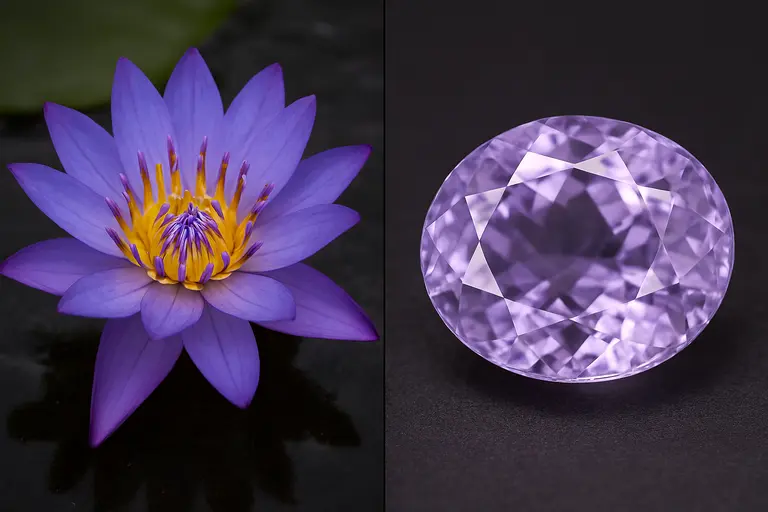
First, let us look at the visual parallel. Both the Nil Manel (Nymphaea nouchali) and Taaffeite display captivating cool-toned hues that evoke tranquility.
The Flower’s Hue
The Nil Manel typically unfurls in violet-blue or pale sky-blue petals with a yellow center. However, it is not a “Navy Blue.” It is an ethereal, pastel shade often described as “Manel” color in local Sinhalese culture.
The Gem’s Hue
Similarly, Taaffeite gems shimmer in lilac, mauve, and greyish-violet shades. For instance, high-quality Taaffeite from Sri Lankan gem gravels often mimic the exact pale violet of the flower’s outer petals. Unlike the deep saturation of a Kashmir Sapphire, Taaffeite is prized for its soft, dreamy pastel tone. Therefore, jewelers often pair these colors in high-end designs to evoke the dawn over a Sri Lankan lake.
The Discovery Story: A Gemological Miracle
To understand the value of Taaffeite, we must look at its history. It has the most unique discovery story in gemology. In 1945, Count Edward Charles Richard Taaffe, a bohemian gemologist based in Dublin, bought a box of “Spinels” from a jeweler.
While examining them, he noticed something strange. Spinel is Singly Refractive (SR)—it does not split light. However, one small mauve stone showed slight Double Refraction (DR). Consequently, he sent it to the London Chamber of Commerce laboratory. They confirmed it was a new mineral. Thus, Taaffeite became the only gemstone to be discovered as a faceted stone before it was found in the rough. If you are interested in how experts identify stones, read my guide on Colored Stone Grading.
Geographic Origin of Nil Manel and Taaffeite
Geographically, Sri Lanka serves as the heartland for both treasures.
The Habitat of Nil Manel
Primarily, the Nil Manel holds national pride as Sri Lanka’s official flower. It flourishes in the island’s lowland wetlands and ancient tanks (Wewas). According to botanical records, its presence symbolizes the nation’s mastery over water irrigation since ancient times.
The Source of Taaffeite
Meanwhile, Taaffeite emerges from Sri Lanka’s gem-rich soils (Illam). Miners extract it from alluvial deposits in Ratnapura (City of Gems). In fact, for decades, Sri Lanka was the only known source. Thus, both thrive in the same tropical paradise. The flower drinks the water above, while the stone sleeps in the gravel below. You can read about similar alluvial mining in my post on Panna Diamond Mining.
Rarity of Nil Manel and Taaffeite
Rarity elevates both to prized status, but Taaffeite is in a league of its own.
Taaffeite stands out as one of the world’s rarest gems—millions of times rarer than Diamond. Experts estimate that for a long time, only a handful of stones existed. For example, a gem miner might work his entire life in Ratnapura and never find a single Taaffeite. Consequently, when a fine Mauve Taaffeite appears at auction, it commands astronomical prices, often bought by museums or elite collectors.
Likewise, the true Nil Manel demands authenticity. In local markets, common water lilies are often sold as Nil Manel. Therefore, finding the pure, native strain is a botanical treasure hunt, mirroring the gemological hunt for the stone.
Cultural Significance of Nil Manel and Taaffeite
Finally, Sri Lankan culture weaves deep meaning into both Nil Manel and Taaffeite.
- The Flower: It embodies purity, discipline, and virtue in Buddhist traditions. It is the preferred offering at the Temple of the Tooth in Kandy.
- The Stone: Taaffeite signifies hidden worth. Because it looks like Spinel but is far more valuable, it represents “Inner Truth.”
For the collector, owning a Taaffeite is the ultimate “Stealth Wealth.” It doesn’t scream like a Diamond; it whispers to those who know. This aligns with the philosophy I discuss in Water Tasting vs Diamond Grading—the expert ability to detect nuance.
Conclusion: Nil Manel and Taaffeite
Ultimately, the connection between Nil Manel and Taaffeite highlights nature’s elegance. Whether it is the biological structure of a petal or the crystal lattice of a mineral, Sri Lanka has produced perfection. In summary, if you ever visit the island, admire the flowers in the pond, but keep an eye on the gravel. You never know when you might find a miracle.
FAQ: Nil Manel and Taaffeite
What makes Taaffeite rarer than diamonds?
Taaffeite’s extreme scarcity stems from its chemical composition (Beryllium Magnesium Aluminium Oxide). Nature rarely brings these elements together. Fewer than 1 in 10,000 gems cut from Sri Lankan gravels yield it.
Is Nil Manel the same as a Blue Lotus?
Technically, yes and no. It is often called the “Blue Water Lily of Sri Lanka,” but specifically, it is Nymphaea nouchali. It has a distinct pale violet-blue color compared to the deep Egyptian Blue Lotus.
Where can I find authentic Taaffeite?
You must seek high-end gem dealers in Ratnapura or Colombo. Crucially, never buy Taaffeite without a lab report from GIA or Gubelin, as it is easily confused with Spinel.
Why pair Nil Manel with Taaffeite?
They share the same “Soul” of Sri Lanka. Both represent the unique geological and botanical heritage of the island, united by their rare violet hue.
Is Taaffeite expensive?
Yes. Due to its rarity, price per carat can range from $2,500 to over $10,000 depending on color and clarity.
Author Bio
P.J. Joseph, also known as Saju Elizamma, Gemstone & Gold Consultant serving Kerala, Tamil Nadu, and Karnataka.