Introduction
In 2026, Gemstone Therapy captivates millions worldwide, blending ancient wisdom with modern self-care rituals. Proponents claim crystals like Amethyst harness vibrational energies to heal physical ailments or align chakras. However, the scientific community firmly labels it a pseudoscience, citing a lack of empirical evidence.
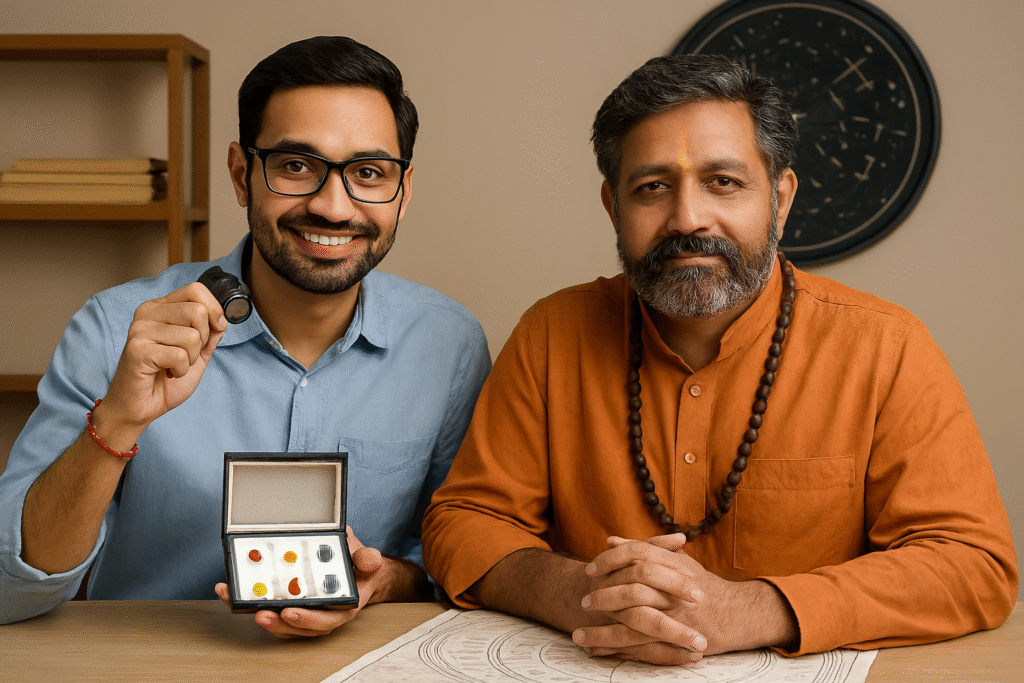
Yet, as people prove endlessly complicated, Gemstone Therapy thrives not just in yoga studios but in the hearts of rational people. In this article, we explore both sides: the rigorous scientific critique and the enduring traditional appeal. As a Gemologist, I look at stones under a microscope. But as an Indian, I understand the cultural weight of a Navaratna ring. Let us navigate this nuanced topic together.
The Scientific Perspective on Gemstone Therapy
From an evidence-based standpoint, we must be blunt: Gemstone Therapy lacks credible support in physics or biology. Scientists argue that concepts like “energy fields” manipulated by crystals do not align with measurable data. For example, a review by the National Center for Complementary and Integrative Health (NCCIH) found no rigorous studies proving crystals influence health outcomes beyond psychological suggestion.
Moreover, clinical trials consistently fail to validate claims. In contrast to proven therapies like physiotherapy, Gemstone Therapy shows no repeatable results in controlled environments. Therefore, researchers attribute user testimonials to the Placebo Effect. As Harvard Health Publishing explains, the placebo effect is not “fake”; it is a powerful neurobiological reaction where belief alone triggers real improvements in mood or pain perception.
Additionally, the field suffers from a lack of standardization. Unlike pharmaceuticals, there is no universal protocol. One practitioner might recommend Ruby for vitality, while another suggests it for love. Consequently, organizations like the Committee for Skeptical Inquiry classify it as pseudoscience, urging caution against unsubstantiated health promises.
The Psychological Power: Why It “Works”
If science says “No,” why do millions say “Yes”? The answer lies in Human Psychology. For many, crystals act as tangible anchors for intention-setting (a concept known as “Totems”).
For instance, if a person suffering from anxiety carries a smooth Blue Lace Agate, they touch it when they feel stressed. This physical action interrupts the panic loop. The stone isn’t vibrating; the stone is a reminder to breathe. Thus, in the context of mental health and mindfulness, Gemstone Therapy functions as a tool for focus.
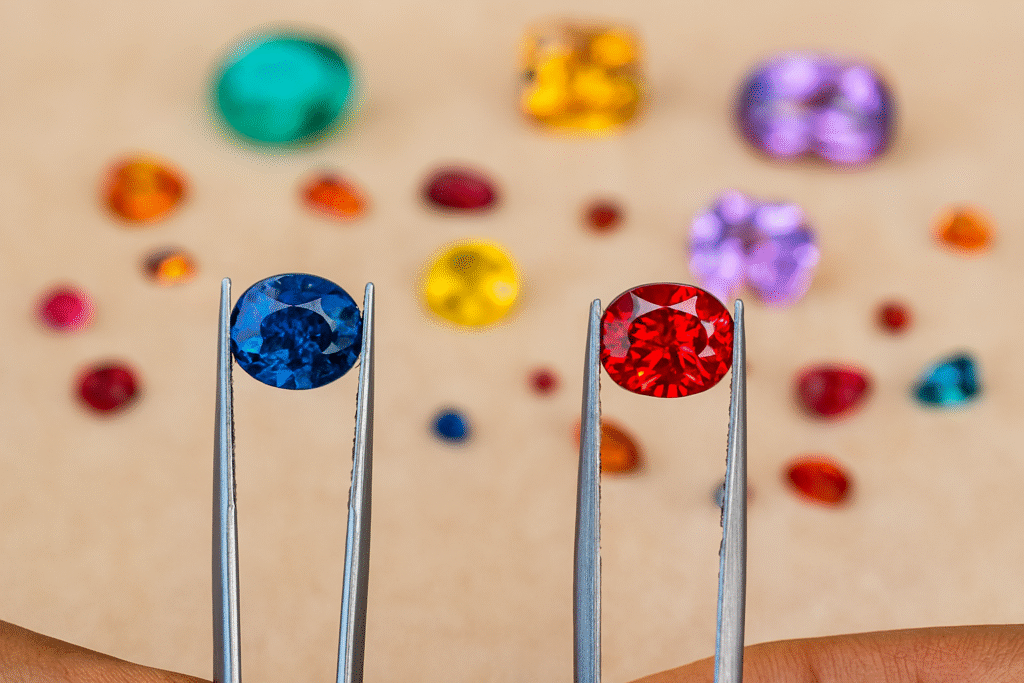
If you are interested in the physical properties of these stones, check my guide on Colored Stone Grading.
Cultural Roots: Vedic and Ayurvedic Views
However, dismissing Gemstone Therapy entirely overlooks its profound cultural legacy, especially in India. For thousands of years, civilizations have revered crystals for more than mere adornment.
In India, Vedic traditions elevate gemstones to cosmic tools. According to Vedic Astrology principles, stones like Blue Sapphire (Neelam) are not meant to cure cancer; they are meant to mitigate planetary influences (Doshas) related to Saturn. This is a spiritual technology, not a medical one.
Furthermore, in Ayurveda, gems are used differently. Through calcination (burning), gems are turned into Bhasmas (medicinal ash). In this form, the chemical elements (Calcium, Iron, Magnesium) enter the body. This is distinct from simply wearing a stone. Transitioning to the Americas, Native American tribes used Turquoise in rituals for harmony. These practices persisted because they resonated with human intuition about the natural world.
The “Middle Path”: Constructive Criticism
In addition to history, personal conviction fuels the industry. Younger generations (Gen Z) use Gemstone Therapy as a counterbalance to “Digital Overload.” It is a way to connect with the Earth in a high-tech world.
Yet, balance is key. While empowering, over-reliance risks delaying evidence-based care. My Constructive Criticism is this:
- Use Gems for Wellness: If a crystal makes you feel calm, focused, or happy, use it. The mind is powerful.
- Use Doctors for Illness: If you have an infection or a broken bone, go to a hospital. Do not rub a stone on it.
Ultimately, science measures the tangible, but culture honors the symbolic. Even in 2026, as globalization blends practices, Gemstone Therapy endures because humans are not just biological machines; we are emotional beings.
Conclusion
Is Gemstone Therapy real? Scientifically: No. Psychologically and Culturally: Yes. The stone does not change the world; the stone changes you, and then you change your world. Whether you view a Diamond as a carbon allotrope or a symbol of Venus, its beauty remains undeniable.
FAQ: Common Questions on Gemstone Therapy
Is Gemstone Therapy scientifically proven?
No. Major health bodies classify it as unproven. Any benefits are largely driven by the Placebo Effect (the power of belief), though this can still provide real emotional relief.
Which stones are used in Gemstone Therapy for beginners?
Practitioners often suggest Clear Quartz for clarity or Amethyst for calm. Always source ethically from trusted gemologists. You can find authentic sources on The Arkenstone.
Can crystals replace medical treatment?
Absolutely not. This is the most dangerous misconception. Always consult doctors for physical health issues; use gems only for emotional support or spiritual grounding.
What is the link between Vedic astrology and Gemstone Therapy?
In Vedic tradition, specific stones amplify planetary effects. For example, a Pearl connects to the Moon (Mind). This is based on ancient texts like the Garuda Purana, distinct from modern crystal healing.
Author Bio
P.J. Joseph, also known as Saju Elizamma, Gemstone & Gold Consultant serving Kerala, Tamil Nadu, and Karnataka.