Introduction
Imagine standing on a misty hill in Munnar, Kerala, sipping a fresh brew. Now, imagine holding an Emerald in your hand. At first glance, these two experiences seem unrelated. One is a fleeting drink; the other is a permanent mineral. However, Tea Tasting and Colored Stone Grading represent fascinating expert evaluations of natural treasures. Both processes demand skilled professionals who assess “Quality” through careful observation.
Yet, they diverge sharply in their methods. For example, while gemstone grading follows structured global standards, tea tasting embraces more fluid, sensory traditions. In this article, we will explore these differences and surprising similarities. As a certified gemologist who also appreciates a good cup of tea, I often reflect on how these fields intersect in valuing authenticity and origin
Differences Between Tea Tasting and Colored Stone Grading
First, let us consider the primary criteria used to judge quality.
The Evaluation Criteria
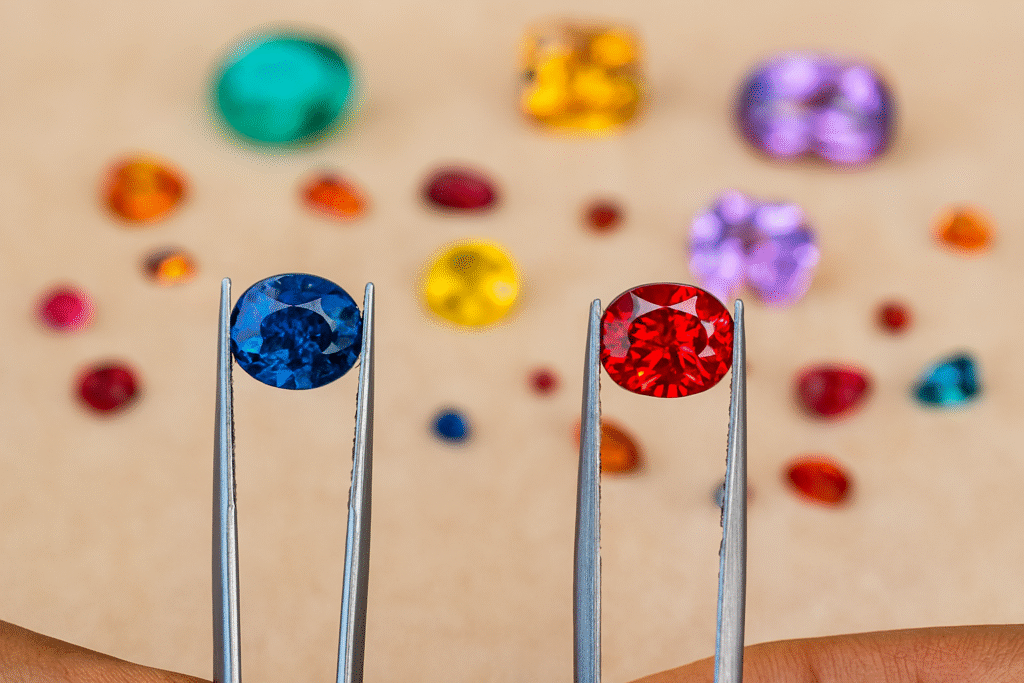
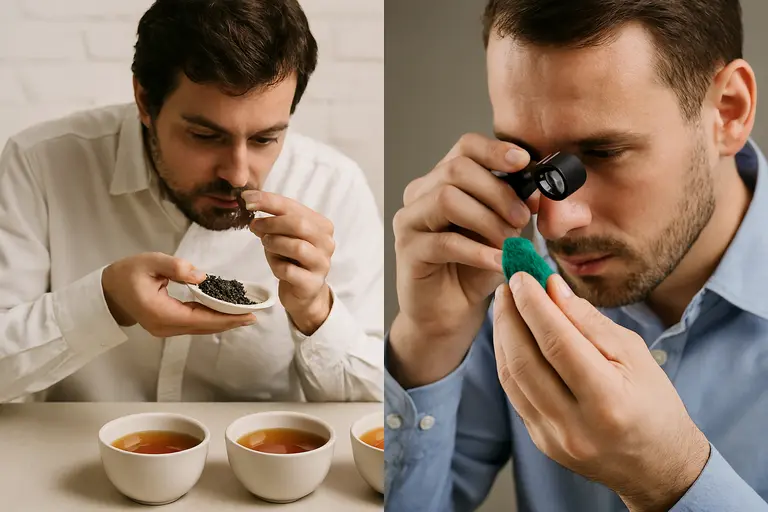
Tea tasting focuses on the appearance of dry leaves, the aroma of the wet leaves, and the brewed flavor profile. It unfolds in layers—top notes, body, and finish. In contrast, Colored Stone Grading hinges on the renowned “4 Cs”:
- Color: Hue, Tone, and Saturation.
- Clarity: Inclusions (The “Jardin”).
- Cut: Symmetry and Polish.
- Carat: Weight.
These gemstone factors determine market value with scientific precision, as outlined by the GIA (Gemological Institute of America).
Tools for Tea Tasting and Colored Stone Grading
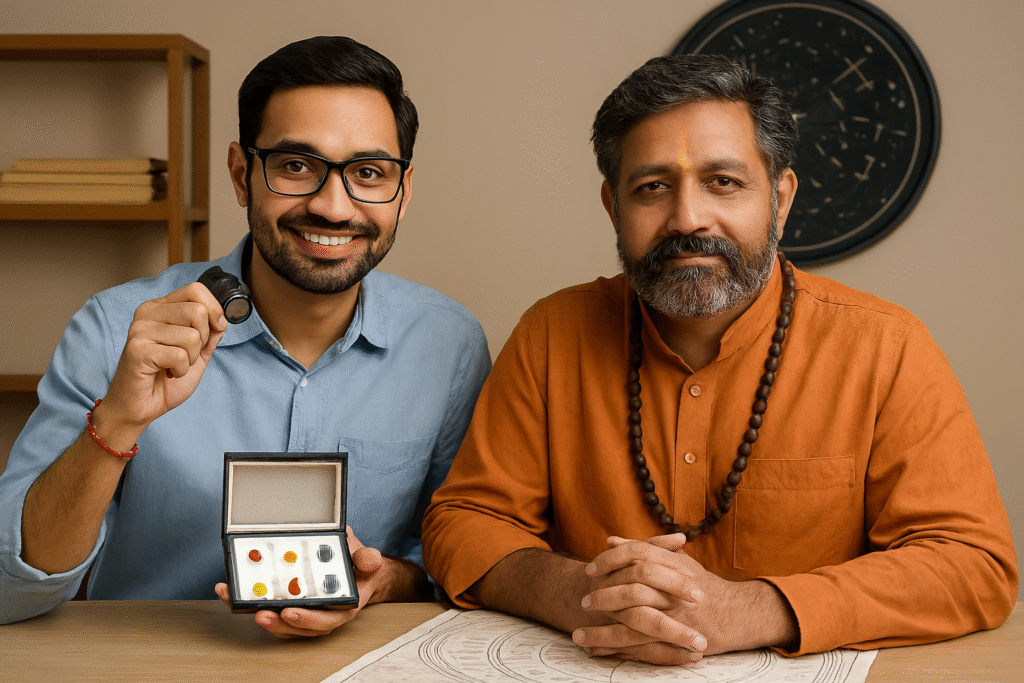
Next, evaluation methods differ markedly. Tea tasters rely on a multisensory experience, involving sight, smell, and taste. They often “slurp” the hot brew to aerate flavors across the palate. However, gem graders use objective tools, such as a 10x Loupe, for magnification and controlled lighting environments to inspect facets. Consequently, the gem approach minimizes variability, unlike the palate-driven subjectivity in tea.
Permanence vs. Perishability
Moreover, the objects themselves vary fundamentally. Tea is a consumable agricultural product. Its quality can shift over time due to humidity, storage, or brewing temperature. On the other hand, colored gemstones are durable minerals with fixed qualities. For instance, a well-cut Emerald from Colombia retains its clarity indefinitely. It is an heirloom.
You can read more about durable investments in my guide on Padmanabhaswamy Temple Treasures.
Origin in Tea Tasting and Colored Stone Grading
Despite the differences, one massive thread unites Tea Tasting and Colored Stone Grading: The concept of Origin (or Terroir).
Soil in Tea Tasting and Colored Stone Grading
In the tea world, a Darjeeling First Flush tastes different from a Munnar High-Grown tea. Why? Because of the soil, the altitude, and the mist. Similarly, in the gem world, the “Geological Terroir” dictates value.
- A Kashmir Sapphire has a velvety “cornflower blue” glow caused by microscopic inclusions unique to the Himalayas.
- A Burmese Ruby has a fluorescence caused by the marble host rock in Mogok.
Therefore, in both fields, knowing where the product came from is as important as what it is. In fact, GIA has recently launched new services to track this. Read my update on GIA Origin Reports 2026.
Commonalities in Tea Tasting and Colored Stone Grading
Furthermore, several other common threads unite these practices.
Sensory Calibration
Primarily, both depend on highly trained experts. A Master Tea Taster undergoes rigorous palate training to detect subtle fermentation defects. Similarly, a Gemologist trains their eye to spot a “synthetic flame fusion” curved line in a fake ruby. Thus, both are disciplines of Purity.
Visual Inspection
In addition, visual inspection forms the foundation.
- Tea: Tasters scrutinize dry leaves for “tips” (golden buds) and uniformity.
- Gems: Graders examine rough stones for “Color Zoning” (uneven color distribution).
This initial step reveals the product’s potential before it is even processed.
Treatments and Enhancement
Moreover, treatments add value strategically in both fields.
- Tea: Leaves benefit from rolling, oxidizing (fermentation), or steaming (for Green Tea).
- Gems: Sapphires benefit from Heat Treatment to dissolve silk and improve blue hue.
However, in gems, disclosure is mandatory. In tea, it is called “processing.”
To avoid buying heavily treated stones without knowing, check my Gemstone Buying Mistakes guide.
Conclusion: Artistry in Nature
Ultimately, whether you are sipping a cup of Orange Pekoe or admiring a Padparadscha Sapphire, you are enjoying a gift from the Earth. Tea Tasting and Colored Stone Grading are simply the languages we use to appreciate these gifts. As a buyer, whether you are buying tea in a supermarket or a gem in a showroom, the rule is the same: Look for Quality, ask about Origin, and trust your senses.
FAQ
Subjectivity in Tea Tasting and Colored Stone Grading?
Colored stone grading is more objective because it uses tools (microscopes) and master comparison stones. However, color aesthetics (like “Pigeon Blood Red”) still add some subjectivity—though far less than tea’s flavor evaluations.
Can tea quality change after grading?
Yes. Tea is perishable. Storage conditions (moisture, heat) affect flavor over time. In contrast, gemstone traits remain stable for centuries.
Why does origin matter in both?
Unique soils and climates create signature profiles. Just as Darjeeling commands a premium over common dust tea, a Burmese Ruby commands a premium over a Mozambique one.
Are there global standards for tea tasting?
Not fully. Systems vary by culture (Chinese vs. British vs. Indian). Unlike the GIA’s strict gem protocols, tea grading is often region-specific (e.g., ISO standards exist for Black Tea, but specialty teas vary).
Author Bio
P.J. Joseph, also known as Saju Elizamma, Gemstone & Gold Consultant serving Kerala, Tamil Nadu, and Karnataka.