Introduction
Imagine a world where the earthy crimson of a dried Karnataka chilli dances alongside the fiery glow of a precious gemstone. That is the magic behind the phrase “one hundred shades of Byadgi chilli and ruby.”
As a Gem Expert who also appreciates fine food, I often see parallels between the kitchen and the laboratory. Far from being just a list of colors, this comparison celebrates the deep red hues that define South Indian culture. In this article, we will explore the story behind the famous Byadgi chilli of Karnataka, the allure of the Ruby, and how their shared palette creates a bridge between everyday cuisine and high-end luxury.
The Byadgi Chilli & Ruby: Nature’s Red Gold
To begin with, let us look at the pride of Karnataka: the Byadgi Chilli. Grown primarily in the Haveri and Dharwad districts, this variety is not famous for its heat, but for its Color. Unlike the fiery Guntur chilli, the Byadgi is mild. Its value lies in its high levels of Capsanthin, a pigment that paints dishes in a deep, crinkled, blood-red hue.
For instance, when you see the appetizing red color of a Bisi Bele Bath or a traditional Udupi Sambar, you are not seeing artificial coloring; you are seeing the natural “dye” of the Byadgi. Moreover, this chilli holds a GI Tag (Geographical Indication), making it as culturally protected as Champagne in France. It is an agricultural gem.
If you are interested in how natural ingredients shape our health, you can read the guide on Healthy Living and Diet.
Ruby Gemstones: The Pinnacle of Red Luxury
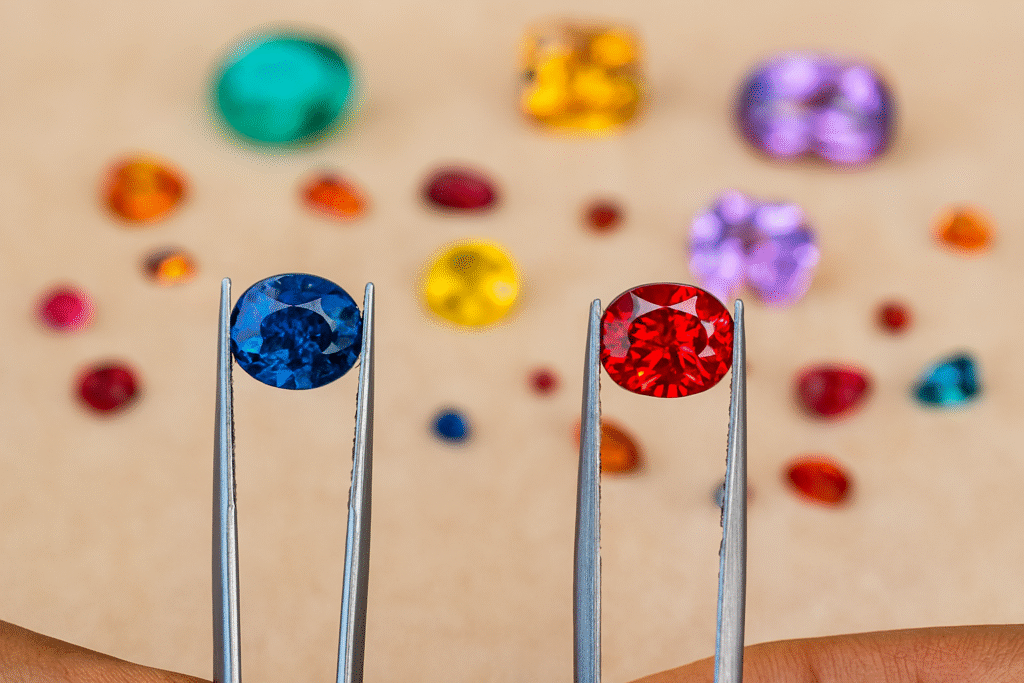
Now, shift your gaze from the spice market to the jewelry showroom. The Ruby is nature’s crown jewel of red. As a variety of Corundum, it gets its color from chromium traces. However, unlike the chilli, the Ruby interacts with light differently.
- The Chilli is Matte: It absorbs light, giving it a warm, earthy, grounded feeling.
- The Ruby is Vitreous: It reflects and refracts light, creating “Fire.”
The most prized examples, specifically the “Pigeon’s Blood” rubies from Burma (Myanmar), command prices that can exceed millions of dollars. In comparison, the “Kempu” stones used in Tamil Nadu temple jewelry offer a deeper, darker red that is closer to the dried chilli shade. You can learn more about these regional differences in my article on Kempu Ruby: Tamil Nadu vs Kerala.
Blending Byadgi Chilli & Ruby Shades
So, how do Byadgi and Ruby converge? The metaphor of “100 Shades” captures the infinite gradations between the organic world and the mineral world.
- Pantone 186C (Chilli): A warm, brownish-red.
- Pantone 188C (Ruby): A cool, blueish-red.
Consequently, this spectrum defines the aesthetic of South India. In a South Indian wedding, you will see the bride wearing a Kanchipuram saree in “Chilli Red,” adorned with a “Ruby Red” necklace. The interplay between the fabric (Matte) and the stone (Sparkle) creates a perfect visual harmony.
Furthermore, designers are increasingly using this palette. Interior experts recommend “Byadgi” tones for warm accent walls, paired with “Ruby” cushions for a pop of luxury. It proves that red is not just one color; it is a language.
Scientific Parallel: Chromium vs. Capsanthin
As a gemologist, I find the science fascinating.
- In the Gem: The color comes from Chromium. It is permanent. A ruby will remain red for a billion years.
- In the Chilli: The color comes from Capsanthin. It is organic and fleeting. If you leave a Byadgi chilli in the sun too long, it fades.
Therefore, when we hold a Ruby, we are holding “Permanent Red.” When we cook with Chilli, we are enjoying “Ephemeral Red.” Both have beauty; one lasts forever, one nourishes us today.
Practical Tips: Choosing Byadgi Chilli & Ruby
Ultimately, how can you use this knowledge?
- For the Foodie: When buying chilli powder, look for the deep, dark red color. If it is too bright neon-red, it might be artificial. Real Byadgi has the tone of a dark garnet.
- For the Jewelry Buyer: When buying Rubies, do not look for “Traffic Light Red.” Look for the deep, glowing red that has a hint of blue. However, be careful of glass-filled rubies that try to fake this look. Read my warning in Gemstone Buying Mistakes.
Conclusion
Whether it is the spice in your Sambar or the stone in your ring, Red is the color of energy (Shakti). The Byadgi Chilli represents the earth of Karnataka, while the Ruby represents the fire of the earth’s core. Together, they form the 100 shades that color our lives.
FAQ
What is Byadgi chilli known for?
Byadgi chilli is prized for its deep, wrinkled red appearance and mild heat. It is used primarily as a natural coloring agent in South Indian cuisine.
Why are rubies called “Pigeon’s Blood”?
This is a trade term describing the finest Burmese rubies. It refers to a specific red hue with a slight blue undertone and strong fluorescence, making the stone look like it is glowing.
Can I use Byadgi chilli to identify a Ruby color?
Metaphorically, yes. A high-quality “Kempu” ruby often shares the deep, saturated, slightly dark tone of a dried Byadgi chilli, rather than a bright pinkish-red.
Where to buy authentic Rubies in South India?
Trusted hubs include Chennai (for Kempu/Temple Jewelry) and reputable jewelers in Kerala. Always insist on a lab report to ensure the color is natural.
Author Bio
P.J. Joseph, also known as Saju Elizamma, Gemstone & Gold Consultant serving Kerala, Tamil Nadu, and Karnataka.