Introduction
Indian jewelry sales secrets are not learned from manuals.
There are no guarantees in life, but in the Indian jewelry trade, one thing is certain: Gold is not just fashion; it is family heritage. Selling jewelry in Kerala, Tamil Nadu, or Karnataka is different from selling in New York or London. Here, you are not just selling a product; you are managing a family’s life savings.
Although reading a blog is no substitute for decades of experience on the floor, I have curated the most critical wisdom for Indian jewelry showrooms. Whether you are a sales executive in a corporate chain or an owner of a traditional family shop, these practical steps will build the one thing that matters most: Trust.
The Indian Art of Hospitality (Sathkaram)
In the West, a customer may be offered champagne. In India, we offer respect. The sale begins before the customer even sees the gold.
The “Namaste” Rule in Indian Jewelry Sales
Someone must always be at the “sweet spot” (10 feet inside the door) to greet customers within five seconds. A warm “Namaste” or “Vanakkam” with a genuine smile sets the tone. People buy jewelry for happy occasions; they want to buy from happy people.
The Seat and the Water
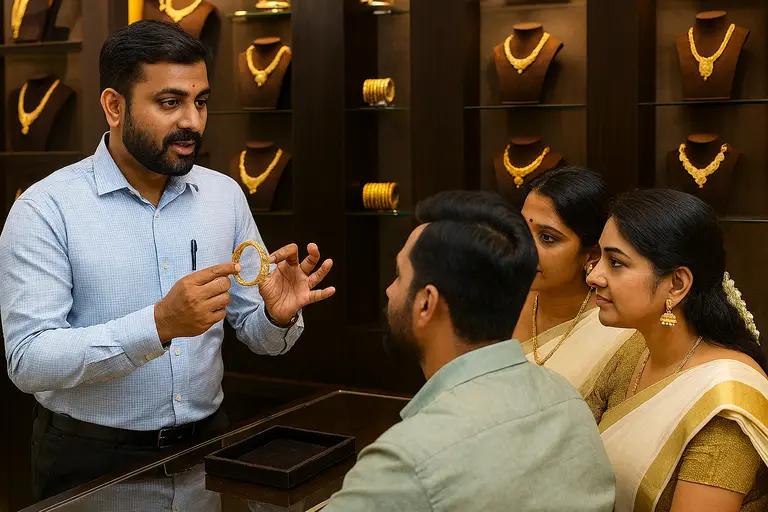
In Indian jewelry retail, unlike other retail, the customer sits. Pull out the chair for them. Immediately offer water, coffee, or fresh lime juice. A customer holding a warm cup of tea is relaxed and stays longer.
Never Judge the “Dhoti”
Every veteran jeweler has a story about a farmer wearing a faded dhoti or simple chappals who pulled a bundle of cash out of his pocket to buy a wedding set. Never judge a client by their clothes. Treat the auto-driver with the same respect as the CEO.
Acknowledge the Elders
In South Indian weddings, the bride chooses the design, but the father or grandmother often holds the wallet. If you ignore the silent elders, you lose the sale. Address everyone in the group, not just the young couple.
Technical Trust: Indian Jewelry Sales Secrets on the Floor
Indian buyers are smart. They know the gold rate better than you do. Do not try to “sell” them; try to “educate” them.
HUID Transparency and BIS Hallmark
Use a loupe to immediately show them the BIS Hallmark and HUID code. Please do not wait for them to ask. Say, “Please check the purity first; we only sell 916 BIS Hallmarked gold.” This establishes honesty instantly.
Handle Gold with Reverence
Never toss a necklace onto the glass counter. It makes a cheap sound. Place it gently on a velvet tray. In our culture, gold is Lakshmi. If you treat it like a cheap toy, the customer will feel disrespected.
Simplify Jewelry and Diamond Jargon
Don’t use confusing terms like “Mounting” or “Melee” without explanation. Instead, use terms they understand—Pavan (Sovereign), Vadam, or Thali. If you sell diamonds, explain the “Dosham” (flaws) clearly. If a diamond has a VVS clarity, explain that it means “Very Very Slightly Included,” ensuring they know why the price is higher.
Making Charges (VA) Explained Clearly
Be upfront about Value Addition (VA). If a customer asks for a discount, explain the logic: “Sir, this is intricate Nagas work from Tamil Nadu; the labor is higher than a machine-cut Kerala chain.” When you explain the why, they accept the price.
For Further Reading: Making Charges and VA in gold jewelry
Emotional Intelligence in Indian Jewelry Sales
Sales succeed when customers feel heard.
Listen More, Talk Less in Indian Jewelry Sales
God gave you two ears and one mouth. Use them in that ratio. Ask open-ended questions: “Is this for a wedding or daily wear?” Then, listen.
The “Touch” Test in Indian Jewelry Sales
Say, “Let’s see how it looks on you.” Jewelry comes alive on the skin. For bridal sets, suggest they take a photo and send it to their family. It creates an emotional bond with the piece.
Cleaning Old Gold as a Trust Builder
If a customer walks in wearing dirty rings, offer to clean them in your ultrasonic machine for free while they browse. It costs you nothing but earns you massive goodwill.
Closing the Sale and the Long-Term Bond
Trust does not end at billing.
The Add-On Logic in Jewelry Sales
If they buy a necklace, show them the matching earrings immediately. Don’t ask, just place them on the tray next to the necklace. The visual logic often closes the sale for you.
Respecting the Customer’s Budget
Avoid asking “How much do you want to spend?” It makes people uncomfortable. Instead, show a mid-range piece. If they frown, go lower. If they ask, “Do you have something heavier?”, go higher. Read their eyes, not their wallet.
Buy-Back Assurance in Indian Jewelry Sales
The biggest fear for an Indian buyer is, “What if I need cash later?” Always explain your exchange and buy-back policy clearly before they pay. It removes the final barrier to purchase.
Final Thoughts on Jewelry Sales
Ultimately, an independent jewelry business is nothing without its reputation. Whether you are in a village in Karnataka or a high street in Kochi, remember this: You are not selling metal. You are selling an asset that will likely be passed down to the customer’s grandchildren. These Indian jewelry sales secrets are learned only on the showroom floor, not from textbooks.
Therefore, under-promise and over-deliver. If you promise a ring in 10 days, deliver it in 7. If you make a mistake, admit it. In the 10-year game of jewelry retail, integrity is your only true capital.
FAQ
What is the most important rule in Indian jewelry sales?
Genuine hospitality. Offering a seat and a drink relaxes the customer and builds a relationship before business begins.
How do I handle bargaining on Making Charges (VA)?
Focus on the craftsmanship. Explain that high-quality, handmade finish requires skilled labor, which justifies the VA.
Should I show the most expensive item first in Indian jewelry sales?
Generally, yes. It sets a benchmark for quality. Even if they buy a cheaper item later, they will appreciate the quality difference.
Author Bio
P.J. Joseph, also known as Saju Elizamma, Gemstone & Gold Consultant serving Kerala, Tamil Nadu, and Karnataka.