Summary
Learn how gemstone certificates from GIA, AGL, IGI, GII, SSEF, and Gübelin can guide your purchase. Discover when they add value, when they don’t, and how to choose wisely.
What a Gemstone Certificate Tells You
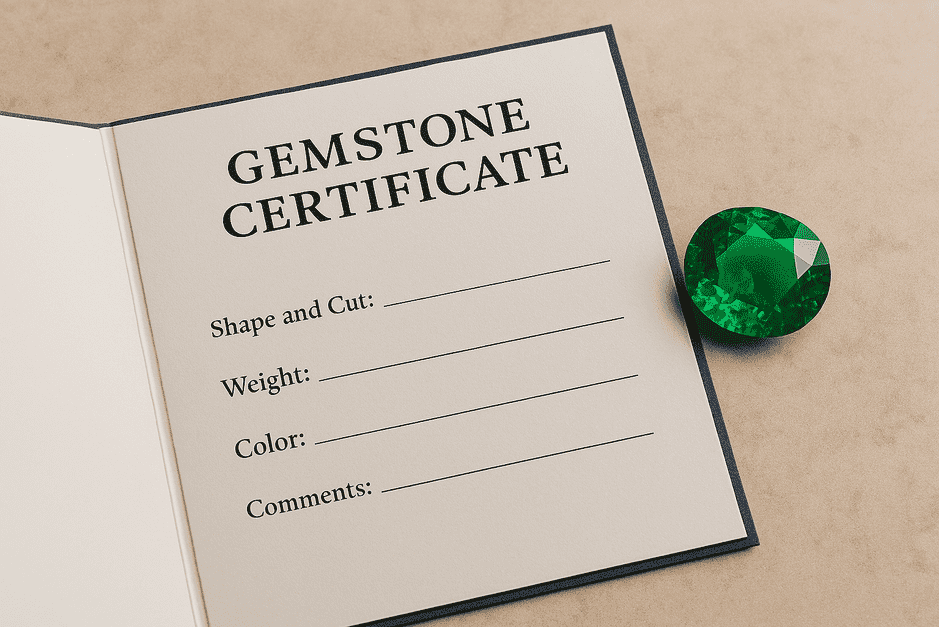
A certificate from reputable labs like GIA or AGL confirms whether a gem is natural, synthetic, or imitation. It lists any treatments such as heating, fracture filling, or dyeing, and records basic details like weight, dimensions, cut, and color. Some high-end labs, such as SSEF or Gübelin, may even provide country-of-origin analysis.
For buyers curious about gold jewelry alongside gemstones, understanding a 24K vs 22K gold buying guide can complement gemstone insights.
What Certificates Don’t Tell You
Certificates don’t guarantee beauty or market value. They won’t tell you if the stone’s color excites you in real life or what its resale price will be. Your own judgment matters—just as you wouldn’t buy art based only on a written description.
If you’re purchasing high-end jewelry, reading about BIS Hallmark standards can help ensure authenticity alongside gemstone certification.
Stones That Benefit Most from Certification
Not every gem needs a report. Certificates are most valuable for:
- High-value gems: Rubies, sapphires, emeralds, and rare spinels.
- Diamonds: Especially those above 0.50 carats.
- Unusual stones: Where origin or treatment affects value.
For smaller or inexpensive stones, the cost of a certificate can exceed the gem’s price.
Choosing the Right Lab
Reputation is key. Buyers worldwide respect:
- GIA – authority for diamonds.
- AGL – trusted for colored stones.
- IGI – popular for diamonds and jewelry reports.
- GII – widely used in India.
- SSEF & Gübelin – top European labs for rare, high-end stones.
Ask yourself: who will trust the report if you ever resell the stone?
A Practical Approach
- Use certificates as a tool, not a crutch.
- Let your eyes, taste, and budget guide you.
- Spend on certification only when it adds clarity or supports value.
Remember, a certificate is a snapshot of facts, not the gem itself.
FAQ
Q1: Are certificates required for all gems?
No. They’re mostly valuable for high-value or rare stones.
Q2: Which lab is best for colored gems?
AGL is widely respected for colored gemstones.
Q3: Can a certificate guarantee future value?
No. It only confirms factual details, not market performance.
Q4: Is it worth certifying small stones?
Usually not, as the certificate may cost more than the gem.