Introduction
If you have ever browsed a gemstone market or jewelry boutique, you may have noticed two strikingly beautiful stones that share a vivid combination of Pink, Red, and Green. Watermelon Tourmaline vs Ruby in Zoisite often confuses buyers. At first glance, these gems appear almost like cousins, united by their bold color palettes and organic, one-of-a-kind appearances. However, despite their visual similarities, these two stones are fundamentally different in composition, origin, and character.
One is a transparent crystal; the other is an opaque rock. As a Gemologist, I find this comparison fascinating because it shows how nature can use the same colors to create two totally different materials. In this guide, I will break down the science, the origin, and the value. Whether you are a collector or someone drawn to the metaphysical properties of the “Heart Chakra,” understanding these differences will help you make an informed choice.
Colors of Watermelon Tourmaline vs Ruby in Zoisite
First, let’s look at the palette. One of the first things collectors notice is that both stones feature a captivating contrast between pink/red tones and rich green hues. This shared color palette has made both gems popular in organic-style and nature-inspired jewelry. Furthermore, both stones are associated with the Heart Chakra in crystal healing traditions, where they are believed to symbolize a harmonious balance.
Despite these surface-level similarities, however, the two stones could not be more different beneath the surface.
- Watermelon Tourmaline: Is a single, zoned Crystal belonging to the Elbaite variety. It grew as one unit.
- Ruby in Zoisite: Also known as Anyolite, is actually a Rock. It is composed of multiple distinct minerals (Ruby + Zoisite + Hornblende) fused together. That distinction alone sets the stage for all the differences that follow.
Origins of Watermelon Tourmaline vs Ruby in Zoisite
To understand them, we must look at how they formed.
Watermelon Tourmaline
This gem forms in Pegmatites, which are coarse-grained igneous rocks. As the crystal develops, shifting concentrations of elements like Manganese (Pink) and Iron/Lithium (Green) cause different colors to form in concentric layers. This creates the signature pink core surrounded by a green outer rind. Primarily, miners source it from Brazil, Madagascar, and Nigeria. You can read more about color zoning in my Tourmaline Color Palette guide.
Ruby in Zoisite (Anyolite)
By contrast, Ruby in Zoisite is a metamorphic rock. It forms when Green Zoisite and Red Ruby crystals—both created under intense heat and pressure—merge over time. Often, black Hornblende spots are present, adding a third color. Miners find this stone almost exclusively in Tanzania (near the Longido mining district). Interestingly, the name “Anyolite” comes from the Maasai word Anyoli, meaning “Green.” If you like Tanzanian gems, check my post on Tanzania’s Cloves and Tanzanite.
Appearance of Watermelon Tourmaline vs Ruby in Zoisite
Visually, the texture tells the story.
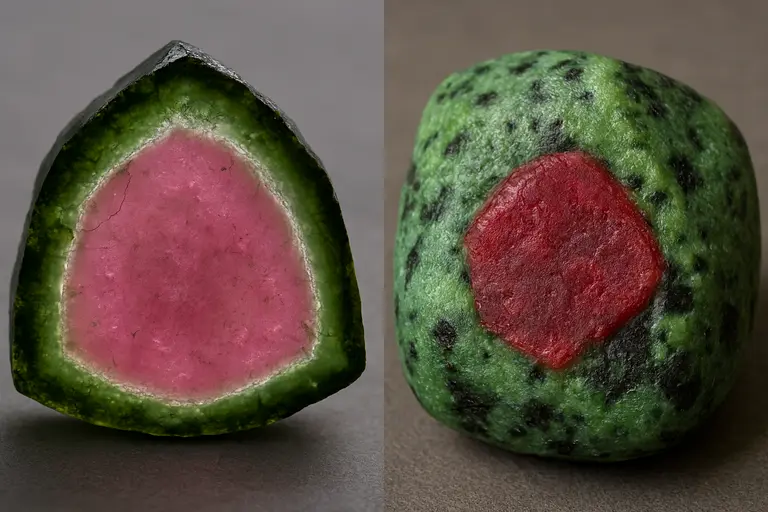
- Watermelon Tourmaline: Displays a Concentric pattern. Imagine a slice of actual watermelon. The pink center gradually transitions into a white buffer zone and then a green outer edge. The stone is often transparent to translucent.
- Ruby in Zoisite: Presents a Mottled pattern. The red ruby crystals are randomly embedded throughout the green matrix like raisins in a cake. There is no order. The stone is opaque.
Therefore, Tourmaline looks like stained glass, while Zoisite looks like abstract art.
The “UV Light” Test
As an expert, here is a trick I use. If you shine a UV Light (Blacklight) on Ruby in Zoisite, the red Ruby spots will often glow with a bright red fluorescence. The green Zoisite stays dark. In contrast, Watermelon Tourmaline is generally inert (does not glow). This simple test can help you identify the stone instantly in a dark room. For more identification tips, read my Gemstone Buying Mistakes guide.
Jewelry Use: Watermelon Tourmaline vs Ruby in Zoisite
When choosing between Watermelon Tourmaline vs Ruby in Zoisite for jewelry, consider the wear and tear.
Tourmaline
Hardness: 7 to 7.5 Mohs. Use: It is durable enough for rings, but it can be brittle due to internal tension. Style: It is often cut into thin “Slices” or faceted into Emerald cuts to show the zoning. It looks best in Gold settings that let light pass through.
Ruby in Zoisite
Hardness: 6.5 to 7 Mohs (The Ruby parts are 9, but the Zoisite is softer). Use: It is tough but softer than Tourmaline. It is best for beads, cabochons, and large statement pendants. Style: It pairs beautifully with Silver or Oxidized metal for a “Bohemian” look.
Buying Tips and Value
Value is another major differentiator. Watermelon Tourmaline is significantly more expensive. A clean, well-zoned slice can cost hundreds of dollars per carat. Conversely, Ruby in Zoisite is affordable. It is often sold by the gram or the piece, not the carat. You can buy a large cabochon for under $50.
Therefore, Tourmaline is an “Investment Gem,” while Zoisite is a “Fashion Gem.” However, large specimens of Zoisite with massive Ruby crystals are prized by carvers for making statues. Read about other affordable gems in Agates of Cambay.
Conclusion on Watermelon Tourmaline vs Ruby in Zoisite
In summary, both stones offer the healing colors of Pink and Green. One offers the clarity of a crystal; the other offers the complexity of a rock. Ultimately, the choice depends on your style. Do you want the refined elegance of Tourmaline or the rugged earthiness of Zoisite?
FAQ: Watermelon Tourmaline vs Ruby in Zoisite
Is Watermelon Tourmaline natural?
Yes. It is a naturally occurring variety of Elbaite Tourmaline. While some stones are heated to improve color, the distinct pink-and-green zoning is 100% natural and formed by changing chemistry during growth.
Is Ruby in Zoisite a real Ruby?
Yes. The red spots are genuine Corundum (Ruby). However, because they are opaque and heavily included within the rock, they are not “Gem Quality” rubies suitable for faceting. They are “Rock Quality.”
Which stone is better for jewelry?
It depends. For fine jewelry (rings/earrings), Watermelon Tourmaline is superior due to its transparency. For artistic, chunky jewelry or beads, Ruby in Zoisite is excellent and durable.
Can these stones be used together?
Absolutely. Because they share the same color palette, designers often mix them. A necklace might feature a Tourmaline centerpiece strung on Zoisite beads.
How do I clean them?
Gently. Use warm, soapy water and a soft cloth for both. Avoid ultrasonic cleaners, especially for Ruby in Zoisite, as the vibration can separate the different minerals in the rock.