Introduction
In the ultra-luxury jewelry world, one name evokes more poetry than any other: Van Cleef & Arpels. Founded in 1906 at Place Vendôme, this French Maison thrives by blending timeless heritage with modern financial strength. However, their success is not accidental. The Van Cleef & Arpels Business Model is a masterclass in balancing “High Art” with “Commercial Scale.”
Unlike independent jewelers who rely on custom orders, VCA (owned by the Richemont Group) has cracked the code of selling standardized luxury items—like the famous Alhambra clover—while maintaining an aura of extreme exclusivity. In this article, I will break down their strategy. As a Gemologist, I will also explain the “Mystery Set” technique that makes their pieces distinct from competitors like Cartier or Bulgari.
Pillars of the Van Cleef & Arpels Business Model
To begin with, the business model rests on two distinct legs.
1. Haute Joaillerie (High Jewelry)
This is the “Dream.” These are one-of-a-kind pieces featuring rare Kashmiri Saffron and Padparadscha style gems. They take thousands of hours to create.
Financially, these might not drive the bulk of the revenue, but they drive the Brand Equity. They prove that VCA is the master of the craft.
2. The Icons (The Cash Cow)
On the other hand, we have the Alhambra and Perlée collections. Launched in 1968, the Alhambra (the four-leaf clover) is the engine of the Van Cleef & Arpels Business Model. Why? It is recognizable, collectible, and relatively affordable (starting around $1,500 – $3,000). Consequently, it serves as the entry point for younger buyers, turning them into lifelong patrons.
The “Mystery Set”: A Technical Moat
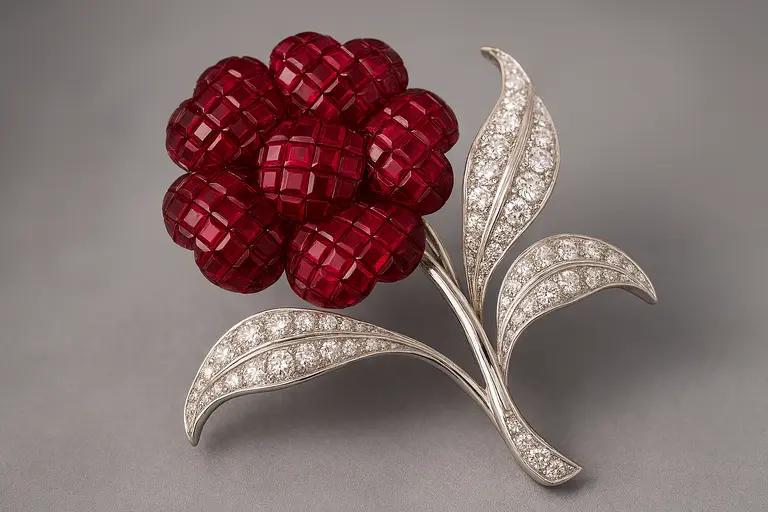
As a Gem Expert, I must highlight the technical innovation that protects their business. In 1933, VCA patented the Serti Mystérieux (Mystery Set).
How it works:
- Grooves are cut into the sides of gemstones (usually Rubies or Sapphires).
- They are slid onto gold rails.
- The Result: A surface of pure color with no visible prongs.
Why this matters for business: It is incredibly difficult to copy. Only a few master jewelers can do it. Therefore, VCA owns a “Technical Moat.” When you see a Mystery Set brooch, you know it is VCA. If you are interested in gem cutting, compare this to the precision required for Colored Stone Grading.
Distribution in the Van Cleef & Arpels Business Model
Next, let’s look at how they sell. Van Cleef & Arpels prioritizes absolute control over its brand image. Unlike brands that wholesale to third-party jewelers, VCA sells primarily through Standalone Boutiques.
This approach avoids price dilution. You will never see a “Sale” sign in a VCA window. Moreover, the boutique experience is tactile. Visitors to their Paris or Dubai flagships step into a world of velvet and silence. However, the brand has dipped into digital with curated online selections. This balance lets them reach younger buyers without destroying the feeling of exclusivity.
Storytelling: The Poetry of Time
Furthermore, VCA does not sell “Products”; they sell “Stories.” Their marketing focuses on:
- Nature: Butterflies and flowers.
- Fantasy: Fairies and Ballerinas.
- Romance: The love story of Alfred Van Cleef and Estelle Arpels.
This strategy fosters dreams. For instance, their watches are called “Poetic Complications.” Instead of just telling time, a watch might show two lovers meeting on a bridge. Consequently, buyers feel they are purchasing a piece of art, not just gold and gears. You can compare this narrative approach to the Jaipur Watch Company, which uses history to sell watches.
The Richemont Advantage
Additionally, we cannot ignore the parent company. As part of Richemont (which also owns Cartier and a Rolex Business Model competitor, Panerai), VCA enjoys massive financial muscle.
- Real Estate: Richemont secures the best locations globally.
- Gem Sourcing: They have first rights to the best rough stones.
- Supply Chain: Strict anti-counterfeiting measures protect the design.
Thus, VCA operates with the soul of an artist but the backbone of a corporate giant.
Investment Value: Blue Chip Jewelry
Finally, is VCA a good investment? Yes. Iconic pieces, especially vintage Alhambra or Mystery Set items, hold value incredibly well. In fact, VCA is considered “Blue Chip” in the auction world (Sotheby’s/Christie’s). Unlike generic jewelry that melts down to its gold weight, VCA retains “Signed Value.” Therefore, for the collector in India, buying VCA is similar to buying North vs South Indian Jewelry—it is a store of wealth.
Conclusion on the Van Cleef & Arpels Business Model
In summary, the Van Cleef & Arpels Business Model proves that luxury endures through storytelling and technical perfection. By hooking clients with the Alhambra and mesmerizing them with the Mystery Set, they have built a loyal kingdom. Ultimately, they sell the most expensive commodity of all: Magic.
FAQ: Van Cleef & Arpels Business Model
Is the Van Cleef & Arpels Business Model exclusive?
They focus almost entirely on company-owned boutiques. This ensures they control the price, the service, and the atmosphere, preventing the brand from becoming “common.”
Why is the Alhambra collection so important?
It provides steady cash flow. While a Mystery Set necklace sells once a year, Alhambra necklaces sell every hour globally. It funds the high-art experiments.
What is the Mystery Set?
It is a patented technique where stones are set without visible metal prongs. It requires matched stones and extreme skill, making it the signature of the brand.
Does Van Cleef & Arpels use treated stones?
Generally, no. For High Jewelry, they use only the finest natural, untreated gems. However, for commercial lines (like Onyx or Malachite), standard industry stabilization is used.
Can their jewelry be an investment?
Absolutely. VCA pieces are some of the most sought-after in the secondary market. They often resell for close to or above retail price, depending on rarity.
Author Bio
P.J. Joseph, also known as Saju Elizamma, Gemstone & Gold Consultant serving Kerala, Tamil Nadu, and Karnataka.