Introduction
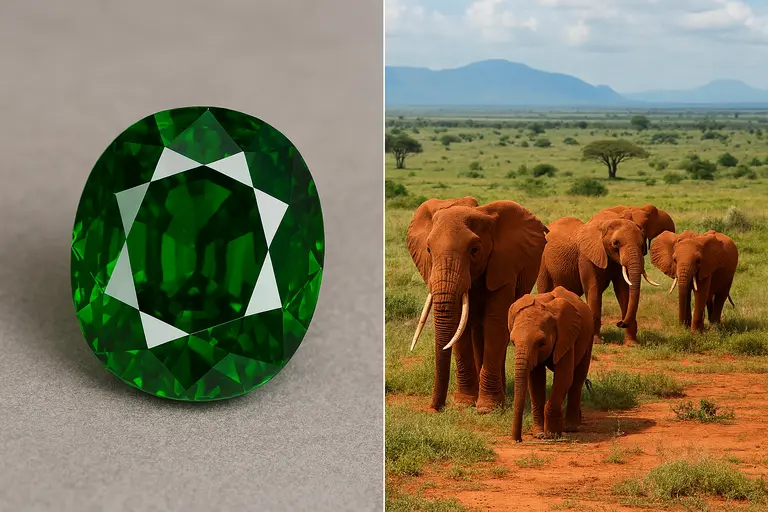
In the vast wilderness of Kenya, geology and biology collide spectacularly. Tsavorite Garnet and Tsavo Park share a fascinating bond that few other gems can claim. One is a National Park famous for its “Red Elephants,” and the other is a vivid green gemstone hidden beneath that very red soil.
In fact, this connection stems from geography and history. Campbell Bridges discovered the rare crystal in this region in the late 1960s. Subsequently, Henry Platt named it in 1974 (President of Tiffany & Co.) to honor the park and the nearby Tsavo River. As a Gemologist, I find Tsavorite superior to Emerald in many ways—it is cleaner, brighter, and untreated. In this article, we will explore the park’s landscapes, the gem’s unique traits, and the dramatic story of its discovery. Whether you are a gem enthusiast or a wildlife lover, these stories reveal Kenya’s hidden treasures.
Exploring Tsavo East: The Theatre of the Wild
First, let’s look at the land. Tsavo National Park spans southeastern Kenya as the nation’s largest protected area. Conveniently, a major highway divides it into two unique experiences: East and West.
Locals often call Tsavo East the ‘Theatre of the Wild’. It boasts endless semi-arid plains. What makes it iconic? It’s famous “Red Elephants.” Specifically, these giants roll in the iron-rich red volcanic soil to protect their skin from the sun and insects. Consequently, they turn a dusty crimson color, creating a stunning contrast against the green acacia trees. This same geological richness (iron and minerals) is what creates the conditions for gemstones to form underground.
Discovering Tsavo West: The Green Oasis
In contrast, Tsavo West provides a more diverse volcanic terrain. It is filled with springs, hills, and lush oases. One highlight is Mzima Springs, where crystal-clear waters teem with hippos and crocodiles.
Moreover, the Ngulia Rhino Sanctuary plays a vital role in conserving the endangered Black Rhinos. For the gem lover, the rugged lava flows here are a reminder of the violent geological history that birthed the Tsavorite Garnet and Tsavo Park connection. Therefore, a safari here is not just about animals; it is about the earth itself. If you enjoy African treasures, read my comparison of Tanzania’s Cloves and Tanzanite.
Discovery of Tsavorite Garnet and Tsavo Park
Transitioning from the park to the stone, we must honor Campbell Bridges. Originally, the Scottish geologist first spotted the green gem in 1967. However, he was in Tanzania at the time, and the government seized the mines, forcing him to leave.
Undeterred, he followed the geological vein north into Kenya. In 1970, he rediscovered the deposit in the hills near Tsavo National Park. Remarkably, to protect his claim from wild animals (and bandits), Bridges lived in a treehouse. He famously used a python to guard his gem stash! This discovery sparked a global sensation. Tiffany & Co. launched a marketing campaign declaring it the “most important gemstone discovery of the 20th century.”
Tsavorite vs. Emerald: The Technical Win
As an expert, I often advise clients to choose Tsavorite over Emerald. Why?
- Brilliance: Tsavorite has a High Refractive Index (1.74), much higher than Emerald (1.57). This means it sparkles more.
- Hardness: It ranks 7–7.5 on the Mohs scale, making it durable for daily wear.
- Clarity: Emeralds are famous for “Jardin” (inclusions/cracks). Tsavorite is often “Eye-Clean.”
- Treatment: Crucially, Tsavorite is untreated. It comes out of the ground green. Unfortunately, Emeralds are almost always oiled to hide cracks.
Therefore, Tsavorite is the “Honest Gem.” You can read more about gem treatments in my Gemstone Buying Mistakes guide.
Rarity of Tsavorite Garnet and Tsavo Park
Why is Tsavorite so sought after? Geologists estimate it is 1,000 times rarer than Emerald. Specifically, stones over 2 carats are incredibly scarce. The geological stress that forms them usually shatters crystals larger than 1 carat.
In 2026, prices reflect this scarcity. Currently, high-quality faceted Tsavorites fetch $1,500 to over $3,000 per carat. However, unlike the inflated prices of diamonds, this value is driven by genuine supply shortages. As a result, investing in a fine Tsavorite is a bet on the finite nature of the earth. For more on rare investments, check my guide on Antique Diamonds.
Cultural Links to Tsavorite Garnet and Tsavo Park
Finally, a note for my Indian readers. Notably, the vivid apple-green of Tsavorite matches the lush landscapes of Kerala. Just as we value the green of the Butterfly Pea vs Cobalt Blue Spinel (leaf vs. flower), we value green gems for Mercury (Budha) in astrology. While astrologers consider Emerald the traditional stone for Mercury, many modern astrologers accept Tsavorite as a powerful, cleaner alternative.
Conclusion on Tsavorite Garnet and Tsavo Park
In summary, Tsavorite Garnet and Tsavo Park are inseparable. Essentially, one is the setting; the other is the jewel. Ultimately, owning a Tsavorite is like owning a piece of the African wilderness—wild, untamed, and spectacularly beautiful.
FAQ: Tsavorite Garnet and Tsavo Park
What is Tsavorite Garnet?
Tsavorite is a rare, vivid green variety of Grossular Garnet. It gets its color from trace amounts of Vanadium or Chromium, the same elements that color Emeralds.
How does Tsavorite Garnet and Tsavo Park connect?
Tiffany & Co. named the gemstone after the National Park in 1974 because the primary mines were located in the Taita-Taveta district, bordering the park. Moreover, miners found it in only one location on Earth.
How rare is Tsavorite compared to Emerald?
Extremely rare. Geologists estimate it is 1,000 times rarer than Emerald. Finding a clean stone over 3 carats is a major geological event.
Is Tsavorite heat-treated?
No. Unlike Tanzanite (which is heated), Tsavorite is one of the few gems sold completely natural. Its color comes 100% from nature.
What is the best time to visit Tsavo Park?
The dry seasons (June to October or January to February) are best. Animals gather at waterholes like Mzima Springs, making them easy to spot.
Author Bio
P.J. Joseph, also known as Saju Elizamma, Gemstone & Gold Consultant serving Kerala, Tamil Nadu, and Karnataka.