Introduction
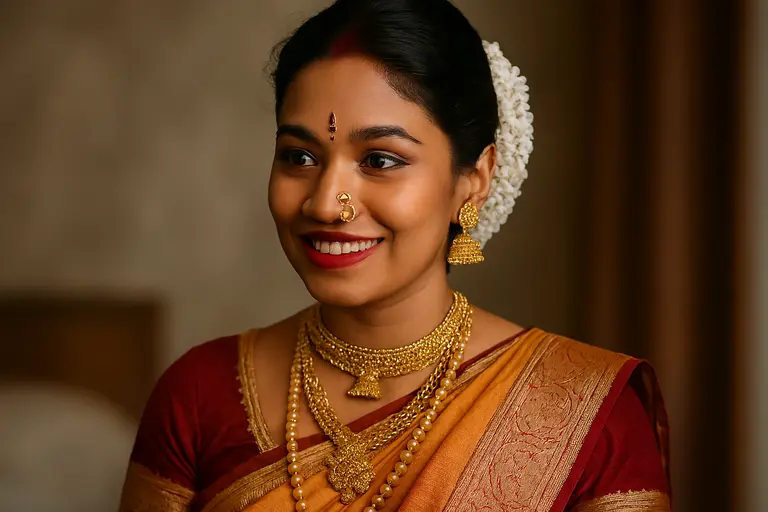
When we speak of Indian heritage, Traditional Maharashtrian Jewellery stands out for its elaborate designs and profound cultural roots. Unlike the heavy temple gold of Kerala, Maharashtrian jewelry is a delicate balance of Gold and Pearls, inspired by the legacy of the Peshwas and Marathas.
Moreover, these pieces often showcase motifs inspired by the moon (Ambada), peacocks, and revered goddesses. However, for a buyer coming from the South, understanding the construction of these ornaments is vital to ensure you are paying for Gold, not wax. In this article, we will explore the key pieces—from the Kolhapuri Saaj to the Thushi—and the craftsmanship that makes them timeless. Whether you are a bride-to-be or a jewelry enthusiast, this is your guide to Maharashtra’s treasure.
Necklaces in Traditional Maharashtrian Jewellery
Necklaces form the heart of the Maharashtrian bridal set. To begin with, let’s examine the two most famous styles.
Kolhapuri Saaj in Traditional Maharashtrian Jewellery
The Kolhapuri Saaj is a hallmark long necklace from the Kolhapur region. Typically, it features 21 dangling pendants shaped like leaves.
- The Symbolism: Ten leaves represent the avatars of Lord Vishnu, while the rest display auspicious motifs like emeralds or peacocks.
- The Comparison: Think of this as the Maharashtrian equivalent of the Temple Jewelry South India “Lakshmi Haram.” It drapes dramatically over the Nauvari saree.
Thushi in Traditional Maharashtrian Jewellery
Next, the Thushi shines as a snug choker necklace woven from gold beads of graduated sizes. Artisans thread them tightly on a flexible dori (cord), allowing adjustments for comfort. Consequently, it rests perfectly at the neck’s base, symbolizing abundance.
However, as a Gem Expert, I must issue a warning. Traditional Thushi beads are often filled with Lac (Wax) to preserve their shape while keeping the gold weight low. Therefore, when buying Thushi, always ask for the Net Gold Weight. Do not pay gold rates for the wax filling. This is a common mistake, similar to what I describe in my Jewelry Sales Secrets guide.
Pearls of Elegance: Tanmani and Nath
Maharashtra’s love affair with pearls dates back to the trade routes of the Deccan.
Tanmani Style in Traditional Maharashtrian Jewellery
The Tanmani offers a refined pearl necklace with three to five strands. At its center hangs an ornate pendant encrusted with gems (usually Rubies or Spinels) and pearls. Unlike the heavy gold of Kerala, the Tanmani exudes subtlety. Furthermore, the pearls used today are usually cultured. If a jeweler claims they are “Basra Pearls,” be very careful. Read my article on The Hyderabad Pearl Myth to understand why real Basra pearls are extinct.
The Nath in Traditional Maharashtrian Jewellery
No Maharashtrian ensemble is complete without the Nath. Crafted from gold, it creates a unique shape—often described as a cashew nut—dazzling with pearls and a single-colored stone (Pink or Red Ruby). Worn on auspicious days, it highlights the face dramatically. It is perhaps the most recognizable piece of these traditional designs globally.
Accessories in Traditional Maharashtrian Jewellery
Beyond necklaces, the hands and neck carry deep significance.
Tode and Jodvi
- Tode: These are heavy, interlinked gold bangles. Unlike the hollow bangles of modern times, authentic Tode are often solid and adjustable. They are a fantastic investment.
- Jodvi: These are silver toe rings, usually gifted by the mother-in-law. Traditionally, they grace the middle toe, signifying the woman’s new role in her husband’s family.
The Vati Mangalsutra
While South India has the Thali, Maharashtra has the Vati Mangalsutra. It consists of two gold cups (Vatis) representing Shiva and Shakti. Additionally, the black beads are believed to ward off the evil eye. The simplicity of this design makes it perfect for daily wear.
Crafting Traditional Maharashtrian Jewellery
What elevates Maharashtrian jewellery? Primarily, artisans use 22-karat gold. However, you will notice a distinct color difference. Maharashtrian gold often has a reddish-orange finish (Gheru finish). This is intentional. It highlights the design and contrasts beautifully with the white pearls. In contrast to the bright yellow gold of Kerala, this antique finish gives the pieces a regal, heirloom look.
In addition, sustainability is driving modern practices. Many jewelers in Mumbai now offer Lab-Grown Diamond alternatives for the studded parts of these traditional designs, blending old aesthetics with new tech.
Conclusion: Bridging the South and West
Ultimately, Traditional Maharashtrian Jewellery is a celebration of culture. It shares the “Gold Love” of the South but adds the “Pearl Elegance” of the North.
For the buyer, the rules remain the same: Check the purity (HUID), ask about the net weight (especially for Thushi), and buy from trusted sources.
Whether you are in Pune or Palakkad, gold is an asset. Treat it with respect.
FAQ
What makes Kolhapuri Saaj unique?
It is unique because of its structure: 21 specific pendants representing Vishnu’s avatars and nature, specific to the Kolhapur region of Maharashtra.
Is Thushi made of solid gold?
Usually, no. Thushi beads are often hollow or filled with Lac (wax) to maintain shape. Always check the Net Gold Weight before paying.
Why is Maharashtrian gold reddish?
It is often given a “Gheru” polish—a reddish coating that protects the gold and gives it a traditional antique look essential to the Marathi aesthetic.
Are the pearls in a Nath real?
In modern jewelry, they are usually Cultured Pearls. Natural Basra pearls are extremely rare and expensive antiques.
Where to buy Traditional Maharashtrian Jewellery?
Trusted hubs include Kolhapur and Pune. Always look for the BIS Hallmark to ensure purity.
Author Bio
P.J. Joseph, also known as Saju Elizamma, Gemstone & Gold Consultant serving Kerala, Tamil Nadu, and Karnataka.