Summary
Learn how appraisers test gold purity using traditional touchstone methods and modern XRF machines. Understand hallmark verification, density checks, and how each process builds trust in the gold trade.
Introduction
When you buy or sell gold, you deserve full clarity.
Appraisers use a combination of old and new testing methods to check purity and value.
From rubbing gold on a touchstone to scanning it with XRF devices, each step helps confirm authenticity and protect your investment.
1. Touchstone Method
This is one of the oldest and simplest ways to test gold.
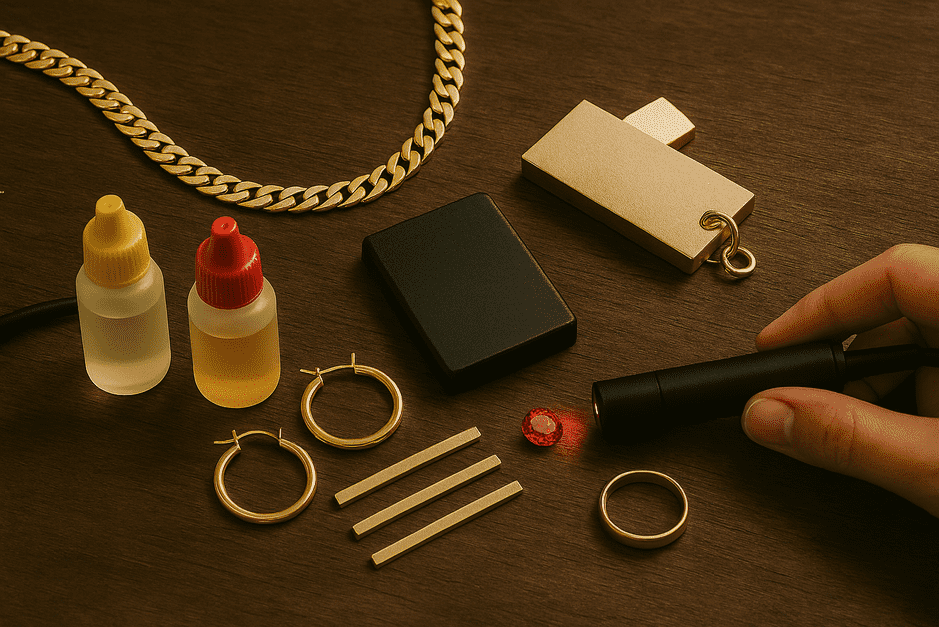
The jeweller rubs the piece on a black stone, leaving a streak.
Different acid solutions of known karat values are then applied.
If the streak remains the same, the purity matches the solution.
Example:
If your chain is marked as 22K, it should remain unchanged when tested against 22K acid.
This traditional test is still popular in small jewellery shops because it is quick, inexpensive, and fairly reliable.
Related reading: Understanding BIS Hallmark: What It Means for Your Jewellery
2. XRF (X-Ray Fluorescence) Machine
Modern gold testing uses XRF devices — small handheld scanners that analyze metal composition.
They give instant digital readings without scratching or damaging the jewellery.
Example:
An XRF scan can verify if a coin is truly 24K without using acid or removing material.
These machines are now common in hallmarking centers and top jewellery stores, ensuring transparency in every transaction.
3. Weighing and Density Check
Gold is weighed both in air and in water.
The difference in weight reveals its density.
Pure gold has a density of 19.3 g/cm³.
If the result is lower, it may indicate impurities or other metals mixed in.
This test helps spot hidden fillings or fake gold bars.
4. Hallmark Verification
A BIS hallmark is the official proof of purity in India.
Each hallmark includes the karat, hallmarking center, and year of marking.
Example:
A ring stamped “916” should confirm 22K purity when checked by an appraiser.
Always cross-check hallmarks through the BIS Care App — a government tool for consumers.
Why This Matters
Knowing how your gold is tested builds trust between you and your jeweller.
It ensures fair pricing, transparency, and confidence in every transaction.
Wouldn’t you feel more assured if the appraiser explained each step before testing your jewellery?
FAQ
1. Can XRF testing detect fake gold plating?
Yes, XRF can identify surface composition, but it may not detect deep plating layers.
2. Is acid testing safe for jewellery?
It’s safe for solid gold but may leave a small mark. For delicate pieces, XRF is better.
3. What does “916” mean on gold?
It represents 91.6% purity — equivalent to 22-karat gold.
4. Why is density testing important?
It helps confirm that gold hasn’t been mixed with cheaper or denser metals.