Introduction
As we step into 2026, the line between jewelry and technology is blurring. Synthetic Emeralds in Watches are no longer just cheap substitutes; they are becoming engineering marvels. Watch brands increasingly turn to these lab-created gems for their timepieces. For instance, companies prioritize consistent color and flawless clarity that nature simply cannot provide at scale.
However, a divide remains. Luxury houses often stick to mined stones for prestige, while modern innovators use synthetics for performance. In this article, we will explore why synthetics are dominating certain sectors of watchmaking. Additionally, as a Gem Expert, I will teach you how to distinguish a “Real Synthetic” from simple green glass.
Why Watch Brands Choose Synthetic Emeralds
Synthetic emeralds provide practical advantages over natural ones. First and foremost, they ensure uniform quality. Unlike natural stones, which are full of “Jardin” (inclusions/cracks), manufacturers can produce identical, flawless stones batch after batch.
Moreover, cost savings are significant. Natural emeralds from Colombia or Zambia command premium prices due to rarity. In contrast, lab-grown versions slash expenses by up to 80%. According to the GIA (Gemological Institute of America), this affordability allows designers to use Emeralds in places they never could before—like the entire watch case.
Ethical sourcing further boosts their appeal. Mining often involves environmental damage. Therefore, synthetics offer a conflict-free alternative. For more on this, check my guide on the Future of Lab-Grown Diamonds.
The “Structural” Argument: Why Nature Fails Here
As a Gemologist, I must highlight the physical reality. Natural Emerald is a Type III gemstone. This means it is naturally included and brittle. If you tried to carve a watch case out of a Natural Emerald, it would likely shatter under the pressure of the screws or a slight knock against a doorframe.
Consequently, Synthetic Emeralds (specifically Hydrothermal ones) are superior for structural use. They are grown slowly in a lab to remove internal stress. As a result, they retain the hardness of Beryl (7.5–8 Mohs) but gain the toughness needed to protect a watch movement.
Leading Brands Embracing Synthetics
Several watchmakers openly embrace these gems for different reasons.
The Innovators: Aventi
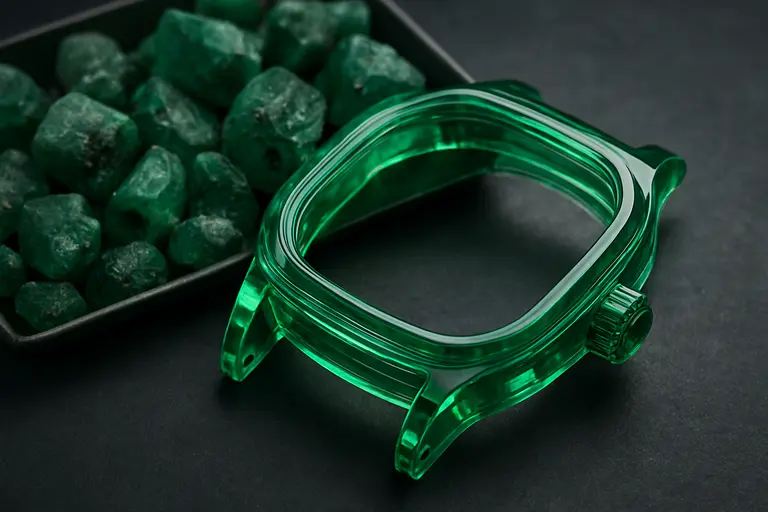
Take Aventi, for example. Their limited-edition pieces often feature cases carved from pure Synthetic Emerald crystals. Unlike a metal watch, these are translucent. You can see the movement through the green case. The brand highlights 100% clarity and full transparency about the lab process. This is “Tech Luxury.”
The Fashion Sector: Daniel Wellington & Fire-Boltt
Brands like Daniel Wellington (Iconic Link Emerald) and Fire-Boltt (Emerald Smartwatch) use the aesthetic of the emerald. However, a warning: In this segment, the term “Emerald” often refers to the Color, not the Material. Often, these are green mineral glass or Swarovski crystals. They deliver luxury looks at affordable prices but are not gemologically synthetic emeralds.
If you are buying a fashion watch, always check the specs. Read my guide on Jewelry Sales Secrets to learn how to read product descriptions.
Luxury Brands and the Natural Choice
On the other hand, high-end brands take a different path. Houses like Cartier, Chopard, Patek Philippe, and Audemars Piguet favor Natural Emeralds for their high-jewelry watches.
Why? Because their clients buy for Investment, not just durability. For example, a Patek Philippe bezel set with Colombian Emeralds showcases the unique “fingerprint” of the stones. However, even these houses are experimenting. They sometimes use synthetic sapphire crystals (for the glass) while keeping natural emeralds for the bezel. This blend balances tradition with innovation.
Comparison: Natural vs. Synthetic Emeralds in Watches
Let us summarize the differences for the buyer.
- Aesthetics: Synthetics lack inclusions. They appear more vibrant and “Electric Green.” Naturals have a softer, velvety glow due to the jardin.
- Durability: Both score 7.5–8 on the Mohs scale. Yet, synthetics resist fractures better due to controlled growth.
- Consistency: Matching 50 tiny emeralds for a bezel is a nightmare with natural stones (color matching is hard). With synthetics, it is easy.
- Price: Synthetics start at $50 per carat. Naturals can exceed $5,000 per carat.
Additionally, synthetics withstand watch environments—like pressure and humidity—better than oil-filled natural emeralds. Learn more about hardness in my Gemstone Buying Mistakes guide.
Conclusion: Function vs. Romance
Ultimately, the choice depends on your goal.
- Choose Synthetic: If you want a watch case made of gem material, or a perfectly matched bezel for daily wear. It is a triumph of science.
- Choose Natural: If you are buying a “Safe Queen” (a watch kept in a safe) for investment. It is a triumph of nature.
In summary, Synthetic Emeralds in Watches power the modern aesthetic. They allow us to wear the color of nature without the fragility of nature.
FAQ
Are synthetic emeralds in watches real emeralds?
Synthetic emeralds share the same chemical formula (Beryllium Aluminum Silicate with Chromium) as natural ones. However, they are lab-made, not mined.
Do luxury watches ever use synthetic emeralds?
Rarely in top-tier pieces (Patek/Rolex), as they prioritize the rarity of natural stones. But almost all brands use Synthetic Rubies inside the movement for bearings.
How do you spot synthetic emeralds in watches?
Check brand disclosures. If the stones are perfectly clear, neon-green, and look identical to each other, they are likely Lab-Grown. Natural emeralds almost always have visible flaws.
Are synthetic emeralds durable for watches?
Absolutely. They match natural hardness (7.5–8 Mohs) but are less prone to cracking because they lack internal fissures.
Why are synthetics cheaper?
There are no mining costs or scarcity premiums. Labs can produce them efficiently in weeks, whereas nature takes millions of years.
Author Bio
P.J. Joseph, also known as Saju Elizamma, Gemstone & Gold Consultant serving Kerala, Tamil Nadu, and Karnataka.