Introduction
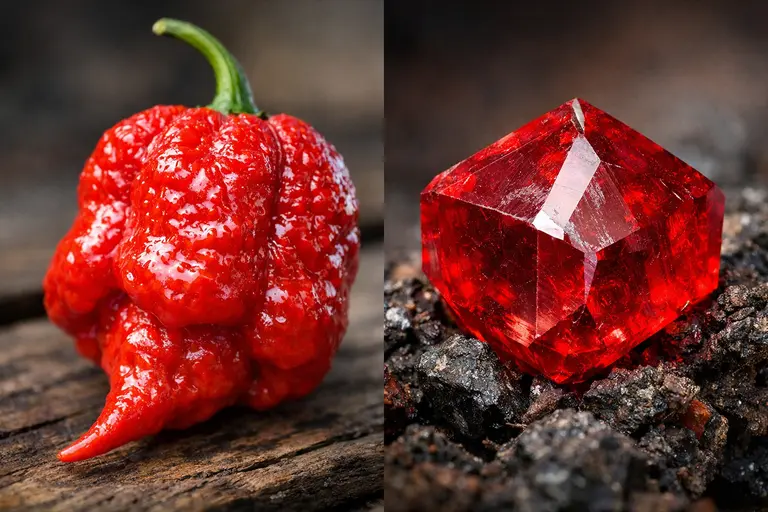
What do a rare gemstone mined deep in the earth and the world’s hottest chili pepper have in common? At first glance, absolutely nothing. Look more closely, however, and you will find that both the Rough Red Spinel and Carolina Reaper share one of the most vivid, saturated, and electrifying reds found anywhere in the natural world.
Furthermore, both carry a long history of mistaken identity, imitation, and costly surprises for the unprepared. As a Gemologist who also appreciates the fiery spice of Kerala cuisine, I find this comparison fascinating. One burns your wallet if you buy a fake; the other burns your tongue if you eat it. In this article, we will explore their origins, their shared visual language, and the practical knowledge every buyer needs before they get burned—literally or financially.
Origins of Spinel and Carolina Reaper
To begin with, let’s look at the birthplaces of these two red marvels.
The Pepper: A Lab Creation
The Carolina Reaper is a cultivar developed by breeder Ed Currie at the PuckerButt Pepper Company in South Carolina, USA. Currie crossed a Pakistani Naga pepper with a Red Habanero. The result? A fruit of extraordinary heat. The Guinness World Records certified it at 1.5 to 2.2 million Scoville Heat Units (SHU). To put that in perspective for Indian readers, our famous Kanthari Mulaku (Bird’s Eye Chili) is around 100,000 SHU. The Reaper is 20 times hotter.
The Gem: A Geological Miracle
Meanwhile, Red Spinel forms deep within the earth under extreme heat and pressure, typically inside metamorphic limestone. Geographically, the finest specimens historically come from the Mogok Valley in Myanmar (Burma). Miners recover rough Spinel crystals in octahedral form—a natural double-pyramid shape with sharp geometric points. This structure gave the stone its name: Spinella in Latin means “little thorn.” Therefore, one has a “Stinger Tail” (the pepper) and the other has “Thorns” (the gem).
Mistaken Identity: Spinel and Carolina Reaper
Interestingly, both Spinel and Carolina Reaper have histories filled with confusion and fraud.
Spinel’s Royal Impostor Past
For over five centuries, Red Spinel and Ruby were considered the same stone. Crucially, medieval kings had no tools to distinguish them. As a result, several of the most famous “Rubies” in royal collections turned out to be Spinels. The most celebrated example is the Black Prince’s Ruby—a 170-carat red stone sitting at the front of the British Imperial State Crown. Eventually, scientists identified it as a Spinel. Read more about gem history in my Madurai Meenakshi Temple Jewels post.
The Reaper’s Rise to Infamy
Similarly, the Carolina Reaper’s fame attracted imitators. Vendors began selling inferior seeds under the Reaper name. Buyers who paid premium prices for authentic seeds often grew mild, generic peppers instead.
Color Contrast in Spinel and Carolina Reaper
Both objects occupy a specific point on the color spectrum that separates them from ordinary reds. Most naturally red objects—tomatoes, red apples like the Kissabel Rouge—carry brownish or purplish undertones. However, the ripe Carolina Reaper and fine Red Spinel push past those undertones into a pure, high-chroma red.
In gemology, this quality is called “Electric Glow.” Why does it glow? Because of Chromium. Chromium absorbs green/blue light and re-emits it as a vivid red fluorescence. Remarkably, the glossy, blistered skin of the pepper produces a similar optical effect under sunlight, catching and concentrating light across its wet-looking surface.
How to Identify the Real Thing
Distinguishing authentic Spinel and Carolina Reaper from fakes requires specific knowledge.
Identifying Authentic Red Spinel
- Refractive Index: Specifically, Spinel has an RI of 1.712–1.736. It is Singly Refractive. Ruby is Doubly Refractive. A Gemologist can check this in seconds.
- Fluorescence: Natural Red Spinel shows strong red fluorescence under long-wave UV light.
- Inclusions: Natural rough Spinel often contains fine needle-like inclusions. Perfectly clean stones might be synthetic (Flame Fusion). Always demand a lab certificate from GIA or IGI.
Identifying Authentic Carolina Reapers
- Surface Texture: The skin is heavily blistered and wrinkled—almost volcanic. Smooth-skinned red peppers are not Reapers.
- The Stinger Tail: The Reaper has a distinctive pointed, curved tail at the base.
- Source: Crucially, purchase seeds or sauce only from verified suppliers linked to PuckerButt Pepper Company.
How an Uninformed Buyer Gets Burned
Unfortunately, ignorance is costly in both markets.
Burned by Spinel
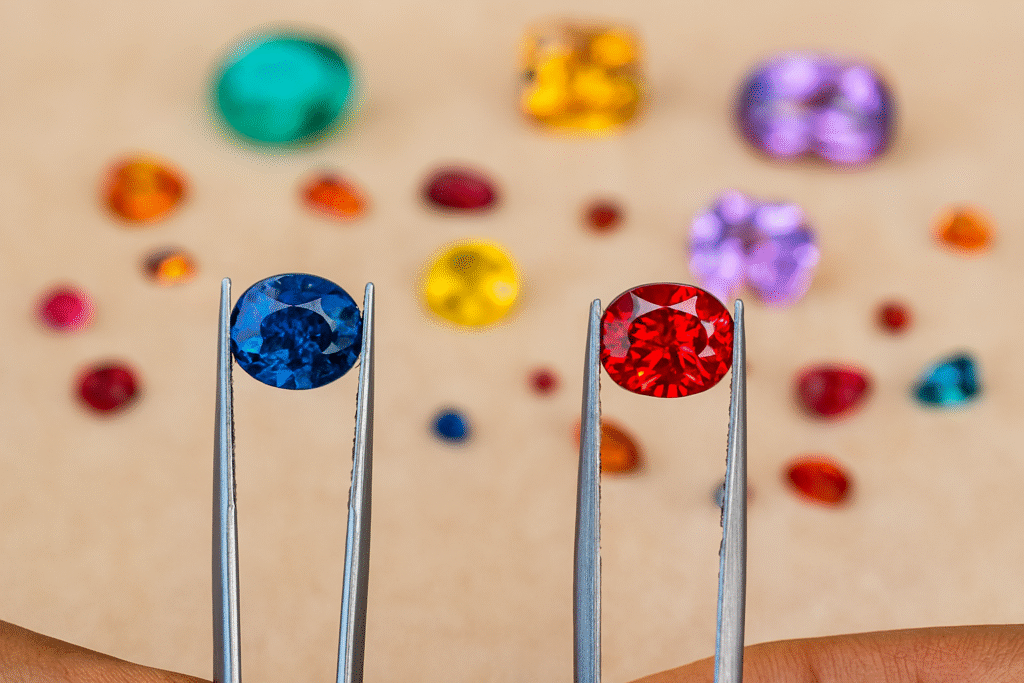
An uninformed buyer risks paying Ruby prices for Spinel. Even worse, they might pay Spinel prices for red glass. Without a lab certificate, a buyer has no reliable way to distinguish them by eye. Check my Gemstone Buying Mistakes guide for more tips.
Burned by the Reaper
Literally, touching a Reaper bare-handed and then touching your eyes causes intense burning that lasts for hours. Furthermore, eating one without preparation can cause vomiting and severe gastric distress. Therefore, always wear nitrile gloves when handling them.
Conclusion on Spinel and Carolina Reaper
In summary, nature rarely repeats itself, yet the comparison of Spinel and Carolina Reaper reveals a shared destination: a pure, dangerous red that commands respect. One crystallized under mountains over millions of years. The other ripened in a garden in a single summer. Ultimately, whether you are reaching for a gemstone or a pepper, the rule is the same: Handle with extreme care.
FAQ: Spinel and Carolina Reaper
Is Red Spinel rarer than Ruby?
Yes. Fine gem-quality Red Spinel is arguably rarer than fine Ruby. However, the gemstone market historically priced Ruby higher due to its fame. Consequently, today, top Spinels are catching up in price.
Can I grow a Carolina Reaper in India?
Yes. The Reaper grows well in warm, humid climates similar to Kerala. Ideally, it requires well-draining soil, consistent moisture, and full sun.
Why does Red Spinel glow so intensely?
Chromium traces in Spinel’s crystal structure absorb green and blue light and re-emit energy in the red wavelength range, producing a vivid, luminous glow (Fluorescence).
Is eating a Carolina Reaper dangerous?
It is not acutely fatal for a healthy adult, but it causes extreme physical distress. Therefore, people with heart conditions or digestive disorders should avoid it entirely.
What is the best way to relieve Reaper burn?
Dairy products like milk or yogurt. Chemically, the casein protein binds to capsaicin molecules and removes them from your nerve receptors. Water does not help.