Introduction
If you have ever admired the blazing oranges and golden yellows of a late-season garden, you already have a sense of what makes Sphalerite one of the most visually captivating gemstones in the world. Often called “Zinc Blende,” gem-quality Sphalerite shares a striking autumnal palette with two of the season’s most beloved flowers: the Chrysanthemum and the Marigold (Chendu Malli). Sphalerite vs Autumn Flowers represents a fascinating visual echo between the botanical and mineral kingdoms.
From its warm, fiery hues to its multifaceted brilliance, Sphalerite is nature’s answer to the seasonal splendor of blooms. As a Gemologist, I find this stone unique because it is one of the few gems that can outshine a diamond. In this guide, we explore the remarkable similarities between this rare gem and the iconic flowers of fall, along with everything you need to know about identifying, buying, and caring for it.
Color Palette of Sphalerite vs Autumn Flowers
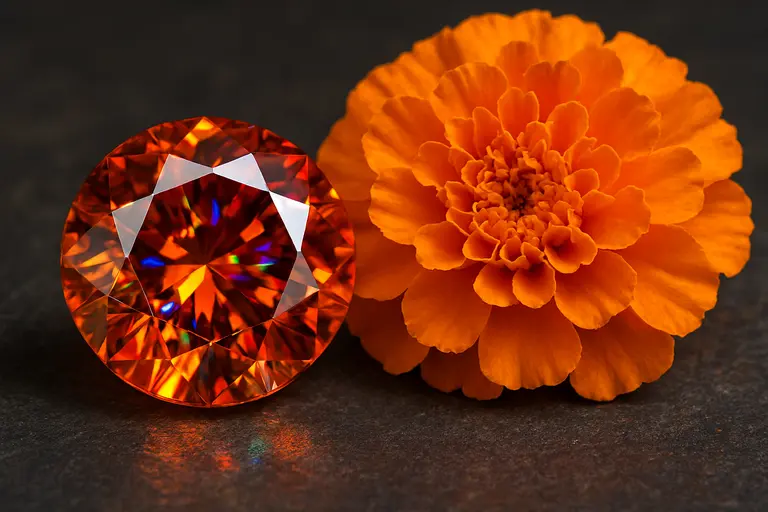
The most immediately obvious connection between Sphalerite vs Autumn Flowers is color. Both Chrysanthemums and Marigolds are celebrated for their rich spectrum of deep yellows, fiery oranges, and warm reddish-browns—the classic tones of the fall season.
The Gem Mirror
Remarkably, Sphalerite mirrors this palette almost perfectly.
- Golden varieties recall the bright face of a freshly bloomed Marigold.
- Deep Orange varieties echo the richest tones of an Autumn Chrysanthemum.
- Reddish-Brown specimens—sometimes called “Ruby Blende”—mimic the dried leaves of the season.
The Science of “Fire”
Furthermore, when a well-cut Sphalerite stone is held to the light, it produces what gemologists call “Fire” (Dispersion). In fact, Sphalerite’s dispersion is 0.156, which is three times greater than that of Diamond (0.044). This means each facet acts as a miniature prism, splitting white light into rainbows of red, green, and orange. This effect closely resembles the layered, ray-floret structure of a Chrysanthemum, where petal upon petal radiates outward in warm, overlapping waves of color. If you love colorful gems, compare this to Mandarin Fruit vs Mandarin Garnet.
Origins of Sphalerite vs Autumn Flowers
Interestingly, both autumn flowers and Sphalerite have fascinating geographic origins.
The Flowers
Chrysanthemums are native to East Asia, particularly China, where they have been cultivated for over 2,500 years. Marigolds, on the other hand, trace their roots to the Americas, where they were sacred to the Aztecs. In India, Marigolds are essential for festivals like Diwali and Onam, symbolizing the sun and positivity.
The Gemstone
Sphalerite, meanwhile, forms in hydrothermal mineral deposits, often alongside companion minerals such as Galena (Lead) and Quartz. The finest gem-grade specimens come primarily from the Picos de Europa Mountains in northern Spain, as well as from Bulgaria. Just as autumn flowers represent the peak of a seasonal cycle, Sphalerite forms over geological timescales under intense heat and pressure. It is a slow, dramatic transformation that ultimately yields breathtaking color. Read more about mining in my Panna Diamond Mining guide.
Identification of Sphalerite vs Autumn Flowers
Despite its beauty, Sphalerite has historically been a source of confusion for mineralogists. Its name is derived from the Greek word Sphaleros, meaning “Deceiving,” because it was so frequently mistaken for Galena (Lead Ore), which yields no zinc. Today, however, collectors identify it by several reliable characteristics.
- Luster: It displays a distinctive Resinous to Adamantine (diamond-like) luster. It looks “oily” but brilliant.
- Streak: When rubbed against unglazed porcelain, it leaves a brownish-white to pale yellow streak (due to Iron).
- Cleavage: It has perfect Dodecahedral Cleavage (six directions). This makes it very difficult to cut without shattering.
Consequently, a well-cut Sphalerite is a testament to the lapidary’s skill. For more on identification, consult my Gemstone Buying Mistakes guide.
Durability of Sphalerite vs Autumn Flowers
Like cultivated Chrysanthemums, which are delicate, Sphalerite is a fragile beauty. Durability is an important consideration for any prospective buyer.
Sphalerite ranks only 3.5 to 4 on the Mohs hardness scale. To put this in perspective, household dust contains quartz particles (Mohs 7). Therefore, simply wiping dust off a Sphalerite with a dry cloth can scratch it. As a result, this gem is best suited for Pendants, Brooches, or Earrings—jewelry that does not suffer impact. Think of it much like a cut flower—stunningly beautiful but requiring special care to preserve its best qualities. Compare this to the toughness of Synthetic Sapphire in Watches.
Buying Tips for Sphalerite vs Autumn Flowers
When shopping for Sphalerite, prioritize Color and Fire over carat size. Vibrant orange and reddish-orange stones command the highest prices. A well-cut, transparent stone will flash brilliant rainbow colors across its facets, especially in incandescent light (Candlelight).
Prices generally range from $20 to $200 per carat, making it an accessible collector’s stone. However, large, high-clarity specimens from Spain can exceed this range considerably. For care, clean Sphalerite gently with mild soap and lukewarm water. Avoid ultrasonic cleaners entirely, as vibrations can exploit the gem’s perfect cleavage and cause cracking.
Conclusion on Sphalerite vs Autumn Flowers
In summary, Sphalerite vs Autumn Flowers is a celebration of warmth. One blooms for a season, the other blooms forever in the dark. Ultimately, owning a Sphalerite is like capturing the sunset of autumn and freezing it in a crystal. It is the perfect stone for those who love the “Fire” of a diamond but want the “Soul” of a flower.
FAQ: Sphalerite vs Autumn Flowers
What causes the color in Sphalerite?
The color is primarily caused by Iron impurities replacing Zinc in the crystal lattice. Low iron makes it green/yellow; high iron makes it orange/red; very high iron makes it black (“Black Jack”).
Why is Sphalerite called “Zinc Blende”?
It is the primary ore of Zinc. The term “Blende” comes from the German word for “blind” or “deceiving,” reflecting its history of confusing miners.
How does Sphalerite’s fire compare to Diamond?
Sphalerite has 3x the fire. Its dispersion is 0.156 vs. Diamond’s 0.044. This means it splits light into rainbows much more aggressively than a diamond.
Where is the best Sphalerite found?
The Aliva Mine in the Picos de Europa mountains of Spain is famous for producing the world’s finest, large, transparent, gem-quality stones.
Is Sphalerite rare?
Gem-quality transparent Sphalerite is rare. While the mineral itself is common (as zinc ore), finding clear crystals suitable for faceting is a challenge for collectors.