Summary
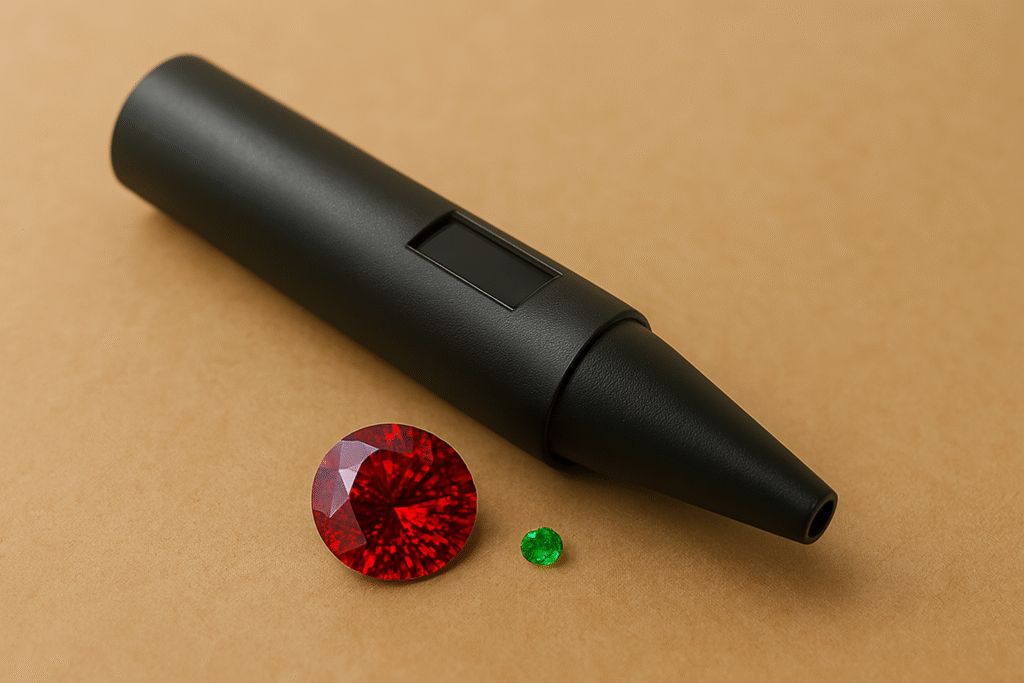
The spectroscope helps gemologists identify gemstones by analyzing how they absorb light.
This tool separates stones like ruby, spinel, garnet, and jadeite through unique absorption spectra.
Understanding these spectral lines makes gemstone identification faster, more reliable, and scientific.
Learn how to use a spectroscope in gemology. Discover how this simple tool separates rubies, garnets, spinels, and jadeite by revealing absorption spectra.
Introduction
In gemology, small instruments often deliver the biggest insights.
One such tool is the spectroscope — a compact device that reveals how gemstones interact with light.
Every gemstone absorbs and transmits specific wavelengths.
By observing these patterns through a spectroscope, you can identify natural stones, spot treatments, and detect imitations.
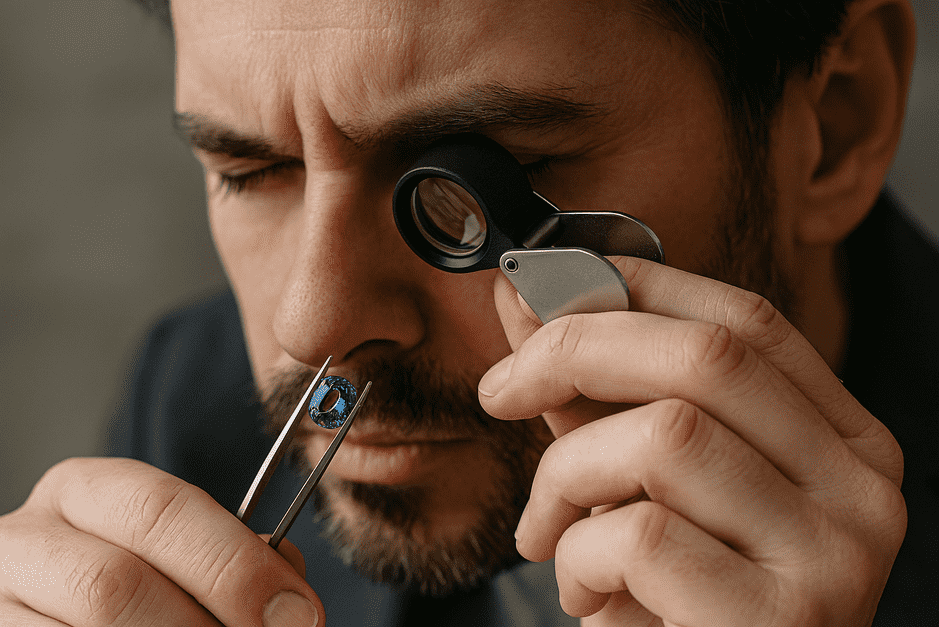
Whether you’re a professional gemologist or a curious learner, understanding how to use a spectroscope will strengthen your gem testing skills.
When combined with tools like the refractometer and gemological microscope, it offers a reliable way to confirm gemstone identity with precision.
Spectroscope: A Simple Tool with Powerful Results
The spectroscope is one of the most compact and useful instruments in gemology.
You only need a portable, concentrated light source to make it work.
With a spectroscope, you can:
- Separate red garnets from rubies and red spinels
- Distinguish synthetic blue spinel from aquamarine and blue zircon
- Tell dyed jadeite from natural chrome-colored jadeite
For beginners, it’s one of the easiest ways to start understanding gemstone optics.
You can also read more about other essential tools, like the gemological microscope and refractometer for complete gem testing.
How the Spectroscope Works
The spectroscope splits white light into its component colors — red, orange, yellow, green, blue, and violet.
There are two main types:
- Prism spectroscope – uses prisms to disperse light
- Diffraction grating spectroscope – more affordable, uses etched lines (up to 1000 per millimeter)
Although multiple spectra may appear, you only observe the strongest and clearest spectrum.
For deeper study, visit GIA’s educational guide on gemstone spectroscopy.
Why It Matters in Gemology
When light passes through or reflects from a gemstone, the stone absorbs certain wavelengths.
The spectroscope spreads this light into spectral colors, showing dark absorption lines or bands.
Each gemstone has a unique absorption spectrum, like a fingerprint.
That makes the spectroscope a reliable tool for gemstone identification — especially when combined with a refractometer and dichroscope.
What You Need for Proper Viewing
A concentrated light source is essential.
A pocket torch or fiber-optic light with a focused beam gives clear results.
Hold the stone close to the spectroscope and align the light carefully.
You’ll soon learn to recognize characteristic spectra — such as ruby’s chromium lines or garnet’s broad absorption zones.
Questions to Ask Yourself
- Can you identify the absorption lines in a ruby versus a garnet?
- Have you compared the spectra of natural jadeite and dyed jadeite side by side?
- Is a torch part of your gem kit for accurate results?
With regular observation, your eyes will start to memorize these spectral signatures.
FAQ
1. What does a spectroscope show in a ruby?
A ruby shows sharp absorption lines caused by chromium, especially in the green region of the spectrum.
2. Can I use a spectroscope without a darkroom?
Yes. A handheld spectroscope with a strong, focused light source works in normal room light.
3. Which is better — prism or diffraction type?
Both are useful. Diffraction spectroscopes are cheaper and easier to handle for field gemology.
4. Why is a spectroscope important for gem testing?
It reveals absorption spectra that help distinguish similar-looking gemstones, such as ruby vs red spinel.
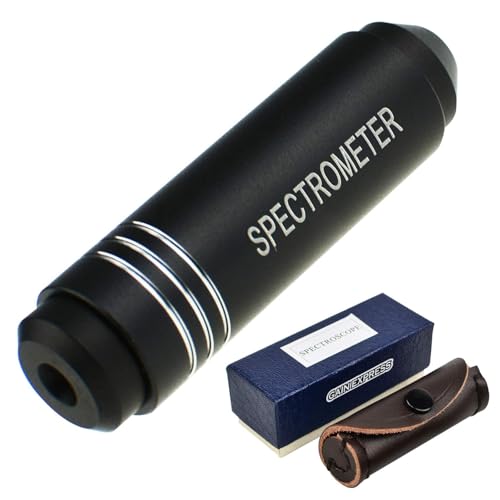
- Material Aluminum (Durable)
- Item Weight: 1.41 ounces
- Made of aircraft aluminum and finest optics