Introduction
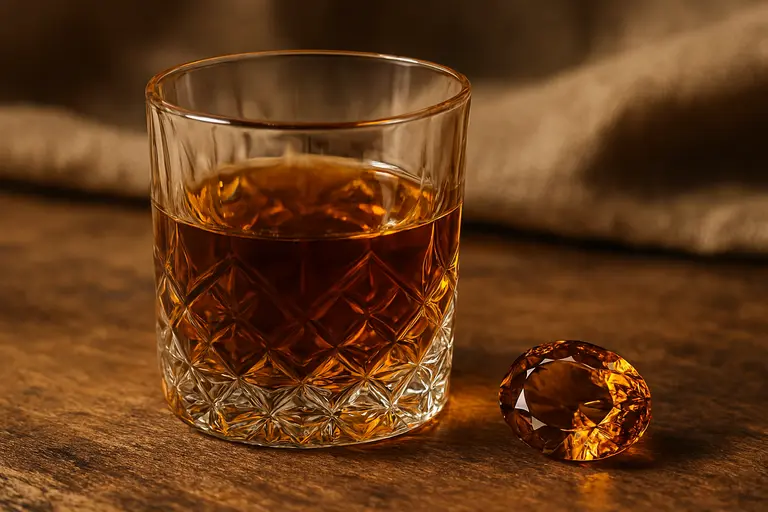
Imagine sitting on a veranda in Colombo as the sun sets. In your hand is a glass of amber liquid; on your finger is a ring glowing with a golden-brown stone. Sinhalite and Ceylon Arrack both emerge from Sri Lanka’s rich heritage, captivating enthusiasts with their warm, honeyed tones.
One is a rare mineral, named after “Sinhala” (the Sanskrit word for Sri Lanka). The other is a traditional spirit distilled from the sap of the coconut flower. Surprisingly, they share a striking “golden-brown” spectrum. Moreover, their visual similarities extend beyond aesthetics, inviting unique pairings in jewelry storytelling and cultural experiences. As a certified gemologist who appreciates the finer things in life, I see a harmony here. In this article, we will explore these overlaps. Therefore, whether you are a gem collector or a fan of fine spirits, discover how these treasures harmonize.
Shared Color Profiles: The Golden Spectrum
To begin with, the connection is visual. Sinhalite and Ceylon Arrack align closely in their palette.
Golden Yellow Hues
High-quality Sinhalite frequently displays a vibrant Golden-Yellow hue. This mirrors the bright, sun-kissed glow of a young, premium Ceylon Arrack. For example, top-grade Sinhalite from Ratnapura sparkles with this lively tone under light. Similarly, Arrack’s distillation process yields a comparable brilliance. Therefore, pairing a golden Sinhalite ring with a glass of Arrack creates a seamless sensory match—a celebration of the island’s“Gold.”
Honey and Amber Tones
Next, both treasures often exhibit Honey or Amber tones. Sinhalite appears in transparent honey-yellow to light brown grains. It is prized for its Vitreous (glass-like) luster. On the other hand, Ceylon Arrack gains its natural amber-gold from aging in Halmilla wood casks. This process infuses subtle vanilla notes, paralleling the gem’s warm translucency. If you enjoy comparing colors, check my guide on the Tourmaline Color Palette.
Rich Brown Depth
Finally, deeper variations seal their kinship. Rich brown or “Chocolate” Sinhalite resembles the darker, concentrated shades of well-aged Arrack (Old Reserve). Consequently, both convey earthy luxury. These intense hues arise from Iron impurities in the mineral and wood tannins in the spirit.
Origins of Sinhalite and Ceylon Arrack
Furthermore, Sri Lanka serves as the pivotal origin for both treasures.
The Stone: A Case of Mistaken Identity
Sinhalite has a fascinating history. For centuries, gemologists mistook it for Brown Peridot. However, in 1952, gemologists realized it was a completely new mineral (Magnesium Aluminum Borate). Because miners found it only in Sri Lanka, experts named it Sinhalite. Thus, it is a stone that carries the identity of the nation in its very name. You can read about other Sri Lankan discoveries in my post on Nil Manel and Taaffeite.
The Spirit: The Sap of the Coconut
Meanwhile, Ceylon Arrack traces its roots back thousands of years. Locals make it from the sap of the unopened coconut flower. In Kerala, we know this sap as Neera or Kallu (Toddy). But in Sri Lanka, they mastered the art of distilling and aging it into a refined spirit. Just as Sinhalite is mined from the earth of Ratnapura, Arrack is tapped from the “Kalpavriksha” (Coconut trees) of the coast.
Rarity of Sinhalite and Ceylon Arrack
Rarity elevates both to prized status.
Sinhalite stands out as a collector’s gem. Experts estimate that fine, clean stones are scarce. For example, while you can find Peridot easily, finding a 5-carat clean Sinhalite is a challenge. Consequently, it commands respect in the gemological community.
Likewise, authentic Ceylon Arrack is gaining global status. Unlike molasses-based rums, pure Coconut Arrack is labor-intensive (tappers must climb trees daily). Therefore, both are “Slow Luxury.” One takes millions of years to form, the other takes human agility and years of aging.
Cultural Significance of Sinhalite and Ceylon Arrack
Finally, Sri Lankan culture weaves deep meaning into both.
- The Gem: Sinhalite represents the geological wealth of the “Island of Gems” (Ratna-Dweepa).
- The Spirit: Arrack represents the hospitality of the island.
For the collector, wearing a Sinhalite gemstone is a nod to knowledge. It shows you know your stones beyond the “Big Three” (Ruby, Sapphire, Emerald). In comparison, serving Ceylon Arrack shows you appreciate heritage spirits over commercial whiskey. For more on pairing gems with lifestyle, read my Water Tasting vs Diamond Grading article.
Conclusion: A Toast to Heritage
In summary, Sinhalite and Ceylon Arrack are the perfect pairing. They share a color palette of gold, amber, and brown. They share a home in Sri Lanka. And they share a story of discovery and refinement. Ultimately, whether you wear the stone or sip the spirit, you are enjoying the warm soul of the tropics.
FAQ: Sinhalite and Ceylon Arrack
What makes Sinhalite so rare?
Sinhalite was only identified as a distinct mineral in 1952. Before that, it was confused with Peridot. Its primary deposits are almost exclusively in Sri Lanka, making supply limited.
How is Ceylon Arrack produced?
Distillers create it from the fermented sap (Toddy) of the coconut flower. Crucially, producers age the spirit in Halmilla wood vats, which gives it the signature golden color that matches Sinhalite.
Can you pair Sinhalite jewelry with Arrack?
Absolutely. The warm golden tones of the gem complement the amber liquid perfectly. It is a sophisticated theme for a tasting event or a gentleman’s gathering.
Is Sinhalite durable for jewelry?
Moderately. It has a Mohs hardness of 6.5. Therefore, it is suitable for pendants or earrings, but rings should be worn with care to avoid scratching.
Where can I buy authentic Sinhalite?
Seek certified sources like Sri Lankan miners in Ratnapura or reputable dealers. Always verify with a lab report to ensure it is not Brown Peridot or Zircon.
Author Bio
P.J. Joseph, also known as Saju Elizamma, Gemstone & Gold Consultant serving Kerala, Tamil Nadu, and Karnataka.