Introduction
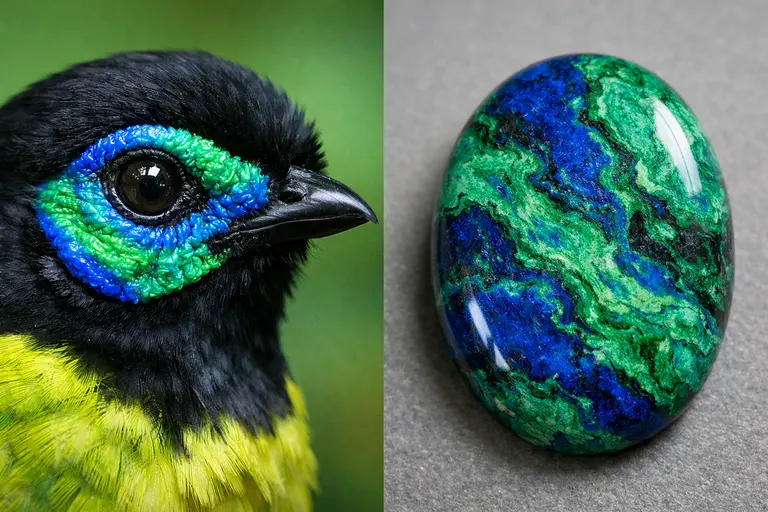
Nature rarely repeats itself—but when it does, the result is breathtaking. The comparison of Schlegel’s Asity and Azurite-Malachite is a perfect example of this phenomenon. The male Schlegel’s Asity (Philepitta schlegeli), a rare bird from Madagascar’s western dry forests, displays a face adorned with vivid blue and green wattle skin. Strikingly, this mirrors the swirling hues of Azurite-Malachite, one of the most visually stunning mineral combinations on Earth.
Both the bird and the stone share an almost identical palette of deep cobalt blues and vibrant emerald greens. This is remarkable given that one is living tissue and the other is ancient geology. As a Gemologist who loves exploring the natural world, I find this overlap fascinating. In this article, we will explore the color similarities, origins, and identification methods that connect these two natural wonders. Ultimately, understanding these links enriches our appreciation for both biology and mineralogy.
Color Similarities of Schlegel’s Asity and Azurite-Malachite
To begin with, let’s look at the visual impact.
The Bird’s Neon Face
The male Schlegel’s Asity produces one of the most vivid displays in the avian world. During breeding season, males develop striking bare-skin wattles around their eyes. These showcase vibrant turquoise-green and apple-green tones, alongside a bold cobalt-blue band that passes directly through the eye. Consequently, this luminous facial display contrasts sharply against a black crown and a bright yellow breast, making the bird instantly recognizable.
The Stone’s Swirling Canvas
Similarly, Azurite-Malachite (also called “Azurmalachite“) is a naturally occurring mixture of deep blue Azurite and vivid green Malachite. Together, they form intricate, swirling, and banded formations. Notably, the glowing, multi-tonal quality of the bird’s eye wattles closely resembles the smooth, polished nodules of the mineral. Both display that same electrifying balance of cool blue and warm green. If you love colorful comparisons, read my guide on Blue Honeysuckle vs Benitoite.
Colors of Schlegel’s Asity and Azurite-Malachite
However, the science behind the colors is completely different.
The Wattle (Biological Color)
Unlike most colorful birds (which derive their hues from feather pigmentation), the male Schlegel’s Asity produces its colors through bare, highly vascularized skin. Specifically, during the rainy season, the wattle swells with blood and fluid. The blue and green are actually “Structural Colors” caused by collagen arrays scattering light. Therefore, it serves a direct evolutionary purpose—signaling health to potential mates. Once the breeding season ends, the wattle fades considerably. It is a temporary spectacle.
The Mineral (Chemical Color)
On the other hand, Azurite and Malachite both form in the oxidized zones of copper ore deposits. Groundwater, carbon dioxide, and copper minerals react over thousands of years. First, Azurite forms, producing the deep blue tones. Over time, however, Azurite absorbs additional water molecules and chemically transforms into Malachite, producing the green color. This makes Malachite a “Pseudomorph”—it literally eats and replaces the Azurite. When these two minerals intergrow before the conversion is complete, they produce Azurmalachite. It freezes this chemical battle in stone.
Identifying Schlegel’s Asity and Azurite-Malachite
Identifying both the bird and the mineral requires a trained eye.
Spotting the Bird
Birders can identify the male Schlegel’s Asity by looking for the vivid green and blue eye wattle on a black-headed bird with yellow underparts. According to the Cornell Lab of Ornithology, this species is endemic only to Madagascar. Thus, any sighting in the wild is genuinely rare.
Spotting the Stone
Collectors identify Azurite-Malachite through several physical properties:
- Pattern: It displays deep blue zones intergrown with banded green (often grape-like botryoidal shapes).
- Hardness: Crucially, both minerals are very soft. They rate only 3.5 to 4 on the Mohs Scale.
- Acid Test: Real malachite effervesces (fizzes) visibly when exposed to dilute hydrochloric acid due to its carbonate chemistry. Warning: Do not do this test on finished jewelry! Read my Gemstone Buying Mistakes guide for safe testing.
Jewelry Uses: Schlegel’s Asity and Azurite-Malachite
Because of its dramatic coloration, jewelers prize Azurmalachite.
However, its softness dictates its use. Ideally, artisans cut it into cabochons for pendants or earrings. If you set it in a ring, the stone will scratch and chip very quickly under daily wear. Furthermore, many designers use minimal Sterling Silver settings to let the natural swirls remain the centerpiece. This “Earthy” style is very popular in modern Bohemian jewelry, similar to the appeal of Best Petrified Wood.
Buying and Care Tips
Whether you are buying jewelry or a raw specimen, follow these rules:
- Keep it dry: Water can accelerate the chemical conversion of Azurite into Malachite. It will turn green over time if kept wet.
- No chemicals: Never use ultrasonic cleaners or harsh soaps.
- Spot fakes: Dyed Howlite and synthetic resin often imitate this stone. Real stones have irregular, natural banding, not uniform paint lines.
Conclusion on Schlegel’s Asity and Azurite-Malachite
In summary, the comparison of Schlegel’s Asity and Azurite-Malachite proves that the Earth has a favorite color palette. Whether it uses collagen in a bird’s skin or copper in a rock, nature knows how to create a masterpiece. Ultimately, protecting the forests of Madagascar and sourcing gems ethically ensures these wonders survive for the next generation.
FAQ: Schlegel’s Asity and Azurite-Malachite
Is Azurite-Malachite a single mineral?
No. It is technically a rock composed of two distinct minerals—Azurite (Blue) and Malachite (Green)—that naturally intergrow in the same copper deposit.
Why does the male Schlegel’s Asity have colored bare skin?
The bird evolved bare skin wattles because the colors can change rapidly in intensity with blood flow. Consequently, this gives females a real-time signal of the male’s current health and fitness.
Can Azurite-Malachite go in water?
No. Prolonged exposure to moisture can cause the blue Azurite to slowly alter into green Malachite. Always wipe the stone with a dry cloth and store it in a dry place.
Where can I find legitimate Azurite-Malachite?
Typically, reputable mineral dealers and certified jewelry retailers are your safest options. Famous, high-quality specimens often come from the Bisbee Mine in Arizona or the Democratic Republic of Congo.
Is the Schlegel’s Asity endangered?
Currently, the IUCN Red List categorizes it as “Least Concern.” However, habitat loss and deforestation in Madagascar’s western dry forests remain an ongoing threat to the species’ long-term survival.