Introduction
The concept of Sacred Geometry in Bharatanatyam and Gem Cutting proves that geometry shapes both movement and matter. In the classical Indian dance form of Bharatanatyam, geometry flows through the human body. Similarly, in the lapidary arts, geometry controls how light behaves inside a precious stone.
At first glance, these disciplines seem entirely unrelated. One is a performing art set to music; the other is a microscopic science executed with diamond saws. However, both depend entirely on precision, symmetry, and balance. Therefore, this article explains how dancers and gem cutters use geometry to create meaning and beauty. In addition, by exploring Sacred Geometry in Bharatanatyam and Gem Cutting, I will show how the visual language of dance helps us understand the complex architecture of gemstones more clearly.
The Body in Sacred Geometry in Bharatanatyam and Gem Cutting
To begin with, Bharatanatyam treats the human body as a structured, almost crystalline system. In other words, every movement follows a clear geometric discipline.
Core Geometric Elements
First, the triangle (Trikona) forms the foundation of the dance. The Araimandi (half-seated) posture creates a stable, heavy triangular base. As a result, the dancer achieves perfect balance and control, much like the pavilion (bottom) of a well-cut diamond anchors its weight.
Next, linear alignment plays a key role. The arms extend in straight 180° lines, while at the same time, the torso aligns with a central vertical axis. Finally, circular movement adds flow. Spins and transitions follow controlled circular paths. Therefore, the dancer creates a moving geometric form that commands space. For deeper cultural understanding, you can refer to ancient texts like the Natya Shastra.
Diamonds and Sacred Geometry in Bharatanatyam and Gem Cutting
Transitioning from the stage to the jeweler’s bench, Diamond cutting is based entirely on optical precision. Unlike dance, where the goal is expression, here the goal is the “Critical Angle.” Therefore, even microscopic changes in angles dictate whether light escapes out of the bottom or reflects to the eye.
Structure and Proportion
The Round Brilliant Diamond remains the most common cut. It typically features 57 or 58 facets arranged with perfect radial symmetry. Historically, mathematician Marcel Tolkowsky influenced modern proportions in 1919. However, today’s “Ideal Cut” follows a range of acceptable angles verified by institutions such as the GIA (Gemological Institute of America).
As a result of this strict geometry:
- Well-cut diamonds look bright and lively (Brilliance and Fire).
- Poorly cut diamonds look dark or dull (Extinction).
Colored Stones: Sacred Geometry in Bharatanatyam and Gem Cutting
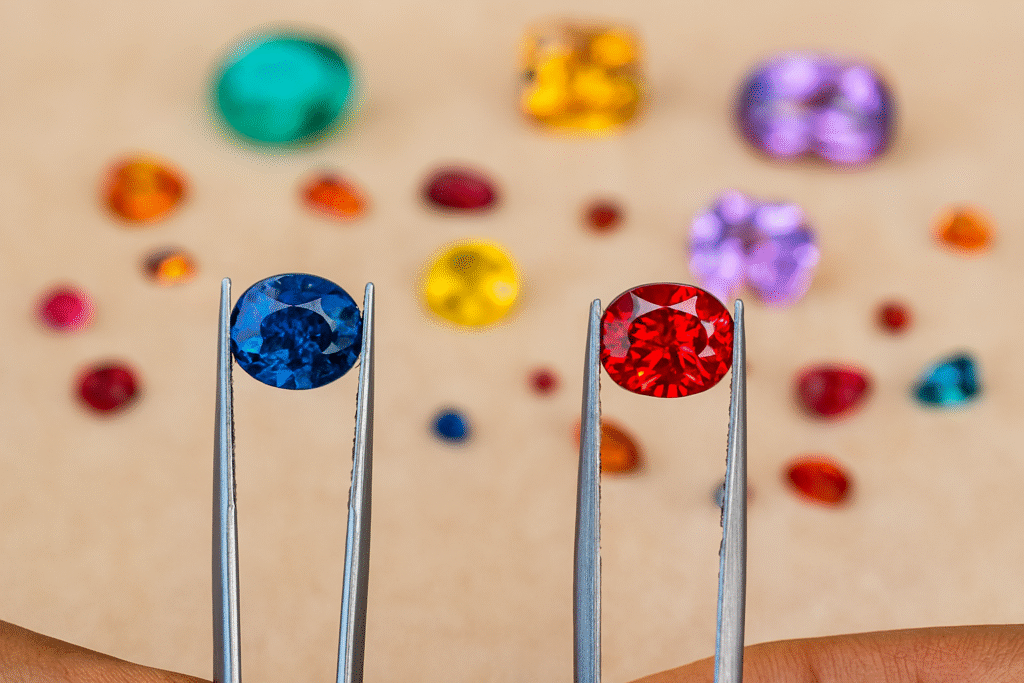
Colored stones, however, follow a very different approach. Unlike diamonds, they do not adhere to a universal cutting standard.
Why? Because cutters prioritize Color over Sparkle. For example, stones such as Sapphire and Ruby require careful handling. The cutter must analyze the natural crystal shape and internal inclusions (flaws).
- First, cutters may use “Mixed Cuts” (brilliant crowns and step-cut pavilions) to balance brilliance and deep color.
- Next, “Step Cuts” highlight clarity and depth. In addition, cutters adjust proportions to avoid “Windowing” (see-through areas in the center). Therefore, colored stone cutting is flexible and adaptive, much like a dancer improvising a routine. Read more about this in my Colored Stone Grading guide.
Mudras and Gem Cuts: Visual Parallels
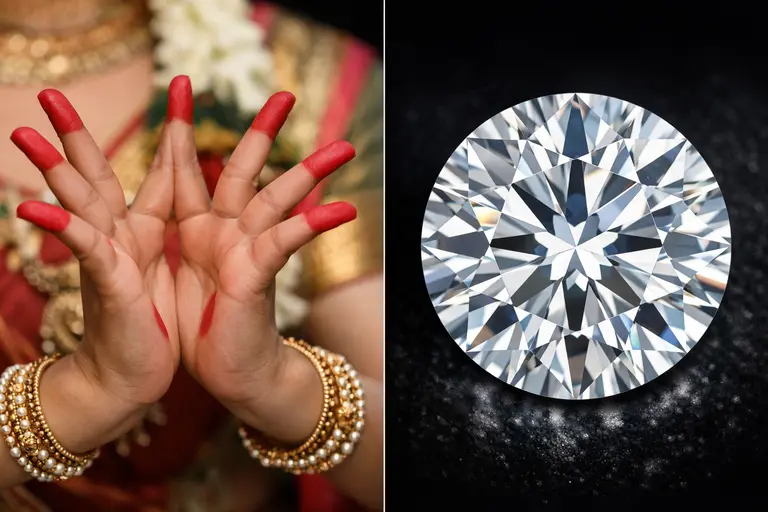
What makes Sacred Geometry in Bharatanatyam and Gem Cutting so fascinating are the visual parallels between hand gestures (Mudras) and facet patterns. While these comparisons are symbolic rather than technical, they help us visualize the cuts.
Emerald Cut and Tripataka Mudra
The Emerald Cut features long, parallel, rectangular facets (Step Cut). As a result, it emphasizes structural clarity rather than chaotic sparkle. Similarly, the Tripataka mudra shows structured, tight finger alignment with three fingers held straight. Therefore, both forms reflect order, calmness, and stability.
Marquise Cut and Katakamukha Mudra
The Marquise Cut has an elongated shape with two pointed ends. Consequently, it appears larger and more prominent on the finger. In comparison, the Katakamukha mudra forms a curved, pointed opening (like a bird’s beak). Thus, both share a similar visual outline characterized by sharp elegance.
Expansion via Sacred Geometry in Bharatanatyam and Gem Cutting
Furthermore, let’s look at how geometry expresses energy.
Alapadma Mudra and The Rose Cut
Alapadma represents a fully opened lotus flower. The fingers spread outward to create a circular, expansive shape. Likewise, the antique Rose Cut diamond has triangular facets that rise from a flat base into a dome. As a result, it produces a soft, widespread glow instead of a sharp sparkle. Therefore, both forms express expansion and openness.
Princess Cut and Suchi Mudra
The Princess Cut has a square shape with sharp, 90-degree corners. Consequently, it produces intense, concentrated brilliance. In the same way, the Suchi mudra uses a single, sharply pointed finger. Therefore, both create a sense of intense direction and sharp focus.
Conclusion on Sacred Geometry in Bharatanatyam and Gem Cutting
In summary, the comparison of Sacred Geometry in Bharatanatyam and Gem Cutting proves that beauty follows rules. On one hand, Bharatanatyam expresses spiritual meaning through moving geometry. On the other hand, gem cutting controls physical light through static geometry.
Even so, both rely heavily on symmetry, precision, and alignment. Ultimately, geometry connects the art of the dancer with the science of the jeweler in a powerful, universal way. You can read more about how Indian culture values jewelry in my Indian Wedding Rings guide.
FAQ: Sacred Geometry in Bharatanatyam and Gem Cutting
Is there a direct link between Bharatanatyam and gem cutting?
No. There is no historical or technical link between the two. However, the metaphorical comparison helps explain the visual similarities and the shared human desire for symmetry.
Why is symmetry important in diamonds?
Symmetry allows light to enter the stone, bounce off the internal facets, and return properly to the viewer’s eye. As a result, a symmetrical diamond appears significantly brighter.
Why are colored stones cut differently than diamonds?
Cutters focus on maximizing color weight rather than just light return (sparkle). Therefore, each rough stone requires a custom approach to hide inclusions or enhance a specific hue.
Are lotus-style diamond cuts standard?
No. While some modern diamond brands use extra facets to create “floral” or “lotus” patterns inside the stone, these are proprietary or niche variations, not standard industry cuts.
Which gem cut is most difficult?
The Heart Cut is one of the most challenging. This is because both halves of the cleft (the lobes) must match perfectly. Even microscopic errors destroy the symmetry.