
Summary
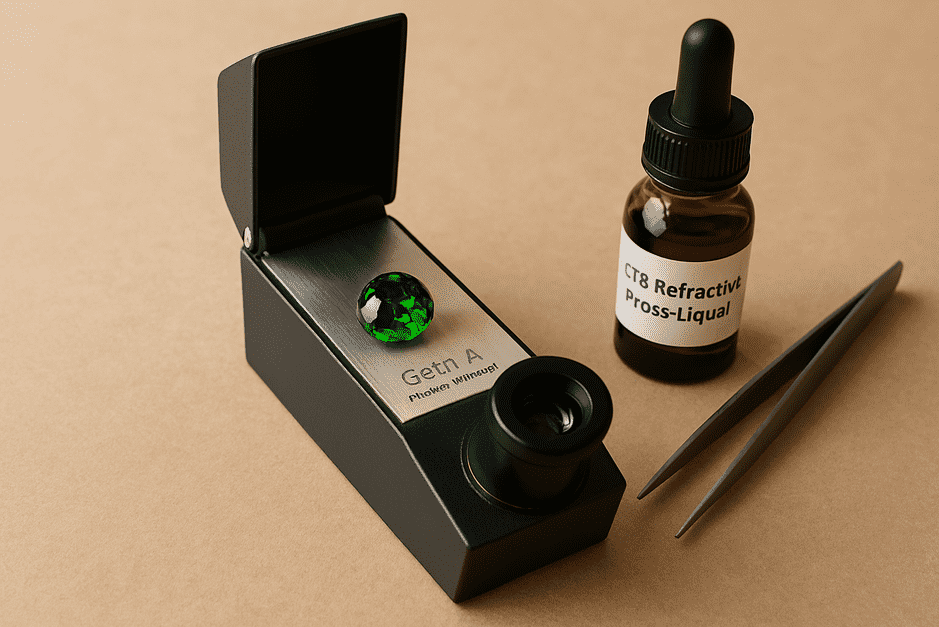
A refractometer measures a gemstone’s refractive index using total internal reflection. It’s a quick, non-destructive, and accurate test in gemology. You’ll need a clean surface, contact liquid, and proper setup for reliable results. Flat surfaces reveal optic properties; curved surfaces provide mean R.I. values.
Introduction
A refractometer is one of the most important tools in gemology. It measures the refractive index (R.I.) of gemstones — a property that helps gemologists identify stones quickly and accurately.
Learning how to use a refractometer correctly ensures you get consistent, reliable readings during gemstone examination.
How a Refractometer Works
A refractometer works on the principle of total internal reflection. Light enters a gemstone and bends at a specific angle, which the instrument converts into an R.I. value.
This measurement is non-destructive, fast, and one of the most dependable tests for gemstone identification. You can read more about gemstone testing tools in our gemological microscope guide.
For deeper theoretical insights, see GIA’s resource on how refractive index helps identify gems.
Requirements for Accurate R.I. Measurement
For correct and repeatable readings, you need:
- Optical contact between the gemstone and the prism
- A clean, polished surface
- The right contact liquid
- The stone’s R.I. within the instrument’s range
- Light moving from a denser to a rarer medium
Always ensure both the stone and prism are spotless before testing. Even a fingerprint can distort readings.
Limits of the Refractometer
A refractometer’s upper limit depends on:
- The refractive index of the prism
- The R.I. of the contact liquid
Most commercial gem refractometers have a limit of 1.81, while modern contact liquids can lower it slightly to 1.79. This limit means very high R.I. stones (like diamond) cannot be measured directly.
What You Can Learn from a Refractometer
From flat surfaces, you can determine:
- Single or double refraction (S.R./D.R.)
- Birefringence
- Optic character (uniaxial or biaxial)
- Optic sign (positive or negative)
From curved surfaces (distant vision method), you can find only the mean R.I. — still useful for quick screening.
Why It Matters
If you work with gemstones, a refractometer can save you time and reduce identification errors. It gives repeatable, quantitative data and often reveals what visual observation alone cannot.
You can also pair it with a 10x loupe for surface clarity checks — see our post on how to use a loupe for gemstone examination.
FAQ
Q: What is the refractive index range of most gemstones?
A: Most transparent gems fall between 1.40 and 1.81 R.I., which is within a standard refractometer’s limit.
Q: Can I test rough stones with a refractometer?
A: No, rough surfaces won’t give optical contact. You need at least one polished facet.
Q: Why use contact liquid?
A: It removes air gaps between the prism and gemstone, ensuring accurate light transmission.

- 【Function】 The refractometer can quickly and accurately identify a variety of single and double , helping to identify , …
- 【What You Get】 1 x Portable Refractometer-1 x Flashlight-1 x Refractive Oil-1 x Box-1 x User Manual
- 【Widely Used】 Great for single and double , , and colored