Introduction to Purple Fluorite and Costa’s Hummingbird
Have you ever spotted a color so vivid that it makes you stop and stare? The electric purple of Purple Fluorite and Costa’s Hummingbird does exactly that. Even though one soars through scorching desert skies and the other sits in a quiet collector’s display case, these two natural wonders share a striking resemblance. Specifically, their shared violet hues captivate nature lovers and gem enthusiasts alike. In this guide, you will learn where they come from, how their colors work, and what fakes to watch out for. Consequently, you will understand how to shop for minerals or birdwatch with confidence. You should also read our guide on gemstone buying basics to understand how quality standards apply to any natural treasure.
The Color Connection of Purple Fluorite and Costa’s Hummingbird
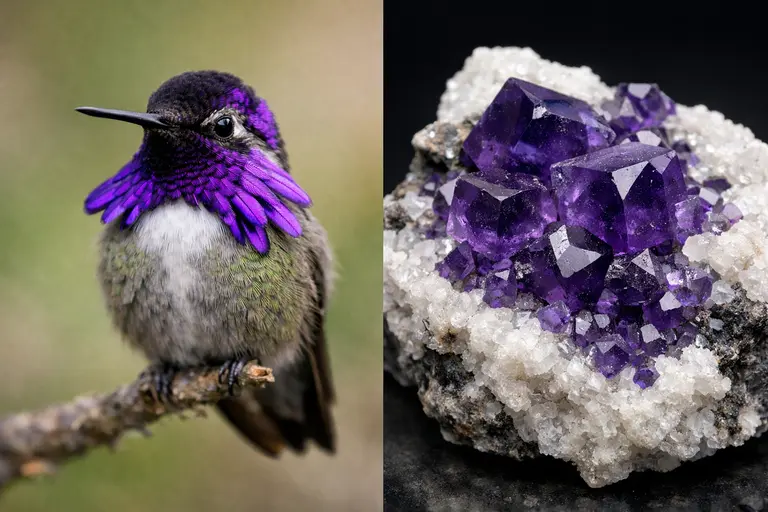
First, let us explore what makes both of these purple treasures so eye-catching. The male Costa’s Hummingbird wears a brilliant violet-purple throat patch called a gorget. In the shade, this patch can look almost black. However, when sunlight hits it directly, that gorget explodes into a glowing, jewel-like purple. Furthermore, the bird sports a violet cap, which makes its head look like it is wearing a tiny, royal crown.
Purple Fluorite and Costa’s Hummingbird pull off a similar trick in natural light. The deep purple crystals sit boldly against white quartz, creating a sharp and beautiful contrast. Specifically, the vivid purple color in the fluorite results from natural radiation exposure deep inside the Earth. These color centers formed over millions of years, allowing the crystal to absorb specific wavelengths of light. Additionally, when you hold a piece under UV light, the crystals often glow. Interestingly, fluorite most commonly fluoresces blue rather than purple. As a result, the resemblance between the bird and the stone genuinely surprises everyone who sees them side-by-side.
Natural Origins of Purple Fluorite and Costa’s Hummingbird
Now that you understand why they look alike, it helps to know where each one originates. Costa’s Hummingbird lives in hot, dry landscapes across the southwestern United States and northwestern Mexico. Specifically, it calls the Sonoran and Mojave Deserts home. During breeding season, males defend small territories among scrubby bushes and cacti. They survive by hovering efficiently near desert flowers to sip nectar. For detailed maps of their habitat, visit the Cornell Lab of Ornithology’s All About Birds site.
Purple Fluorite and Costa’s Hummingbird also share a connection to rugged terrains. While the bird thrives in the desert, purple fluorite forms deep underground. Currently, some of today’s most prized specimens come from China’s Huanggang Mine complex in Inner Mongolia. Hot, mineral-rich fluids interact with surrounding rock to produce these vivid crystals. Interestingly, the rocky terrain surrounding these mines carries its own arid, rugged character. Both of these treasures, therefore, emerge from tough environments—one adapts to scorching heat, while the other forms under immense pressure. To learn more about mineral localities, you can cross-check data at mindat.
Identifying Genuine Purple Fluorite and Costa’s Hummingbird
Whether you are out birdwatching or shopping for rare minerals, knowing exactly what to look for saves you time. To spot a male Costa’s Hummingbird, look for the iridescent violet cap and gorget that fans outward like a small cape. In contrast, females look mostly gray-green with subtle markings. Occasionally, a female shows a tiny speck of purple, but she lacks the male’s vibrant crown.
To identify genuine Purple Fluorite and Costa’s Hummingbird colors in stones, look for cubic crystals resting on milky white quartz. Genuine specimens often show “phantom” zones—faint color bands inside the crystal that indicate different growth stages. Furthermore, the stepped edges on each crystal face provide a good sign of authenticity. Keep in mind that while the daylight color is rich purple, the crystal should glow blue under a UV blacklight. This specific reaction actually confirms you have genuine fluorite rather than a dyed imitation.
Detecting Fakes of Purple Fluorite and Costa’s Hummingbird
Unfortunately, both worlds have their share of impostors. For fluorite, some sellers coat plain white quartz with purple dye and seal it with resin. Others simply glue small, loose fluorite pieces onto cheap rock bases. A close inspection with a magnifying glass usually reveals these tricks. Specifically, look for uneven coating or a “painted” appearance near the edges. Artificial irradiation also exists, but it typically produces a flat blue rather than the deep, multi-dimensional purple of Huanggang specimens.
For hummingbirds, nobody fakes a living bird, but misidentification happens regularly among beginners. Similar species like Anna’s Hummingbird can easily fool the eye. Therefore, you should use a trusted app like Merlin Bird ID to confirm your sighting. In short, buying from a reputable mineral dealer protects you far better than buying on price alone. Always verify the source of your Purple Fluorite and Costa’s Hummingbird inspirations before making a final commitment.
Practical Tips for Purple Fluorite and Costa’s Hummingbird
If you plan to add a fluorite specimen to your collection, follow these practical steps. First, test the surface with a magnifying glass to look for residue. Second, ask the dealer for the exact mine location. Vague answers are a red flag for serious collectors. Third, feel the texture of the crystal. Natural fluorite has glassy, sharp edges, while resin-coated fakes feel soft or slightly sticky. Finally, check our articles on Understanding BIS Hallmark and Gem Identification Methodology Made Simple to see how quality standards vary across different luxury goods. With proper preparation, you can enjoy the “electric” beauty of these natural twins for years to come.
FAQ: Common Questions on Purple Fluorite and Costa’s Hummingbird
What causes the purple color in each?
Sunlight creates iridescence in the hummingbird through microscopic feather structures. In fluorite, the purple color results from natural radiation exposure, which creates “color centers” inside the crystal structure.
Does purple fluorite glow purple under UV light?
No, it usually fluoresces blue. This surprising contrast between its daylight purple and its UV blue is a defining characteristic of natural fluorite.
Where is the Huanggang Mine located?
The Huanggang Mine is located near Chifeng City in Inner Mongolia, China. It is famous for producing world-class Purple Fluorite and Costa’s Hummingbird colored specimens.
How do I tell a Costa’s Hummingbird from an Anna’s Hummingbird?
The Costa’s has a violet cap and a much longer, flared gorget that extends down the sides of its neck. The Anna’s Hummingbird displays more of a rose-red or pinkish-purple hue.
Is purple fluorite durable enough for jewelry?
Fluorite is relatively soft, rating a 4 on the Mohs scale. Consequently, you should wear it in pendants or earrings rather than rings to avoid scratches and chips.
Disclaimer
This article provides general information for hobbyists and enthusiasts only. It does not constitute professional appraisal, gemological, or ornithological advice. Gem and mineral values change over time — always purchase responsibly and consult a qualified expert for formal assessments. Birdwatching activities should follow local wildlife guidelines and safety practices.