Introduction
In the spectrum of nature, deep purple is a rare and royal color. Purple Corn vs Sugilite captivates the eye with deep, mesmerizing violet hues that seem almost artificial in their intensity. Although one springs from the fertile fields of the Andes and the other from the ancient geological depths of the Kalahari, their color profiles create uncanny visual parallels.
As a Gemologist who loves exploring the chemistry of color, I find this comparison fascinating. One is powered by Anthocyanins (plant pigments); the other is powered by Manganese (metal ions). In this article, we will explore their origins, unique traits, and how to identify them. Whether you are a jewelry lover seeking a rare stone or a food enthusiast seeking antioxidants, this guide bridges the gap between botany and gemology.
Origins of Purple Corn vs Sugilite
First, let’s delve into where these purple wonders come from. Purple Corn (scientifically known as Zea mays var. purpurea) originates from the Andean highlands of South America, particularly in Peru and Bolivia. For centuries, Indigenous communities have cultivated it for its vibrant kernels. Furthermore, these pigments develop through environmental factors like high-altitude sunlight. Each cob is a natural artwork, rich in antioxidants.
Meanwhile, Sugilite emerges from the earth’s fiery core. This rare mineral was first discovered in 1944 in Japan by geologist Ken-ichi Sugi. However, the prime gem-quality specimens hail from South Africa’s Wessels Mine (near the Kalahari Manganese Field). Unlike the corn’s plant-based origin, Sugilite’s hue stems from manganese ions within its complex silicate structure. Thus, distinct origins—organic fields versus inorganic depths—set the stage for their shared visual allure.
Color Profiles: Purple Corn vs Sugilite
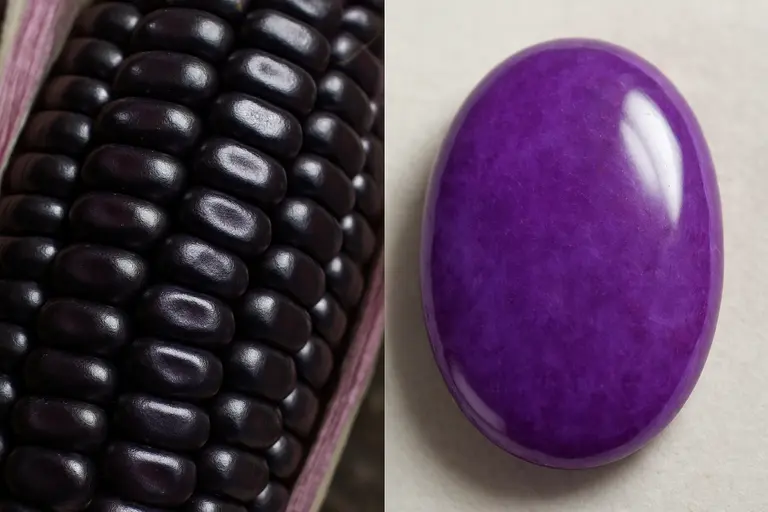
What truly unites Purple Corn vs Sugilite is their intense, mottled purple appearance. Both range from rich violet to nearly black, evoking deep magenta or “Grape Jelly” tones.
The Corn’s Pattern
For instance, Purple Corn kernels display a variegated pattern. Notably, the shades intensify from lavender edges to inky centers, often speckled by natural variations. This depth comes from the concentration of Anthocyanins. In Kerala kitchens, we see similar pigments in the Butterfly Pea vs Cobalt Blue Spinel comparison—nature using chemistry to paint.
The Gem’s Pattern
Similarly, Sugilite mirrors this beautifully. Its color spans translucent lilac to opaque, velvety purple-black. Moreover, black matrix inclusions (Manganese Oxides) create dark speckles akin to the corn’s shadowy hues. According to the GIA (Gemological Institute of America), this “Grape” intensity gives Sugilite a luxurious, organic feel despite its mineral nature. Consequently, collectors often pay a premium for the “Gel” variety, which is translucent like a fruit gummy.
Differences in Stability and Light
However, subtle differences emerge on a closer look. Purple Corn is photosensitive. If you leave a dried cob in the sun for months, the UV light will fade the anthocyanins to a dull brown. In addition, the color is pH-sensitive. Adding lemon juice turns corn extract pink.
Conversely, Sugilite is stable. Its color remains fixed and all-natural, unaffected by chemicals or time. Therefore, this permanence makes it ideal for heirloom jewelry. Unlike the flower’s changeable charm, the stone is forever. For more on gemstone durability, read my guide on Colored Stone Grading.
Identifying Authenticity
Accurate identification ensures you get the real deal, whether it is food or gem.
Testing the Corn
Starting with Purple Corn, look for plump, glossy kernels. True varieties like Peru’s Maíz Morado boast uniform deep purple all the way through the cob. Crucially, avoid hybrids with diluted colors. You can verify this by boiling the corn—if the water turns ink-black instantly, it is rich in pigment.
Testing the Gem
Turning to Sugilite, identification requires gemological savvy. Authentic pieces feel waxy with a vitreous luster. Critically, check the hardness (6-6.5 Mohs). Under UV light, genuine Sugilite stays inert or glows weak reddish-orange. Beware of dyed purple Quartz or plastic imitations (often called “Royal Azel” simulants). Ideally, seek professional certification from labs to verify Manganese content via spectroscopy. Read my Gemstone Buying Mistakes to avoid dyed fakes.
Real-Life Uses of Purple Corn vs Sugilite
Beyond aesthetics, both offer practical magic.
Culinary Uses
Purple Corn shines as a superfood. For example, it is the base for Chicha Morada, a famous Peruvian drink spiced with cinnamon and pineapple. In Kerala, imagine infusing it into Payasam for a vibrant purple twist, similar to how we use Kashmiri Saffron and Padparadscha for color.
Lapidary Uses
Sugilite, conversely, transforms into wearable art. As a “Healer’s Stone,” it is prized in crystal therapy for emotional balance. Furthermore, jewelers craft it into cabochons or beads. Because it is opaque, it looks stunning in silver or white gold settings. In addition, Sugilite’s rarity drives value—top specimens fetch $50+ per carat. Undeniably, this makes it a smart investment for those tracking North vs South Indian Jewelry trends, where unique colors are gaining popularity.
Conclusion on Purple Corn vs Sugilite
Ultimately, these purple twins enrich life uniquely. Corn nourishes the body with antioxidants; Sugilite nourishes the spirit with beauty. In summary, nature loves the color purple, whether she paints it on a cob or crystalizes it in a rock.
FAQ: Purple Corn vs Sugilite
What causes the color in Purple Corn vs Sugilite?
Purple Corn gets its hue from organic Anthocyanin pigments. Sugilite gets its hue from inorganic Manganese ions in its crystal matrix.
How do I spot fake Sugilite?
Check for uniform dye. Fakes look “too perfect.” Real Sugilite has mottled patterns (“Grape Jelly” look) with black or brown matrix inclusions.
Is Purple Corn safe to eat?
Yes, it is nutrient-dense and safe. It is a staple food in Peru and is packed with healthy antioxidants, similar to blueberries.
Can Sugilite fade like Purple Corn?
No. Sugilite is a stable mineral. Its color is permanent and does not fade in sunlight, making it suitable for daily wear jewelry.
Where is Sugilite mined?
The most famous deposit is the Wessels Mine in South Africa. Smaller deposits exist in Japan and Canada, but South African material is the gold standard.
Author Bio
P.J. Joseph, also known as Saju Elizamma, Gemstone & Gold Consultant serving Kerala, Tamil Nadu, and Karnataka.