Introduction
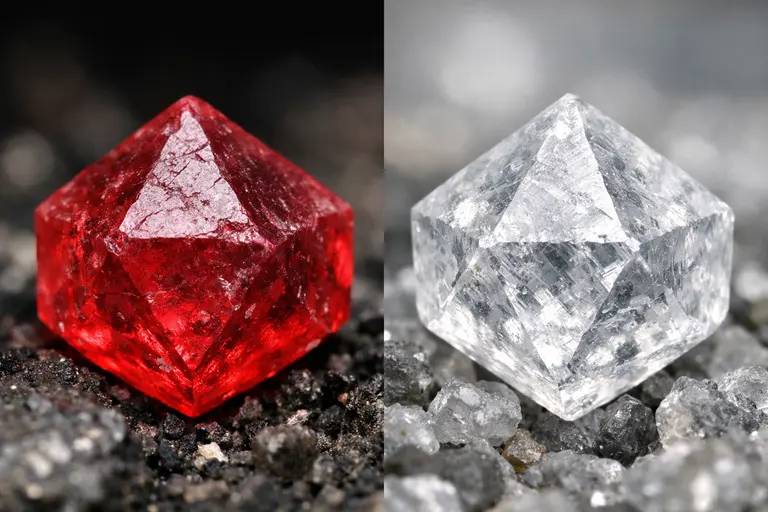
When gemologists and jewelry designers handle rough stones straight from the earth, they often face a striking puzzle. Octahedral Spinel and Diamond look remarkably alike. Both crystals grow in the cubic system, forming the same “double-pyramid” shape. Furthermore, both appear in a dazzling range of colors.
This visual similarity has caused centuries of confusion. Most famously, the “Black Prince’s Ruby,” set in the British Imperial State Crown, is actually a large red Spinel. However, the confusion doesn’t stop at color; it starts at the crystal level. As a Gemologist with over 40 years of experience, I have seen seasoned miners struggle to tell a white Spinel from a Diamond in the dirt. In this article, we will explore what makes these two gems similar, the science of their skin, and the field tests you need to separate them.
Crystal Structure of Octahedral Spinel and Diamond
To begin with, both Spinel and Diamond crystallize in the Cubic (Isometric) crystal system. Nature routinely shapes them into Octahedra—a classic eight-sided, double-pyramid form.
This shared geometry is not coincidental. Both minerals form under high-pressure, high-temperature conditions deep within the earth, and both develop well-defined crystal faces as they grow. Additionally, both gems produce Macles. These are “twinned” crystals that appear as flattened, triangular formations. Jewelers and cutters prize these Macle shapes for specialty cuts (like Trilliants or Heart shapes).
Moreover, both stones display Trigons. These are tiny triangular etch marks on their crystal faces (the “skin” of the rough) caused by partial dissolution during or after growth. Because Trigons appear on both gems, you cannot use them as a reliable visual separator in the field. You can read more about crystal growth in my Trapiche Gemstones guide.
Color Range of Octahedral Spinel and Diamond
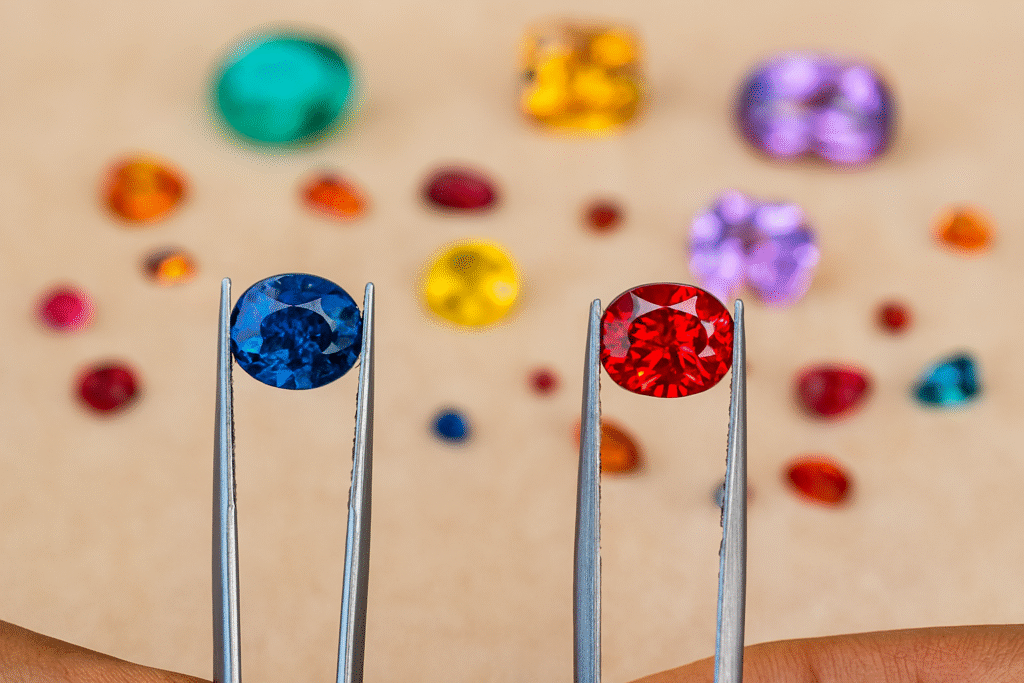
Many people associate Diamonds with colorlessness and Spinel with red. In reality, both gems span a broad spectrum.
The Color Palette
- Spinel: Appears in vivid red, pink, blue (including rare Cobalt Blue Spinel), violet, orange, purple, and black.
- Diamond: Occurs naturally in colorless, yellow, brown, gray, blue, green, pink, red, and black varieties.
Consequently, a rough red or pink crystal recovered from a riverbed could plausibly be either gem—a situation that routinely trips up traders.
Alluvial Origins
Furthermore, Octahedral Spinel and Diamond share a common path to discovery: Alluvial Deposits. These are riverbeds and ancient stream sediments where weathering has freed the crystals from their original host rock. For instance, Sri Lanka, Myanmar, and Tanzania supply notable Spinels, while India’s historic Golconda region and South Africa supply rough Diamonds from similar muddy settings. Therefore, because they travel through the same geological processes, they frequently appear together in the same parcels of rough material.
Identifying Octahedral Spinel and Diamond
Despite their visual similarities, several physical properties reliably distinguish the two gems once a gemologist examines them properly.
1. Specific Gravity (The Water Test)
Specific Gravity (SG) offers a practical and accessible test, particularly useful for traders who carry a portable weighing kit in the field.
- Diamond: Has an SG of 3.52.
- Spinel: Measures notably higher at 3.58–3.61.
To perform the test, the gemologist weighs the stone in the air, then weighs it again while suspended in water, and calculates the ratio. Because the test is non-destructive, it is a convenient first-pass tool when electronic instruments are unavailable.
2. Thermal Conductivity (The Probe Test)
Testing with a thermal probe instantly distinguishes them. Diamond is an exceptional heat conductor. Spinel conducts heat poorly. Thus, a standard “Diamond Tester” pen will beep for the Diamond and stay silent for the Spinel.
3. Fracture vs. Cleavage
This is perhaps the most telling visual indicator for broken rough specimens.
- Diamond: Cleaves perfectly along octahedral planes, producing smooth, flat faces.
- Spinel: By contrast, it displays Conchoidal Fracture—curved, shell-like breakage surfaces (like broken glass). Therefore, a rough crystal showing curved fractures is almost certainly Spinel. Read more about identifying rough stones in my Panna Diamond Mining article.
Octahedral Spinel and Diamond in Jewelry Design
Recently, a growing movement in jewelry design celebrates rough, uncut gemstones. Octahedral Spinel and Diamond sit at the forefront of this trend.
Why? Rough Spinel works exceptionally well in jewelry because its hardness (Mohs 8) makes it durable enough for daily wear even without faceting. Designers mount rough crystals in minimalist, rustic settings. Similarly, raw Diamond jewelry appeals to buyers who value authenticity and sustainability narratives. Instead of faceting away 50% of the stone’s weight, the designer allows the natural octahedral form to function as the centerpiece. This is a popular trend among Luxury Watch Collectors India who also collect bespoke jewelry.
Conclusion on Octahedral Spinel and Diamond
In summary, the comparison of Octahedral Spinel and Diamond proves that nature loves a good disguise. These parallels have confused traders and kings for centuries. Ultimately, as the jewelry industry continues to embrace rough, natural-form gems, both stones offer designers compelling material that celebrates crystals exactly as nature made them.
FAQ: Octahedral Spinel and Diamond
Is Spinel a good diamond substitute?
Visually, no. Spinel is not a substitute for a faceted white diamond because it has a much lower Refractive Index (less brilliance and fire). However, as a rough crystal, a white Spinel looks identical to a rough Diamond.
Can I tell Octahedral Spinel and Diamond apart at home?
A thermal conductivity probe (Diamond Tester) provides the quickest test. Diamond conducts heat exceptionally well; Spinel does not. Visual inspection alone is unreliable given how similar the two look in octahedral form.
What are Trigons?
Trigons are tiny, naturally occurring triangular etch marks found on the “skin” (surface faces) of both rough Diamonds and rough Spinels. They are formed by chemical dissolution while the stone was in the earth.
Is natural Spinel ever treated?
Rarely. Most natural Spinel reaches the market untreated, which is one of its major selling points. Heat treatment is experimental and not standard practice, unlike Corundum (Ruby/Sapphire).
Why is rough octahedral jewelry popular?
Consumers increasingly value natural, unmanipulated gemstones for their authenticity. Additionally, rough gems offer a distinctive geometric aesthetic that cut and polished stones cannot replicate.