Introduction
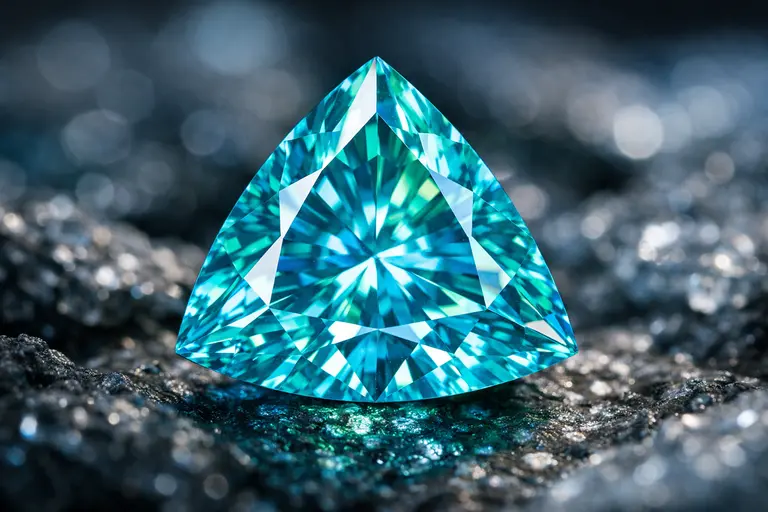
Ocean Green Diamonds rank among the rarest and most mysterious gemstones on Earth. In fact, even the most experienced gemologists frequently describe them as the “unicorns” of the colored diamond world. If you have ever seen one in person—or even in a professional photograph—you already understand why they command such fascination. Their electric blue-green glow looks almost too beautiful to be a natural creation. However, these stones are very real. Understanding what makes them special helps you shop smarter, care for them better, and appreciate their skyrocketing market value. Specifically, this guide explores the science behind the color and the practicalities of owning such a treasure. You should also read our guide on gemstone buying mistakes to ensure you understand how to verify high-value acquisitions safely.
The Science Behind Ocean Green Diamonds
First, we must explore exactly where this mesmerizing color originates. Unlike yellow diamonds, which get their hue from nitrogen, Ocean Green Diamonds owe their stunning appearance to natural radiation deep inside the Earth’s crust. Over millions of years, radioactive minerals like uranium and thorium bombard the diamond crystal. This bombardment knocks carbon atoms slightly out of their planned position.
As a result, this geological process creates tiny structural defects known as GR1 centers (General Radiation 1). These centers absorb red and some blue light waves. Consequently, the stone reflects a vivid green or blue-green color to the observer’s eye. The most legendary example of this phenomenon is the Ocean Dream diamond, a 5.50-carat Fancy Vivid Blue-Green stone. To learn more about the technical spectroscopy used to identify these stones, you can visit the Gemological Institute of America.
How Experts Identify Natural Color
Because modern laboratories can recreate a similar color using artificial radiation, identifying a naturally colored stone is a significant challenge. Therefore, experts at top laboratories examine the diamond for “radiation stains.” These are small green or brown surface patches left behind where the rough stone touched radioactive minerals in the ground.
Furthermore, master cutters often preserve these stains along the “girdle” or edge of the stone on purpose. They do this because the presence of these stains supports a “natural color” conclusion during the certification process. In addition, you must watch for older stones. Some diamonds from the early 1900s received radium treatments and can still trigger a Geiger counter today. As a result, you should always treat any green diamond without a modern, reputable lab report with extreme caution. You may also read our article Understanding BIS Hallmark to see how certification standards protect buyers in different sectors of the jewelry industry.
The Cutter’s Greatest Risk
Above all, cutting and polishing Ocean Green Diamonds entails a significant financial risk. In many instances, the vivid color is confined to a very thin surface zone rather than being evenly distributed throughout the entire crystal. Consequently, if the cutter polishes just a fraction too deeply, they might remove the color layer entirely. If this happens, the diamond loses its rare status, and its value drops by millions of dollars.
Furthermore, these stones are highly sensitive to heat. Specifically, research confirms that exposing these diamonds to temperatures around 500–600°C can destroy the GR1 color centers. If this occurs, the stone may turn a dull brownish color or lose its saturation permanently. Because of this, both master cutters and bench jewelers must work with extreme patience. They must cool the stone constantly and avoid traditional torch work during any repair or resetting process.
Auction History: The Return of the Ocean Dream
Not surprisingly, Ocean Green Diamonds attract massive interest from international auction houses. Their rare hue and scientific mystery set them apart from traditional white diamonds. For instance, in May 2014, Christie’s Geneva sold the Ocean Dream for approximately $8.8 million USD.
Now, in an exciting update for collectors, the same stone returns to the auction block at Christie’s Geneva on May 13, 2026. Experts currently provide a pre-sale estimate of up to $12.8 million USD. Accordingly, this renewed interest proves that these gems remain top-tier trophies for the world’s wealthiest collectors. This price appreciation highlights why many investors view these rare colored diamonds as a stable alternative asset class.
Practical Advice for Prospective Buyers
Fortunately, you do not always need a million-dollar budget to enjoy the look of green gems. However, you must follow specific steps to protect your investment regardless of your price range. First, always demand a GIA report that explicitly states “Color Origin: Natural.” If the report says “Undetermined,” you should proceed with caution or negotiate a lower price.
Second, read the hue description with care. Pure green stones are exceptionally rare. Most contain modifying tones like yellow or gray. Therefore, the “blue-green” ocean hues rank as the most coveted. Finally, if you already own such a piece, you must inform your jeweler about its heat sensitivity before any routine maintenance. Ask for laser-welding techniques instead of traditional torches to preserve the stone’s life.
FAQ: Ocean Green Diamonds
Are Ocean Green Diamonds as rare as pink diamonds?
In many ways, they are rarer. While the Argyle mine produced a steady (though small) supply of pinks for decades, Ocean Green Diamonds appear only sporadically in various mines across Africa and South America.
Can I wear an ocean green diamond every day?
Yes, they possess the same 10 Mohs hardness as any other diamond. However, you should use a protective setting to ensure you do not chip the edges, where the rare color is often most concentrated.
What is the “Ocean Dream” diamond?
It is the most famous blue-green diamond in the world, weighing 5.50 carats. It serves as the “master stone” for gemologists studying this specific color category.
How do I tell an ocean green diamond from a green sapphire?
A diamond will have much higher brilliance and “fire” than a sapphire. Additionally, a simple thermal conductivity test by a jeweler can distinguish them in seconds.
Is it safe to buy lab-grown versions?
Absolutely. Lab-grown Ocean Green Diamonds are chemically identical to natural ones and offer a stunning look at a fraction of the cost. However, they will not appreciate like a natural, radiation-colored stone.
Disclaimer
This article is for educational purposes only and draws on reputable sources, including GIA and Christie’s. Market prices, laboratory practices, and scientific understanding may change over time. Always consult a qualified gemologist and obtain an independent laboratory report before making any purchase decision.