Introduction
Few art forms in the world carry the weight of four centuries of cultural memory. Mysore Rosewood Inlay, a Geographical Indication (GI)-tagged craft from Karnataka, India, does exactly that. Specifically, artisans embed contrasting materials—like white acrylic, mother-of-pearl, and sandalwood—into the dark, richly grained surface of rosewood to produce breathtaking patterns.
Furthermore, this technique adorns not only large furniture but also jewelry boxes, decorative trays, and wearable accessories. As a Gemologist who works with precious metals and stones, I see a brilliant parallel here. Pressing a piece of mother-of-pearl into a wooden groove requires the same patience as setting a diamond into gold. In this guide, we will discover the history, the motifs, and how to identify authentic pieces. Ultimately, understanding this craft helps you protect a dying Indian heritage.
History of Mysore Rosewood Inlay
To begin with, historians trace the roots of this craft back to Persian craftsmanship. Originally, artisans practised this art in Srirangapatna before the tradition eventually moved to Mysore. Over time, royal patrons transformed this imported skill into a distinctly Kannadiga identity.
Both Tipu Sultan and the Wodeyar dynasty actively supported artisans during the 18th and 19th centuries. They provided materials, workshops, and a steady market through the royal court. Consequently, the craft gained international recognition in 1914. In fact, the Mysore Maharaja sent intricately inlaid caskets to the British Empire Exhibition, where those pieces won a gold medal. This catapulted Mysore’s woodworkers onto the global stage. For more on royal artifacts, read my article on the Thanjavur Art Plate.
Signature Motifs in Mysore Rosewood Inlay
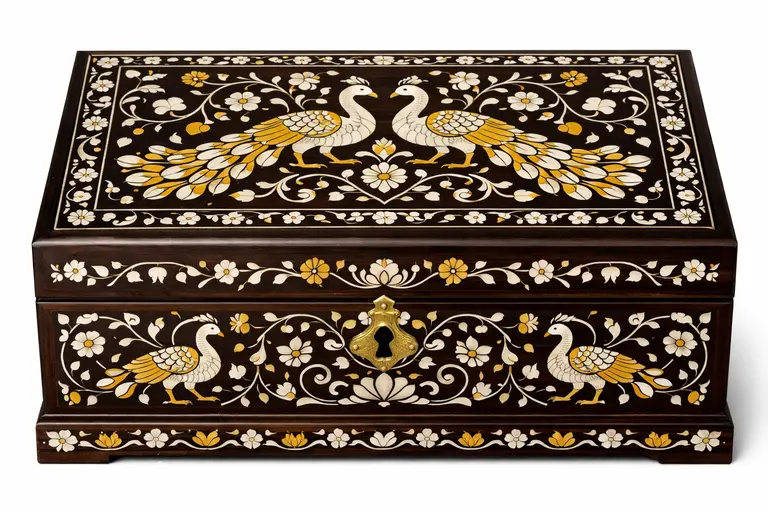
Every piece of Mysore Rosewood Inlay tells a story. Artisans draw their inspiration primarily from nature, mythology, and royal iconography. Therefore, when you examine an authentic piece, you will likely encounter these recurring themes:
- Peacocks: The national bird of India and a recurring symbol of grace in Wodeyar court art.
- Elephants: Representing royal power and auspiciousness in Hindu and Buddhist traditions.
- Floral Creepers: Delicate, continuous vine patterns that frame larger central motifs.
- Mythology: Depictions of deities and epic scenes from the Ramayana and Mahabharata.
- Rural Life: Farmers, birds, and landscapes that celebrate Karnataka’s agrarian identity.
Additionally, motifs connected to the Mysore Palace architecture appear frequently. These designs reflect an entire civilisational worldview, much like the patterns found in Naga Bead Jewellery.
Crafting Mysore Rosewood Inlay
Moving into production, the work is slow and difficult.
First, a craftsperson selects a solid block of Dalbergia latifolia—Indian Rosewood. Experts value this wood for its density, deep grain, and rich dark-brown colour. Next, the artisan hand-carves precise grooves into the surface using fine chisels. Then, they press the contrasting material tightly into those grooves. Historically, they used ivory, but today they use white acrylic or lighter-toned sandalwood.
After that, the craftsperson sands and buffs the entire surface until the inlaid material sits perfectly flush with the rosewood. Importantly, this flush finish is the defining characteristic of authentic work. Finally, artisans apply natural polish or beeswax to achieve a deep, high-gloss sheen. This polishing process is just as demanding as polishing a gem, which I discussed in Colored Stone Grading.
Identifying Authentic Mysore Rosewood Inlay
Because the market contains many imitations, knowing how to distinguish a genuine piece from a machine-made replica is essential. Use this checklist before making a purchase:
- Wood Weight: Authentic rosewood feels noticeably heavy and displays a rich, irregular grain pattern. Conversely, lightweight pieces with uniform grain almost certainly use substitute wood.
- Flush Inlay: Run your fingernail across the surface. Crucially, on an authentic piece, the inlaid material sits perfectly level with the wood. Raised designs indicate cheap painted fakes.
- Carving Fineness: Look closely at the edges. Hand-carved grooves show slight natural variations. Meanwhile, machine-cut grooves look mechanically identical.
- GI Certification: Always ask the seller for a Geographical Indications Registry certificate.
Caring for Mysore Rosewood Inlay
Once you own a piece, proper care extends its beauty for generations. Ideally, apply a thin coat of wax polish every few months to maintain the high-gloss sheen.
Equally important, keep the piece away from direct sunlight. Why? Because prolonged UV exposure fades both the rosewood and the inlay, reducing the beautiful contrast. Furthermore, avoid placing water or wet objects directly on the surface, as moisture can loosen the inlay over time. Treat these boxes with the same care you give to your Traditional Maharashtrian Jewellery.
Conclusion: Supporting the Artisans
In summary, Mysore Rosewood Inlay is far more than a decorative craft. Sadly, the craft faces serious headwinds today. Machine-made imitations flood the market, and younger generations increasingly choose other livelihoods over this demanding practice.
By choosing authentic, GI-certified pieces—whether a grand table or a delicate jewelry box—you directly support the artisans. Ultimately, you are keeping a 400-year-old tradition alive.
FAQ: Mysore Rosewood Inlay
What does GI-tagged mean for Mysore Rosewood Inlay?
A GI tag means that only artisans working in the Mysore region can legally sell their products under this specific name. Essentially, the tag guarantees regional authenticity and protects buyers from counterfeit products.
Is ivory still used in the inlay work?
No. India banned the use of ivory decades ago to protect elephants. Today, artisans use white acrylic, animal horn, or mother-of-pearl to achieve the same high-contrast aesthetic.
How long does it take to make one piece?
A small jewelry box may take a skilled artisan one to two days to complete. However, a large furniture piece with detailed motifs can take several weeks or even months of sustained work.
Where can I buy authentic pieces?
Ideally, visit the Cauvery Handicrafts Emporium on Mananthody Road in Mysore, which stocks certified pieces directly from registered artisans. You can also buy from authorized sellers online.
Can I find these items outside India?
Yes. Some international craft retailers and Indian handicraft exporters carry certified pieces. Nevertheless, buying directly from government emporiums gives you the best assurance of authenticity.