Summary
In gemology, the wisest skill is humility. Knowing When You Don’t Know protects credibility, builds client trust, and keeps your science sharp.
Introduction
After 40 years in gemology, I’ve learned this truth: Knowing When You Don’t Know is your strongest professional skill.
It’s not about memorizing data or mastering instruments—it’s about knowing your limits and respecting the science.
When you say, “I need lab confirmation,” you’re not uncertain—you’re professional.
Why Knowing When You Don’t Know Matters in Gemology
Not every stone reveals its story to the naked eye. Some require advanced lab testing like Raman spectroscopy, UV spectrometry, or X-ray diffraction.
Even seasoned experts must sometimes admit, “This needs a lab test.”
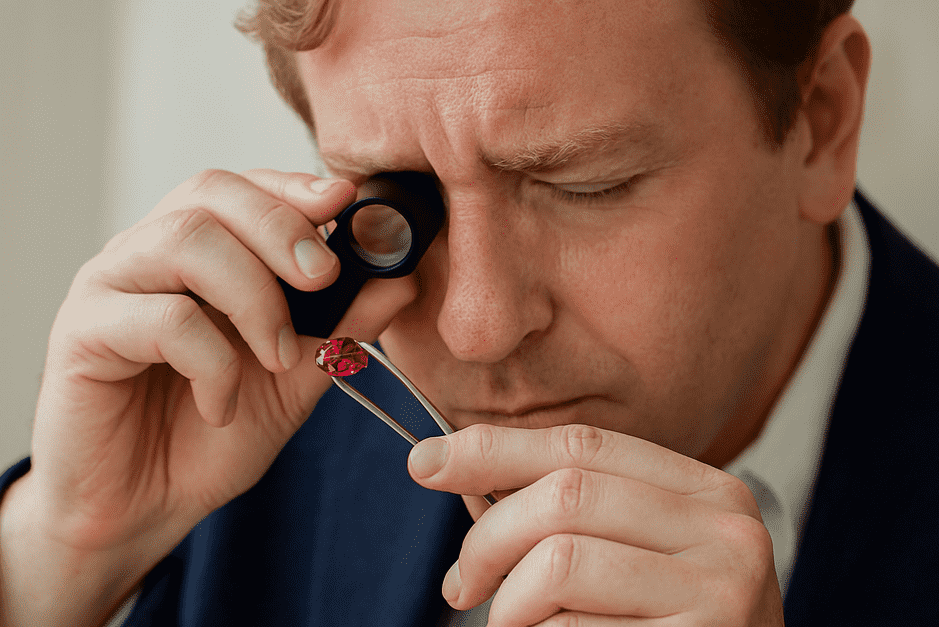
Roughly 95% of gems can be identified using basic tools—loupe, microscope, or refractometer.
The rest? That’s where Knowing When You Don’t Know becomes your greatest protection.
For deeper reading, see the GIA Gem Encyclopedia for verified gemological references.
Building Trust Through Professional Honesty
A client values your honesty more than your ego.
If a sapphire looks unusual or a pearl feels uncertain, say, “Let’s get this verified.”
That simple sentence builds long-term trust.
For more examples, read our article on Heated Sapphires Explained to understand how treatments can mislead even experts.
Essential Gem Testing Tools
Every gemologist depends on tools like:
- 10x loupe
- Microscope
- Refractometer
- Hydrostatic balance
These solve most identification puzzles.
But when results conflict, humility leads you to advanced labs such as IGI India or GIA.
Experience Isn’t Always Enough
Treatments evolve faster than memory. Even a veteran gemologist must keep learning.
Visit Saju Elizamma’s Gemology Guides to explore new testing methods.
Knowing When You Don’t Know reminds you that real expertise grows with honesty and curiosity.
Practicing Humility in Daily Gem Work
- Question your assumptions.
- Stay updated on new synthetics and treatments.
- Collaborate with trusted laboratories.
- Teach beginners that not knowing is part of mastery.
Final Thoughts
Gemology is science guided by integrity.
A doctor who never orders tests loses trust—so does a gemologist who never admits doubt.
Knowing When You Don’t Know isn’t a weakness. It’s the mark of a true professional.
FAQ
Q1: Why is “Knowing When You Don’t Know” vital for gemologists?
It keeps your work credible, transparent, and scientifically sound.
Q2: How can humility improve client relationships?
Honesty earns respect—clients return when they see integrity in your evaluations.
Q3: When should you rely on a gem lab?
When gemstones show unusual features or advanced treatments like diffusion or coating.