Introduction
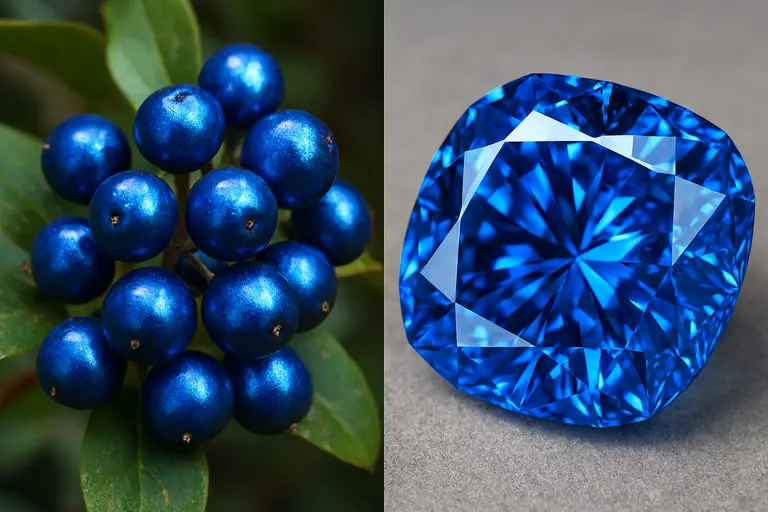
The comparison of Marble Berry vs Blue Diamond reveals a stunning link between the African forest and the deep earth. Imagine discovering a fruit that rivals the shimmer of a rare gemstone. Its metallic blue iridescence draws comparisons to high-end Blue Sapphires or deeply saturated Blue Diamonds.
However, while blue diamonds boast a glassy, transparent depth, the Marble Berry pops with a brighter, pixelated, “Liquid Metal” sheen. As a Gemologist who loves nature, I find this plant fascinating because it cheats. It has no blue pigment. It uses physics to create color, just like a high-quality Opal. In this guide, we will explore the Marble Berry vs Blue Diamond comparison. We will uncover their origins, the science of “Structural Color,” and why this berry might inspire the next wave of sustainable jewelry.
Origins of Marble Berry vs Blue Diamond
To begin with, let’s understand where these blue marvels come from.
The Marble Berry (Pollia condensata)
This herbaceous plant thrives in the lush forests of Africa, stretching from the Ivory Coast to Ethiopia and south to Mozambique. Unlike most fruits, which use color to attract animals for food, the Marble Berry is inedible. It is hard, dry, and offers no nutritional value. So why is it blue? To trick birds. Birds spot the shiny blue, eat it, and disperse the seeds, even though they get no calories. It is nature’s ultimate “False Advertising.”
The Blue Diamond
In contrast, Blue Diamonds form under extreme conditions deep in the Earth’s mantle, over 400 miles below the surface. Historically, they were mined in India’s Golconda region (like the Hope Diamond) and South Africa’s Cullinan Mine. Trace Boron atoms replace carbon in the crystal lattice, imparting that rich blue hue. Thus, while the berry is a biological trick, the diamond is a geological accident.
Color Science: Marble Berry vs Blue Diamond
What truly unites Marble Berry vs Blue Diamond is their intense color. However, the source of that color is completely different.
Structural Color (The Berry)
The Marble Berry has No Blue Pigment. If you crush it, the dust is colorless. Instead, the skin is made of layers of Cellulose fibers stacked in a spiral (helicoidal) pattern. When light hits these layers, it reflects only the blue wavelength. This is called “Bragg Reflection.” Consequently, the color is metallic and pixelated. It looks like a pointillist painting. You can compare this to the unique color patterns in Rare Pipi Pearls or Labradorescence.
Chemical Color (The Diamond)
On the other hand, Blue Diamonds rely on chemistry. The Boron trapped inside the carbon lattice absorbs red light and reflects blue light. Therefore, the color is consistent throughout the stone, not just on the surface. Read more about gem chemistry in my Colored Stone Grading guide.
Permanence of Marble Berry vs Blue Diamond
Remarkably, one standout feature linking Marble Berry vs Blue Diamond is their exceptional stability. Most plant colors (like flowers) fade when they die because the pigment breaks down. However, because the Marble Berry uses structure instead of pigment, it never fades.
In fact, herbarium specimens collected in the 19th Century (over 100 years ago) still gleam with the same pixelated, shimmering blue as a fresh berry. Similarly, Blue Diamonds are eternal. The Boron is locked forever. For collectors in India, this permanence is appealing. We buy gold and gems because they last. The Marble Berry is the only plant that offers that same “Heirloom Quality.” This connects to the concept of durability I discussed in Tanzania’s Cloves and Tanzanite.
Treatments for Marble Berry vs Blue Diamond
When it comes to authenticity, treatments reveal key differences.
- The Berry: Requires no treatment. It is 100% natural. Its metallic shine comes straight from nature.
- The Diamond: Often faces enhancements. Because natural Blue Diamonds are so rare (Type IIb), jewelers often use Irradiation or HPHT to turn brown diamonds blue.
As a buyer, you must be careful. Irradiated blue diamonds are affordable, but they are not “Investment Grade.” Always check for a GIA report to confirm origin. Read my Gemstone Buying Mistakes guide to avoid irradiated stones.
Identification of Marble Berry vs Blue Diamond
Distinguishing these blues demands precision.
For Marble Berries: Look for a “Pixelated” texture. The color isn’t smooth; it looks like tiny dots of blue, green, and purple glitter. Under a microscope, you will see the smooth cuticle over the fiber layers. Also, use a Polarized Light filter. The light from the berry is circularly polarized (left or right), which is unique in the plant world.
For Blue Diamonds: Use Spectroscopy to detect Boron lines. Additionally, check for electrical conductivity. Blue Diamonds are semiconductors (they conduct electricity), unlike white diamonds, which are insulators. This technical test is similar to the “Water Drop Test” for Synthetic Sapphire in Watches.
Applications of Marble Berry vs Blue Diamond
Finally, what can we do with them? Marble Berries inspire Biomimicry. Scientists are studying their cellulose structure to create:
- Fade-proof Paints: That never need repainting.
- Anti-counterfeit paper: For currency (like the Angadia System notes).
- Eco-Friendly Glitter: That doesn’t use microplastics.
Blue Diamonds remain the pinnacle of high jewelry. Ultimately, both remind us that nature is the greatest artist. Whether it is the “Living Jewel” of the African forest or the “Frozen Fire” of the mantle, Blue is the color of wonder.
Conclusion on Marble Berry vs Blue Diamond
Ultimately, the comparison of Marble Berry vs Blue Diamond highlights nature’s versatility. Nature uses the same “Electric Blue” palette for two different purposes:
- To attract a bird (The Berry).
- To structure a crystal (The Gem).
In summary, enjoy the plant for its biological wonder, and wear the gem for its eternal beauty.
FAQ: Marble Berry vs Blue Diamond
What causes the Marble Berry’s blue color?
It is Structural Color. Layers of cellulose reflect light like a mirror. It contains no blue pigment (Anthocyanin) like the Butterfly Pea vs Cobalt Blue Spinel flower does.
Can I use Marble Berries in jewelry?
Yes, but carefully. While they are hard and durable for a fruit, they are still organic matter. Designers often set them in resin or cages to protect them. They make stunning, sustainable beads.
Do Blue Diamonds fade?
No. Natural Blue Diamonds have a stable color. However, some irradiated blue diamonds can fade if exposed to extreme heat (like a jeweler’s torch during repair).
Where can I find Marble Berries?
They grow wild in the tropical forests of Africa (Ghana, Angola, Ethiopia). They are not commonly sold in supermarkets, but botanical collectors trade the seeds.
Which is rarer?
The Blue Diamond. While Marble Berries are rare plants, they can be grown. A Natural Blue Diamond is a geological anomaly that takes billions of years to form.