Introduction
When discussing South Indian adornment, we often focus on the heavy temple gold of Tamil Nadu or the Kasumala of Kerala. However, Konkani Jewelry stands as one of India’s most captivating yet underappreciated traditions. Geographically, rooted in the coastal culture of Goa, coastal Karnataka, and parts of Maharashtra, these ornaments carry centuries of craftsmanship, religious symbolism, and natural beauty.
Traditionally, the Goud Saraswat Brahmin (GSB) and Catholic communities of the Konkan coast have worn these pieces as central expressions of cultural identity. Furthermore, the Daivadnya Brahmin community—traditional goldsmiths—developed and refined these designs, giving them their unmistakable character. As a Gemologist based in Kerala, I have seen the GSB diaspora here proudly maintain these traditions, specifically their unique use of Red Coral. In this guide, we will explore the origins, how to spot authentic pieces, and where to shop smartly across Kerala, Tamil Nadu, Karnataka, and Goa.
Traditional Konkani Jewelry Designs
Visually, Konkani bridal and festive jewelry draw heavily from temple art and the marine environment. Remarkably, each piece carries symbolic meaning and distinct construction features that help buyers identify authenticity.
The Kashithali (Mangalsutra)
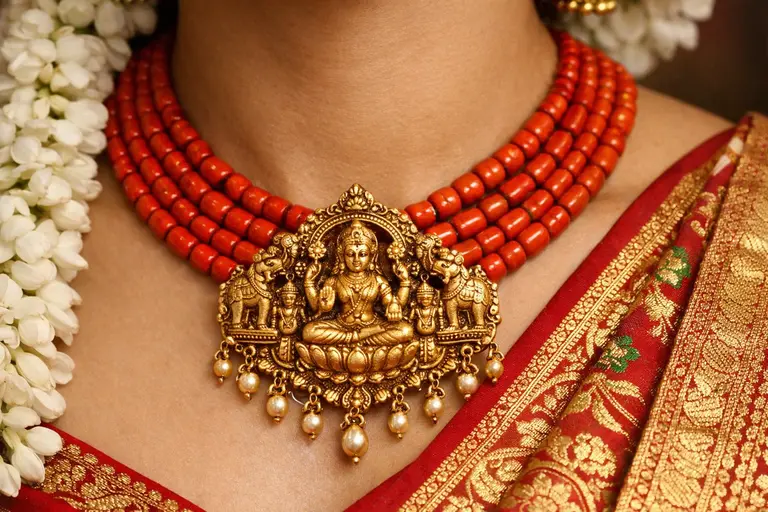
Arguably, the Kashithali (or Kasthali) is perhaps the most iconic Konkani ornament. Essentially, it functions as a traditional Mangalsutra featuring 12 or more large Red Coral beads interspersed with golden beads (Kas). Typically, a central locket, typically engraved with Goddess Lakshmi and set with rubies or emeralds, anchors the piece. Unlike the black-beaded Mangalsutra of the North, the Kashithali uses red to symbolize fertility and marital bliss.
Necklaces: Galsiri and Beyond
Next, the Galsiri (or Galsari) is a long necklace featuring multiple coin-shaped lockets embossed with deities, separated by coral beads. Visually, its length and weight immediately distinguish it from other regional styles like the Traditional Maharashtrian JewelleryThushi.
Bangles: Tode and Goth
- Tode: Remarkably, these are heavy, spiral-designed gold bangles crafted by hand. Usually, they are fitted with an adjustable screw mechanism. Crucially, this mechanism is a reliable authenticity marker—machine-made imitations rarely replicate it accurately.
- Goth (Dotti Goth): Visually, these are simple, solid, rounded gold bangles that married women traditionally wear in pairs. Although they appear minimalist, they require considerable precision to forge perfectly round.
Hair and Ear Ornaments
Traditionally, for hair accessories, women wear an Ambada Aati. This delicate bun pin features golden flowers on springs that tremble naturally with movement. Next comes the Pisolem, which features two peacock-shaped clips joined by chains, worn across the braid. Additionally, the Pake serves as a beautifully crafted ear cuff made from gold and pearls. Finally, the Piddukachi Kankna is a black-beaded bangle worn alongside gold bangles as a protective ornament.
The Origin of Konkani Jewelry
Historically, the roots trace back to the coastal Konkan region, primarily Goa. Specifically, when the Portuguese arrived in Goa in the 16th century, many Goud Saraswat Brahmins migrated south to coastal Karnataka (Udupi/Mangalore) and Kerala (Kochi) to preserve their culture. Consequently, they carried their jewelry traditions with them.
Specifically, two dominant influences shaped their craft:
- The Coastal Environment: Essentially, the coast supplied natural Red Coral and Pearls. Red coral (Moonga) holds sacred status in Hindu astrology (representing Mars) and carries protective significance. Read my guide on Gemstone Therapy for more on this.
- Religious Devotion: Simultaneously, the deep religiosity of the GSB community led artisans to embed deity imagery—particularly Lakshmi and Ganesha—directly into locket designs.
Together, these influences produced a style that is simultaneously spiritual and rooted in nature.
Where to Buy Authentic Konkani Jewelry
Fortunately, several reputable jewelers across four states specialize in authentic pieces. In fact, knowing where to look saves time and reduces the risk of purchasing imitations.
Goa (The Heartland)
- Ulhas Jewellers: Known for authentic Goan and GSB traditional designs.
- Vernekar’s Jewellery: Renowned for its intricate Gizbizle (filigree) traditional designs.
- M.S. Lotlikar Jewellers: A long-standing Goan name with a solid reputation.
Karnataka (Mangaluru and Udupi)
- Abharan Jewellers: With branches in Udupi and Mangaluru, they offer a comprehensive range of traditional bridal pieces.
- Shanthala Jewellers (Shimoga): Popular for handmade traditional jewelry.
Kerala and Tamil Nadu (The Diaspora)
Today, because of the large diaspora, several jewelers now serve this niche:
- Bhima Gold: Offers a wide range of traditional designs across both states.
- Merry Gold Jewellery (Thrissur, Kerala): Highly rated manufacturers with expertise in handcrafted regional designs.
- Queens Jewel Emporium: Known for traditional cord necklaces.
Consumer Tips Before You Buy
However, buying Konkani Jewelry requires more care than purchasing standard gold ornaments.
- Verify the Gold: Always look for the BIS Standard HUID Hallmark, especially for heavier ornaments like Goth and Tode.
- The Red Coral Warning: Personally, as a Gemologist, I must warn you. Natural Red Coral is expensive and highly porous. In fact, many sellers use dyed plastic or glass. A seller who cannot clearly explain the origin of their coral is a red flag. Read my Gemstone Buying Mistakes guide for testing tips.
- Making Charges (VA): Understandably, expect higher making charges. Obviously, since artisans handcraft most ornaments, the labor cost is naturally higher than for machine-made jewelry. Unusually low charges signal a factory-made fake.
- Care for Coral: Store coral jewelry away from direct sunlight and perfumes. Never use an ultrasonic cleaner, as it will destroy the porous coral structure.
Conclusion: The Pride of the Coast
In summary, Konkani Jewelry is a testament to the resilience of a coastal people. Despite centuries of migration, the community kept its gold and its coral intact. Ultimately, when you wear a Kashithali, you are wearing the history of the Arabian Sea.
FAQ: Konkani Jewelry
What makes Konkani Jewelry different from other South Indian styles?
This style uniquely combines coastal natural materials—specifically Red Coral and Natural Pearls—with temple-inspired deity lockets. In fact, pieces like the Kashithali and Tode are exclusive to this tradition and do not appear in standard Tamil or Kerala jewelry.
Can I buy authentic Konkani Jewelry online?
Yes. Fortunately, established jewelers like Abharan and Bhima operate online platforms. However, for high-value items involving real Coral and Pearls, visiting a physical store to verify the materials in person is always the better choice.
Is Konkani Jewelry only for GSB brides?
No. For instance, Catholic Konkani communities in Goa and Mangalore also wear several traditional ornaments (like the cross pendant on a coral chain). Additionally, many non-Konkani buyers now collect these pieces for their unique craftsmanship.
How do I care for red coral in Konkani Jewelry?
Red coral is an organic gem (like Mississippi Pearls). Store it in a soft pouch away from moisture and chemicals. Clean it gently with a dry, soft cloth. Never use harsh dips or ultrasonic machines.
What is the price range for a traditional Kashithali?
Fundamentally, prices vary based on gold weight, coral quality, and making charges. Currently, a basic authentic Kashithali typically starts around ₹50,000 and can exceed ₹2,00,000 for pieces with high-grade natural Italian coral and fine craftsmanship.