Introduction
Pearls blend nature, craft, and commerce. However, most shoppers cannot tell where a pearl grew or why one costs more than another. Kamoka Pearl, a family-owned business, farms Tahitian pearls on Ahe Atoll in French Polynesia, roughly 300 miles northeast of Tahiti. Moreover, it sells directly online and serves approved trade buyers. Consequently, its approach teaches ordinary buyers what to look for when they shop for fine jewellery. By understanding the farm-to-customer model, you make better decisions regarding quality and provenance. To get started, check out our Pearl Buying Guide for Beginners.
How the Kamoka Pearl Business Model Works for Buyers
From Kamoka Pearl Lagoon to Customer
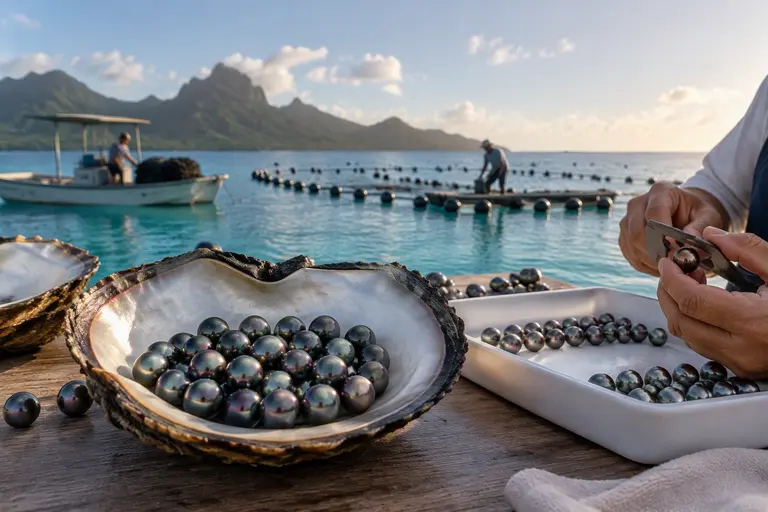
Kamoka Pearl handles key stages itself, including oyster cultivation, grafting, harvesting, and presentation. According to its official website, the company traces its pearls from oyster collection in the Ahe lagoon through production and import into the United States. As a result, the brand explains its methods and connects customers with the farm. However, it does not sell only to consumers. It also runs a wholesale programme for approved retailers, designers, and trade customers.
Managing Financial Risk in Kamoka Pearl Farming
Pearl farming demands patience. First, oyster spat needs time to mature before grafting. Then, the pearl develops for another period before harvest. Therefore, farmers spend money long before a crop earns revenue. They also face oyster mortality, failed grafts, environmental change, and shifting demand. Selling finished jewellery captures more value than wholesale harvest sales alone. Nevertheless, direct retail does not remove risk. Instead, it demands careful cash-flow management, steady quality, and enough customer demand.
Kamoka Pearl Sustainability as a Business Strategy
Protecting the Marine Environment for Kamoka Pearl Farming
Kamoka Pearl uses reef fish to clean oysters naturally, which reduces its reliance on high-pressure cleaning. Likewise, the company says the protected area of its farm helps conserve coral reefs. Furthermore, it states that solar and wind power supply its electricity and that it collects rainwater for freshwater needs. In addition, it makes its nuclei from oyster shells. According to its sustainability page, testing by the Tahitian pearl-farming authority found three times more Grade A pearls with these nuclei than with other types. However, this remains one reported result, not a promise for every farm. Therefore, other producers should test methods under their own conditions and publish measurable results.
Understanding Kamoka Pearl Grading
The Kamoka Pearl Tahitian A to D Grading System
Unlike diamonds, pearls have no single grading system that every seller applies identically. Tahitian cultured pearls commonly use an A to D scale, while some retailers prefer AAA-style labels. The brand judges’ size, shape, colour, lustre, and surface quality, and its Tahitian pearl grading guide explains the method. Grade A sits at the top, with excellent lustre and few surface flaws. Grade B allows more flaws but keeps attractive lustre. Grade C shows more visible flaws, and Grade D covers heavily blemished or duller pearls. Still, terms vary between sellers. Therefore, buyers should not assume that similar labels mean the same everywhere.
What gemologists and laboratories contribute
Gemologists identify pearl types, assess quality, and investigate possible treatments. Likewise, specialist laboratories examine pearl identity and treatment evidence with analytical methods. However, a laboratory report does not guarantee ethical sourcing, commercial quality, or future resale value. Similarly, a retailer’s grade is not an independent laboratory conclusion. Instead, shoppers should rely on accurate measurements, detailed photographs, clear treatment disclosures, and fair return policies.
Treatments and Common Imitations
Colour and lustre drive pearl value. Nevertheless, buyers should verify treatment disclosures instead of assuming that every pearl has passed independent testing. Dyed freshwater cultured pearls, coated shell beads, glass, and plastic imitations all resemble dark Tahitian pearls. Although they look similar at first glance, their composition, durability, and value differ considerably. Moreover, the “tooth test” does not identify pearls reliably and can damage teeth or jewellery. Therefore, examine the item under suitable magnification, and consult a qualified gemologist when doubt remains.
Industry Lessons from the Kamoka Pearl Business Model
Farmers can link environmental protection with long-term production. Meanwhile, dealers can strengthen trust through responsible sourcing and honest descriptions. Similarly, graders should explain their criteria, and laboratories should state the limits of their findings. Consumers, in turn, should compare lustre, surface quality, shape, colour, size, origin claims, and price instead of trusting grade letters alone. Ultimately, Kamoka Pearl shows how farming, sustainability, traceability, and retail work together to create value.
Frequently Asked Questions
What makes Kamoka Pearl different?
Kamoka Pearl combines pearl farming, direct online retail, and a selective wholesale programme. Therefore, it keeps production close to its customers.
Which grading system does Kamoka use?
The company uses the Tahitian A to D scale and assesses lustre, surface quality, colour, shape, and size.
Are Kamoka pearls treated?
Buyers should confirm the treatment disclosures for the exact piece they plan to buy. Moreover, an independent gemological report adds assurance for expensive pearls.
Are sustainable pearls always more expensive?
No. Quality, rarity, labour, design, and distribution also shape prices. Therefore, sustainability claims alone do not prove value.
What should buyers check before buying pearls online?
Review photographs, dimensions, grading criteria, treatment disclosures, origin claims, and return policies.
Disclaimer
This article offers general educational information. It does not audit Kamoka Pearl or certify any individual pearl. Company practices and policies may change, so verify current product details before you make a significant purchase. The author has no financial affiliation with the brands or organizations mentioned.