
Author’s Note
This article is written in the spirit of improving Jewelry Retail Etiquette in Kerala for everyday experiences. Kerala is home to one of the most culturally rich and diverse populations in India, and that diversity is nowhere more visible than in the way communities celebrate life’s milestones through gold and jewelry.
The observations in this piece are drawn from the general social character of two communities—Roman Catholic Syrian Christians and Hindu Nairs—as they are commonly understood in the context of Kottayam and Cochin (Kochi). They are not intended as a definitive portrait of any individual, family, or group. Every buyer is first and foremost a person, and every person deserves courteous, unhurried, and respectful service regardless of community, background, or budget.
Importantly, no community is singled out for criticism here. The goal is better manners on both sides of the jewelry counter—not judgment on either side. This is the first in a series of articles that will, over time, cover the rich diversity of jewelry-buying traditions across Kerala’s many communities, including Muslim, Latin Catholic, and other Hindu communities.
Introduction to Jewelry Retail Etiquette in Kerala
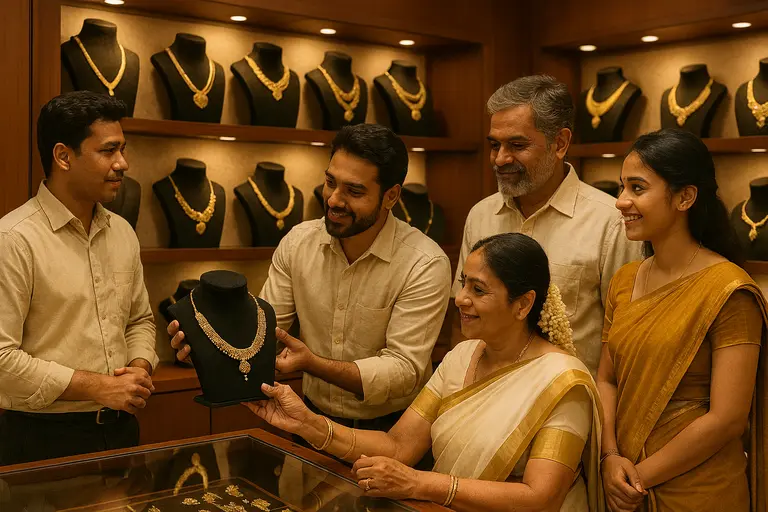
In Kerala, a jewelry purchase is never just a transaction. It is a ritual—woven into weddings, festivals, baptisms, and family milestones. Jewelry Retail Etiquette in Kerala is nuanced. The buyer who walks through your showroom door carries her community’s pride with her. For modern jewelry retail stores in Kottayam and Cochin, this means that staff training must go beyond product knowledge. It must build cultural intelligence, emotional composure, and the instinct for graceful service.
This guide presents that training as a Q&A—the format most useful for role-play, staff briefings, and daily practice. Specifically, it addresses the two most prominent buyer communities in these cities: Roman Catholic Syrian Christians and Hindu Nairs. Moreover, it reflects the different social energies of Kottayam (traditional, family-oriented) versus Cochin (cosmopolitan, fast-paced).
Section 1: Understanding Jewelry Retail Etiquette in Kerala
Who walks into your store?
Q: Why do Syrian Christian women from Kottayam approach jewelry buying so deliberately?
A: For the Syrian Christian women in Kottayam, jewelry is inseparable from identity and occasion. Usually, a purchase is rarely impulsive. Instead, it is linked to a wedding (Minnukettu), baptism, engagement, or church festival. Frequently, the decision often involves the extended family, particularly the mother or mother-in-law. Staff who understand this will not rush the process. They know that the weight, purity, and design carry social meaning within the parish community.
Q: How is the Nair buyer from Cochin typically different in her approach?
A: Generally, she tends to be more independent, urban, and efficiency-minded. She may be buying for Onam, Vishu, or purely as a gold investment. Often, she values store ambiance, digital displays, and prompt service. She is comfortable making decisions on her own and frequently researches designs and gold rates before visiting. Consequently, a good store experience will earn her loyalty; a poor one will earn a social media post.
Q: Does the city of the buyer matter as much as her community?
A: Very much so. For instance, a Syrian Christian buyer from Kottayam and one from Cochin may share the same faith, but the Kottayam buyer typically moves at a slower, more deliberate pace. The Cochin buyer, regardless of community, often expects a streamlined experience. Train your staff to read the room—both the community and the city speak through a buyer’s body language from the first minute.
Section 2: Good Jewelry Retail Etiquette in Kerala
Recognizing and rewarding the ideal interaction.
Q: What does ideal buying behavior look like in a Syrian Christian customer?
A: Typically, she arrives with a clear occasion in mind, listens to staff, and asks informed questions about hallmarking and making charges. She treats the interaction as a relationship rather than a negotiation. When you encounter this buyer, reward her respect with equal respect. Offer your most experienced staff, take time with her, and offer traditional hospitality as described in my Creative Hospitality in Indian Jewelry Stores guide.
Q: What does ideal buying behavior look like in a Nair customer?
A: Characteristically, she is direct, knows her budget range, and is open to design suggestions. Notably, she pays efficiently. She might also provide unsolicited but genuinely useful feedback on your displays. Receive this gracefully. A Nair buyer who feels heard becomes your most effective word-of-mouth advocate—particularly in Cochin’s well-connected social circles.
Section 3: Difficulties in Jewelry Retail Etiquette in Kerala
The calm, skilled response to tension.
Q: A Syrian Christian customer has brought six family members with conflicting opinions. What should staff do?
A: Above all, do not show impatience. This dynamic is culturally normal. She is not wasting your time deliberately. Politely center the conversation on the primary buyer. Say: “Based on what you have shown interest in, may I set aside these two pieces for a closer look?” Effectively, this narrows the field without dismissing the family.
Q: A Nair customer is visibly impatient and interrupts staff. How should this be handled?
A: First, stay calm and do not become defensive. Acknowledge her comparison without arguing. Speed up your own pace slightly to match her energy. Prioritize efficiency over thoroughness and let her lead the conversation. In reality, she does not want to be lectured; she wants to feel in control.
Q: What if a buyer is dismissive toward a junior staff member?
A: Immediately, a senior staff member should step in—not to override the junior, but to add value. Frame it as:” Allow me to assist as well.” Afterward, privately check in with the junior staff. Store culture is built in these small moments.
Q: What constitutes unacceptable behavior?
A: Unquestionably, verbal abuse or deliberate damage to pieces crosses a clear line. A senior manager should speak with the customer privately: “We ask that our staff be treated with the same respect we extend to you.” No sale justifies lasting harm to your team.
Section 4: Staff Training on Jewelry Retail Etiquette in Kerala
Q: How should staff training differ between Kottayam and Cochin?
A:
- Primarily, in Kottayam, training should emphasize patience with extended family visits and the cultural significance of occasion-based purchases. Role-play the “Conflicted Family Group.”
- In Cochin: Focus on speed without sacrificing warmth. Train staff on digital tool fluency for the independent buyer who needs expertise delivered quickly.
Q: What cultural knowledge should staff carry?
A:
- Specifically, for Syrian Christians: Know the significance of the Minnu (Thali) and traditional gold weight expectations.
- Similarly, for Nair buyers, the staff should recognize the role of Temple Jewelry South India designs in festivals and the awareness of gold as an investment. When a staff member says, “This design is traditional for a Vishu gift,” the buyer feels seen.
Section 5: Dos and Don’ts of Jewelry Retail Etiquette in Kerala
Q: Dos and Don’ts for Syrian Christian Buyers?
- Do: Acknowledge the family milestone. Present BIS Hallmark certificates proactively. Furthermore, involve the senior family member.
- Don’t: Crucially, do not push contemporary designs if she cues tradition. Likewise, don’t quote prices rapidly without explaining the breakdown. Don’t rush her.
Q: Dos and Don’ts for Nair Buyers?
- Do: Additionally, offer digital catalogs or tablet browsing. Moreover, highlight investment value. Respect her autonomy as the decision-maker.
- Don’t: Please, do not hover or follow her around (it signals distrust). Don’t make assumptions about her budget based on her age. Don’t dismiss traditional designs as outdated.
Conclusion on Jewelry Retail Etiquette in Kerala
Ultimately, the finest jewelry stores in Kottayam and Cochin understand something crucial. They are not merely selling gold. They are participating in the most significant chapters of a family’s story. After all, Syrian Christian and Nair buyers bring different histories and expectations. However, the store that trains its staff to meet these buyers with proper Jewelry Retail Etiquette in Kerala does not just close a sale.
It earns a family’s trust. And that trust—passed quietly from mother to daughter—is the most precious metal in any showroom in Kerala.