Introduction
Indian Wedding Rings carry centuries of meaning in every loop of gold. Whether you are planning your own wedding or shopping for a loved one, understanding the cultural, regional, and practical dimensions of these rings helps you make a confident choice. In the West, the wedding band is a simple, standardized tradition. However, in India, the concept of a “Wedding Ring” is beautifully complex and highly localized.
In this guide, we walk you through the origin story of Indian Wedding Rings, how to identify authentic pieces, and the key differences between North and South Indian preferences. We also share essential consumer tips to protect your investment. As a Gemologist who has observed the bridal market for decades, I can assure you that buying a ring in India is not just a purchase; it is the merging of two families.
The Ancient Origin of Indian Wedding Rings
To begin with, the tradition of exchanging rings in India dates back thousands of years. Historically, royals and nobility exchanged rings to formalize alliances, express devotion, and seal sacred unions. Over generations, this royal custom filtered into broader society.
Gold has always held a central place in this tradition. Indian culture treats gold as a pure, purifying metal that attracts Lakshmi (Prosperity) and signals the longevity of a marriage. Furthermore, there is a distinct cultural rule regarding placement. Most Indians wear Indian Wedding Rings on the Right Hand. Why? According to Vedic traditions and Ayurveda, the right hand is considered auspicious and active, associated with giving and performing rituals. The left hand is traditionally considered inauspicious. This simple detail reflects how deeply cultural beliefs continue to shape modern jewelry choices.
Engagement vs. Marriage: The Cultural Nuance
Crucially, it is important to distinguish between the Engagement and the Wedding. In many Indian cultures, the ring is actually exchanged during the Engagement ceremony (Roka in the North, Manasammatham or Nischayam in the South). Therefore, the ring is often the “Promise.” The actual marriage symbol, presented on the wedding day, is usually the necklace (Mangalsutra or Thali) or the toe rings (Metti). You can read more about engagement rules in my Manasammatham and Manthrakodi Stone Guide.
North India vs. South India: Contrasting Preferences
Next, regional identity plays a powerful role in shaping ring choices. The divide between North and South India is particularly striking.
North India: The Diamond Statement
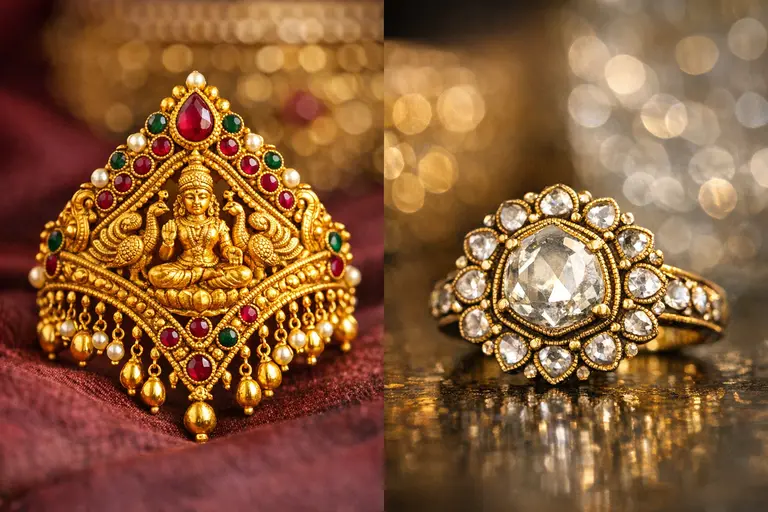
In North India, buyers gravitate toward glamorous, fashion-forward designs. Bollywood culture and growing Western influence drive demand for diamond solitaires, Polki Diamonds (uncut diamonds), and Kundan craftsmanship. Consequently, North Indian brides often treat the ring as a statement accessory that must dazzle. They prefer 18K gold to hold these heavy stones securely.
South India: The Gold Heritage
In contrast, the tradition in South India is markedly different. Buyers overwhelmingly favor heavy, 22K yellow gold pieces that connect them to their heritage. For instance, Temple Jewelry South India designs—featuring motifs of deities or lotus flowers—remain enormously popular. Additionally, the Vanki Ring, shaped like an inverted “V,” holds deep cultural significance and families consider it an essential part of the South Indian bridal trousseau. Jewelers design it to follow the natural shape of the finger, allowing for comfortable daily wear.
City Buyers vs. Rural Buyers: Different Priorities
Beyond regional identity, the buyer’s environment—urban or rural—also shapes purchasing decisions.
- Urban Buyers: City dwellers in places like Bangalore or Mumbai increasingly prefer sleek, minimalist designs. Many choose Men of Platinum Jewelry or white gold bands that are practical for daily office wear. They prioritize comfort and versatility over pure weight.
- Rural Buyers: On the other hand, village buyers hold firmly to tradition. They choose heavier rings made from 22-karat gold, viewing the jewelry as a tangible financial investment. In many households, gold is a form of savings that families can liquidate in times of need.
Consumer Tips Before You Buy Indian Wedding Rings
Making the right purchase requires both cultural awareness and practical knowledge. Here are five tips to guide you:
- Check the BIS Hallmark: Always look for the BIS Standard for Diamonds and Gold (HUID code) on the ring. This guarantees the purity and protects you from fraud.
- Choose the Right Karat: Select 22K Gold if you want a traditional plain band with strong resale value. Choose 18K or 14K Gold if the ring is stone-studded, as the lower gold content makes the prongs stronger.
- Verify Stone Certification: If buying a diamond ring, always ask for a GIA or IGI certification to confirm the quality.
- Think About Daily Wear: A ring you wear every day needs to be practical. Avoid sharp edges that catch on clothing.
- Understand the Resale Value: Remember that jewelers deduct ‘Making Charges’ (VA) when you resell. Plain bands retain more value than intricately carved rings. Read my Jewelry Sales Secrets for more tips.
Conclusion: The Circle of Life
In summary, Indian Wedding Rings are much more than metal and stone. They are a reflection of geography, faith, and financial planning. Ultimately, whether you choose a sparkling Northern Polki ring or a traditional Southern Vanki, you are wearing a piece of India’s enduring heritage.
FAQ: Indian Wedding Rings
Why do Indians wear wedding rings on the right hand?
Culturally, Hindus consider the right hand the auspicious (Shubh) hand for holy rituals, giving, and eating. The left hand is traditionally considered inauspicious. Therefore, people place sacred items like wedding rings on the right hand.
What is a Vanki ring?
A Vanki ring is an inverted V-shaped gold ring traditionally worn by South Indian brides. Artisans design their unique shape to look like the Vanki armlet, making it a significant cultural marker in Kerala and Tamil Nadu.
Is 22-karat or 18-karat gold better for a wedding ring?
It depends on the design. 22K gold is purer and holds stronger resale value, making it ideal for plain bands. However, 18K gold is harder (due to more alloy) and is strictly recommended for rings set with diamonds to prevent the stones from falling out.
Do all Indian communities use rings as the primary wedding symbol?
No. In almost all traditional Indian communities, the Mangalsutra (North) or Thali (South), along with Toe Rings (Metti), serve as the primary, sacred symbols of marriage. The ring is often a symbol of engagement.
How do I verify the authenticity of an Indian gold ring?
Always look for the 6-digit alphanumeric HUID (Hallmark Unique Identification) code laser-etched inside the band. You can cross-check this code on the official BIS Care App to verify the jeweler and the purity.