Introduction
Traditionally, the Hyderabad Pearl Myth is strong across India. Hyderabad is celebrated as the City of Pearls, yet most buyers do not realise that the real story behind this reputation works very differently. However, human skill creates the value you see in Hyderabad pearls, not local seas or natural pearl beds. As a result, many shoppers still pay a premium because they trust the Hyderabad Pearl Myth and ignore the origin or the tag. As a Kerala Gem Expert, I want you to see the reality behind the marketing.
The Hyderabad Pearl Myth and the Nizam Legacy
In fact, Hyderabad’s pearl reputation began with the Nizams, who collected Basra pearls imported from the Persian Gulf. Later, during the Qutb Shahi and Asaf Jahi periods, the city grew into a major centre where craftsmen refined, drilled, matched, and strung these imported pearls into jewellery. Even in those royal days, Hyderabad never produced pearls. As a result, traders brought them from distant seas, and local artisans transformed them into finished pieces. Additionally, for more context on this era, you can read the article Deccan Royal Jewellery Traditions.
Why the Hyderabad Pearl Myth Overlooks Basra’s Extinction
Natural Basra pearls have almost disappeared because oil-related pollution, overfishing, and shrinking oyster populations damaged the Persian Gulf. Today, you mainly see genuine Basra pearls in museums, antique collections, and high-end auctions. If a shop offers you a “Basra pearl” for a few thousand rupees, use your logic. The seller is repeating a marketing story, not showing you a natural gem. Always ask for a lab report. For more clarity, you can read the article Basra vs Cultured Pearls.
Hyderabad Pearls vs Chinese Freshwater Pearls
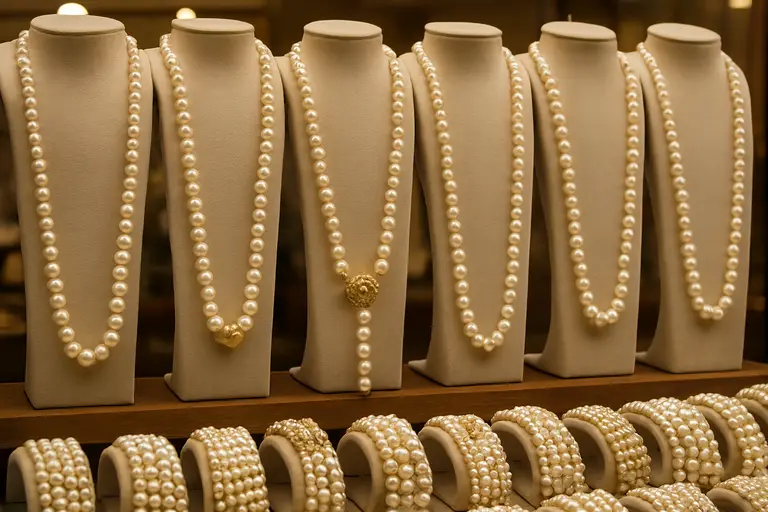
If you place a typical Hyderabad pearl strand next to a Chinese freshwater strand, most buyers cannot spot any difference because both usually come from the same source. Jewellers in Charminar and major Hyderabad showrooms sell cultured freshwater pearls that they import in bulk from China. Local artisans drill, match, and string these pearls to create the final jewellery. In most cases, when you buy a “Hyderabad pearl,” you are buying a Chinese pearl that went through processing in India. To understand quality indicators like luster and nacre, you can read my Pearl Buying Guide.
Further reading: Freshwater Pearl (Wikipedia)
The Hyderabad Pearl Myth Explained Through the Surat Analogy
A quick comparison helps. Surat is called the Diamond Capital of the World, yet it has no diamond mines. Rough stones come from Africa, Russia, and Canada, but the cutting and polishing happen in Surat. Hyderabad works in the same way. The pearls do not come from the region. The real value is created through drilling, matching, and stringing. You can read more about supply chains in Surat Diamonds vs African Mines.
The Real Skill Behind Hyderabad Pearls
Hyderabad’s strength lies in the precision of its artisans. These craftsmen drill tiny holes without cracking the pearl and create neat, balanced designs like the traditional Satlada. When you pay for a Hyderabad design, you are paying for the workmanship, not for a rare local pearl. The soil has nothing to do with the pearl itself. The value lies entirely in the hands that finish the jewellery.
Practical Buying Advice for Hyderabad Pearls
When you shop for pearls in Hyderabad or online, always ask whether the pearl is freshwater or saltwater. Then ask for the country of origin. Honest jewellers will mention China, Japan, or Australia. Next, look at the luster and the nacre thickness instead of relying on the city name. The label “Hyderabad” indicates where the pearl was processed, not where it was grown. If you find the terminology unclear, the article How to Read Jewellery Tags will help.
Final Thoughts on the Hyderabad Pearl Myth
Hyderabad remains an excellent place for jewellery design. Respect the artisan who strings the necklace. Appreciate the neatness, the finishing, and the traditional styles. But do not pay a premium assuming the pearl is unique to the city. Most of these pearls grow in Chinese lakes, not in Hyderabad. Separate the art from the origin and always check the tag before buying.
FAQ — Kerala Gem Expert on Hyderabad Pearls
Are Hyderabad pearls natural Basra pearls?
No. Modern Hyderabad pearls are cultured pearls sourced from international farms.
Does Hyderabad have pearl farms?
No. Hyderabad is a processing centre, not a farming region. It has no coastline.
Why is it still called the Pearl Capital?
Because of artisan skill and historical reputation, not because pearls originate there.
What is the key takeaway?
Buy for craftsmanship, not for the Hyderabad Pearl Myth.
Author Bio
P.J. Joseph, also known as Saju Elizamma, Gemstone & Gold Consultant serving Kerala, Tamil Nadu, and Karnataka.