Summary
A simple, practical guide to using a 10x triplet loupe for gemstone examination. Learn how to choose and test a quality loupe, avoid distortion, and use correct hand technique. If you’re expanding your gemological skills, explore related topics like Gemstone Types Explained and Understanding the Gemological Microscope for deeper insight into gem testing tools.
Introduction
A 10x loupe is the most essential tool in gemstone examination. It helps you see inclusions, surface flaws, and optical features that reveal a gem’s true nature.
This guide explains what makes a good loupe, how to test lens quality, and the correct way to use it.
Loupe: Your First Tool in Gemstone Examination
When you examine a gemstone, your eyes are the first tool. You notice:
- Color
- Luster (surface reflection)
- Condition
- Shape and possible identity
But to see deeper, you need magnification. That’s where the 10x loupe comes in — the foundation of every gemologist’s toolkit.
Why 10x Is the Standard
A 10x magnification reveals most internal and external features clearly. Higher powers like 15x or 25x provide more detail, but they reduce your field of view and working distance. That makes them harder to handle. For this reason, professional gemologists consider 10x the global standard for examination.
If you’re moving into advanced work, you can also explore the Gemological Microscope Guide to learn how it complements loupe work.
Why Triplet Loupes Are Better
Single-element lenses above 3x create visual distortion and color fringing. A triplet loupe uses three lenses that correct:
- Image distortion
- Chromatic aberration
- Edge blurring
These optical corrections give a true, sharp image — essential for judging clarity, inclusions, and surface features. For a broader understanding of natural and synthetic materials, see Gemstone Types Explained.
How to Test a Loupe Before Buying
Before you buy a loupe, test it with graph paper:
- Focus: All lines should appear sharp at once.
- Distortion: Lines must stay straight without bending at the edges.
- Clarity: No colored edges or blurred outlines.
If any of this fails, the loupe isn’t suitable for gemology. A good test saves time and ensures long-term accuracy.
How to Use a Loupe Correctly
Technique matters as much as equipment. Follow these steps:
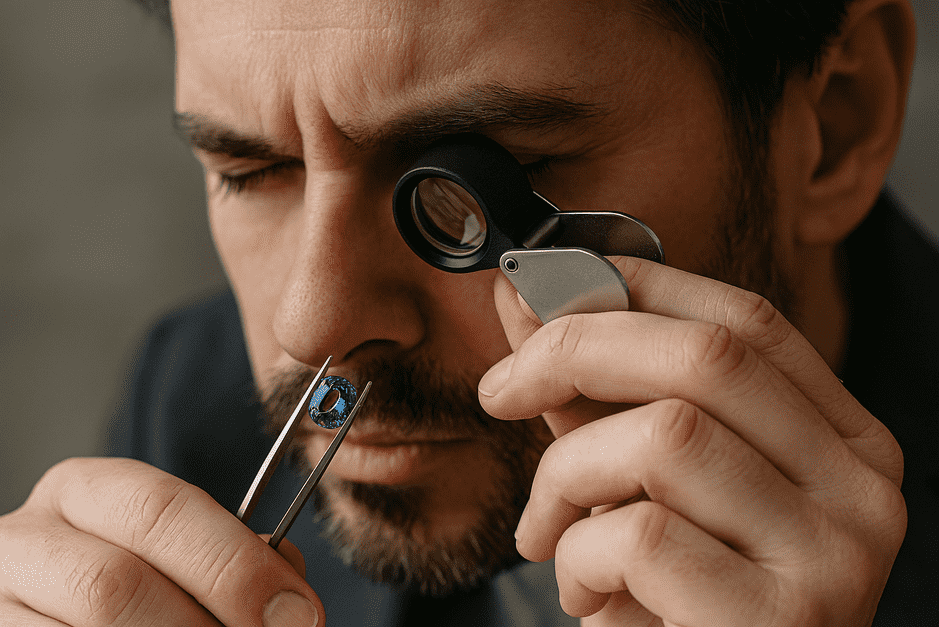
- Hold the loupe close to your eye.
- Keep the gemstone steady in tweezers.
- Move the stone—not the loupe—when focusing on inclusions.
This method ensures stability and a clear field of vision.
Key Takeaway
A 10x triplet loupe remains the most trusted tool in gemstone work. With the right lens and proper handling, you can easily evaluate clarity, inclusions, and authenticity. It’s the first step toward mastering gemstone identification.
FAQ
1. Why do gemologists prefer 10x magnification?
It offers enough detail without making the field of view too narrow.
2. What is a triplet loupe?
A loupe with three lenses that correct distortion and color fringing.
3. Can I use a higher magnification loupe?
Yes, but it limits your field of view and comfort.
4. How do I test loupe quality?
Use graph paper to check for sharpness, straight lines, and no color edges.
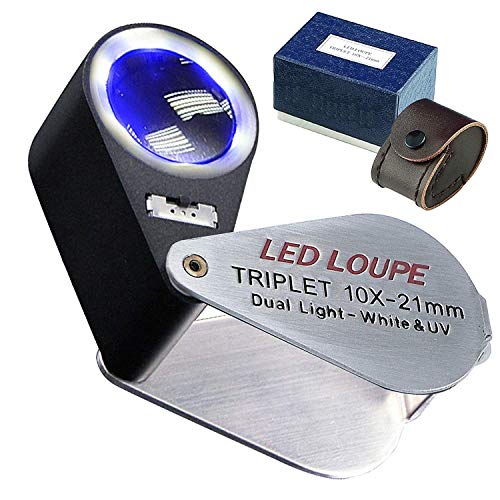
- With 10X magnification, 2-IN-1 with 6 LED Light and UV light and 21mm triplet lens, enable achromatically analysis. It i…
- LED UV Loupe Magnifier Loupes are used widely in jewelry trade, watchmaking, photography, printing, numismatics, scienti…
- Emits a cool bright light that produces bright image and good visibility, even in poor light conditions. Natural white l…