A Note for Readers
A Note for Readers on Hong Kong’s Jade Trade: Market prices, dealer registration requirements, laboratory accreditations, and stall numbers change regularly. Therefore, this article is a starting point, not a substitute for on-the-ground research.
Introduction
Hong Kong’s Jade Trade stands as the world’s premier hub for jadeite. Historically, dealers, collectors, and tourists actively converge on this city to buy, sell, and authenticate one of Asia’s most coveted gemstones. However, navigating this market requires knowledge of licensing rules, sourcing ethics, grading systems, and dealer practices. As a Gemologist, unfortunately, I have seen too many buyers lose money to clever fakes and undisclosed treatments. In this guide, I will walk you through everything you need to know before you spend a single Hong Kong dollar on jade.
How Dealers Get Licensed in Hong Kong’s Jade Trade
To begin with, you must understand the legal landscape. Since April 2023, the Hong Kong Customs and Excise Department has required all jade and precious stone dealers to register under the Dealers in Precious Metals and Stones (DPMS) regime. Ultimately, this framework targets money laundering and strengthens consumer protection across the industry.
Basically, dealers register under one of two categories:
Category A (Non-Cash) in Hong Kong’s Jade Trade
Category A covers traders who conduct non-cash transactions of HK 120000 or more. Importantly, Category A registrants cannot conduct transactions above that threshold. They must hold a valid business registration certificate and pay an initial fee of HK 260 (renewed annually at HK$195). However, they are not required to comply with heavy Anti-Money Laundering (AML) customer due diligence.
Category B (Cash) in Hong Kong’s Jade Trade
Conversely, Category B applies to dealers who handle cash transactions of HK 120000 or more. These applicants must pass a fit-and-proper test, pay an initial fee of HK 1970, and renew every three years. Crucially, they must implement robust AML compliance systems. Dealers operating without proper registration face fines of up to HK$100,000 and imprisonment.
Origins: Myanmar’s Role in Hong Kong’s Jade Trade
Where does the rough stone come from? Myanmar (Burma) supplies between 70% and 95% of the world’s gem-quality jadeite. The most prized rough stones come from the Jade Tract in Kachin State.
- Hpakant: Undoubtedly, the world’s largest jade mining area.
- Tawmaw: Historically known for intense green hues.
- Sate Mu: Valued for high translucency.
Dealers source rough jade through three main channels. First, the Myanma Gems Emporium hosts government-sanctioned auctions in Nay Pyi Taw. Second, the open-air market in Mandalay offers daily cash trading. Third, an estimated 50–80% of jade moves through illegal smuggling routes across the Myanmar–China border, bypassing export taxes entirely. Unfortunately, the industry carries serious ethical risks. Massive open-pit mining has triggered deadly landslides, and armed conflict plagues the region. You can compare this to the ethical strides made in De Beers GemFair Artisanal Diamonds.
Evaluating and Pricing in Hong Kong’s Jade Trade
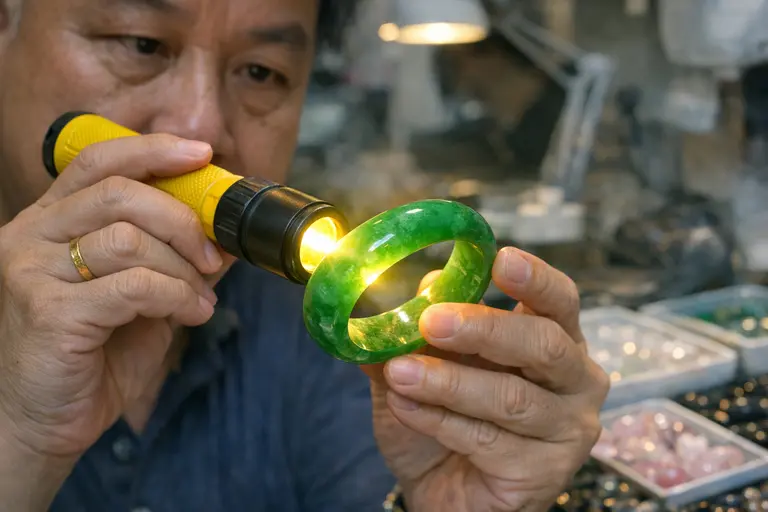
Interestingly, professional buyers practice what the trade calls “Gambling on Stones.” Specifically, they use high-intensity flashlights to assess color, translucency, and texture through a boulder’s rocky crust before committing to a purchase. Unlike diamonds, jadeite has no standardized price list like Rapaport vs IDEX Diamond Prices.
Instead, dealers price items based on market mood and the buyer’s perceived wealth. For instance, a piece worth 30,000 RMB (Renminbi) might be offered to a wealthy executive at 50,000 RMB without hesitation. Historically, at the Yau Ma Tei Jade Market, vendors traditionally offer the “first customer of the day” a lower lucky price. Therefore, bargaining is standard practice. Expect opening prices to sit 40–50% above the eventual sale price.
Grading and Treatments in Hong Kong’s Jade Trade
Hong Kong’s Jade Trade uses a grading system that all buyers must understand.
- Type A (Natural): Untreated jadeite that has only undergone standard cutting and polishing (waxing). Importantly, this process does not diminish the stone’s value. Type A is the only grade that retains investment value.
- Type B (Bleached/Polymer): Essentially, dealers acid-bleach the stone to remove brown stains and inject it with polymer resin to improve translucency.
- Type C (Dyed): Typically, artificially dyed jadeite to intensify existing colors.
- Type D (Imitation): Basically, an informal trade term describing imitations like glass, plastic, or Serpentine passed off as genuine jade.
Note: Recognized institutions like the GIA use “Type” (A, B, C) rather than “Grade,” and they do not officially recognize “Type D” (as it is not jadeite at all). Always demand a certificate from an accredited lab like GIA Hong Kong or the Hong Kong Jade and Stone Laboratory. Read my guide on Nephrite vs Jadeite Jade to understand the mineral difference.
Buying Safely in Hong Kong’s Jade Trade
Buyers can protect themselves by following practical steps.
- Verify the Shop: Look for the Hong Kong Tourism Board’s “Quality Tourism Services” sticker (a red junk boat emblem).
- The Sound Test: Simply, tap a jadeite bangle gently. Natural Type A jade produces a clear, metallic ring, while treated (polymer) jade sounds noticeably dull.
- The Touch Test: Furthermore, real jade feels cold to the touch and resists scratching from a steel blade.
- Choose Transparent Sellers: The Yau Ma Tei Jade Market relocated to 251 Shanghai Street in 2020. Collectors frequently cite Stall 152 (Sandra and Kelvin Chau) and Stall 36 (Anna and Agnes) for honest, no-pressure approaches. However, always verify locations on-site as stall numbers change.
Conclusion on Hong Kong’s Jade Trade
In summary, Hong Kong’s Jade Trade is a thrilling but complex arena. By understanding the DPMS laws, the treatments, and the art of negotiation, you can navigate it safely. Ultimately, buying a piece of Type A Jadeite is an investment in a cultural legacy that spans thousands of years.
FAQ: Hong Kong’s Jade Trade
Is it legal to buy rough jade directly from Myanmar?
Legally, buyers must comply with Myanmar’s export regulations and their home country’s import laws. In fact, since 2019, Myanmar has periodically banned raw jadeite exports, making formal channels difficult.
What is the most important document to request?
Crucially, request a certificate from an HKAS-accredited laboratory (like GIA Hong Kong). Verify the report number online before completing any purchase.
Can I negotiate prices at licensed jade shops?
Yes, bargaining remains culturally accepted at hawker stalls. However, reputable shops with fixed certification costs may offer less flexibility.
What is the difference between Category A and Category B registration?
Category A covers dealers conducting non-cash transactions over HK$120,000 (lower fees, no heavy AML compliance). Category B covers dealers handling cash transactions exceeding the limit (higher fees, stricter AML supervision).
Is Grade D jade officially recognized?
No. It is an informal trade term for imitations (plastic/glass). Recognized institutions like the GIA do not use a “Grade D” classification.
Disclaimer
This article is published for general informational and educational purposes only and is intended for everyday consumers and travellers. Consequently, it does not constitute legal, financial, investment, or professional advice of any kind. The information was accurate to the best of the author’s knowledge at the time of writing. Readers should independently verify all information before making any purchasing or business decisions. The mention of specific market stalls and laboratories is based on publicly available information and traveller reports only. It does not constitute a commercial endorsement, and the author has no sponsored, affiliate, or paid relationship with any business mentioned. Trade conditions involving Myanmar are particularly susceptible to change due to ongoing political developments and international sanctions. Indian readers planning to import jade should consult the Directorate General of Foreign Trade (DGFT).