
Summary
Many jewellery buyers in Kerala still pay gold prices for worthless stones. The reason? They don’t ask the jeweller whether the bill is based on gross vs net weight. Learn how this one question can help you pay only for the real gold in your ornaments — not for glass or synthetic stones used in Nagapada Thali, jhumkas, and bangles.
When you buy stone-studded jewellery in Kerala, one question decides if you’re paying fairly: Are you being billed by gross or net weight?
The difference between gross vs net weight determines whether you pay for gold alone or for the stones, enamel, and lac inside the piece. Sadly, many jewellers still bill on gross weight, making you pay gold rates for materials with no resale value.
If you’re unsure about hallmarking or purity checks, you can read our related post — Understanding BIS Hallmark: What It Means for Your Jewellery — to understand how hallmarking ensures authenticity.
Understanding Gross vs Net Weight in Jewellery
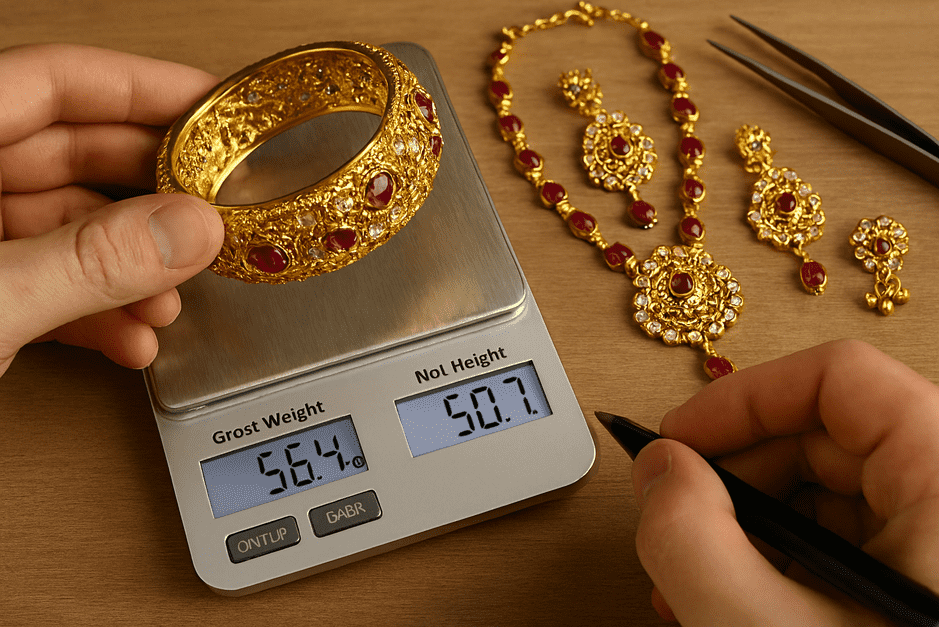
Gross weight = gold + stones + enamel + lac
Net weight = only the actual gold content
Jewellers often prefer gross weight because it increases the total value on paper. However, as a buyer, your goal should be to pay only for the net gold weight.
For example, designs like Nagapada Thali or stone-studded jhumkas contain synthetic or semi-precious stones. If the bill doesn’t clearly separate weights, you may end up paying the gold rate for stones.
To make smarter choices, see our internal guide on 24K, 22K, 18K: What Every Malayali Gold Buyer Must Know.
Why the Gross vs Net Weight Question Matters
As jewellery buyers, we often focus on design and price but forget to check how the weight is calculated. This is where misunderstandings occur. When billed on gross weight, you lose money during resale because only gold holds value, not glass or enamel.
For gold rate updates and price verification, consult the India Bullion and Jewellers Association. To cross-verify purity standards, check directly with the Bureau of Indian Standards (BIS).
Ask These Questions Before You Buy
Always ask your jeweller:
- Is this bill based on gross vs net weight?
- Can you show me the net gold weight separately?
- What is the stone weight and cost?
These simple questions ensure full transparency.
Example: Why It Matters
A Nagapada Thali weighs 25 grams (gross) but only 18 grams (net gold). If you pay for 25 grams at today’s gold rate, you lose money on 7 grams of stones.
Always ask for the gold and stone weight to be listed separately on the invoice.
Action Points for Buyers
- Always demand a detailed bill showing gold weight, stone weight, making charges, and GST.
- Compare the same design with multiple jewellers. Some charge for net gold, others inflate using gross weight.
- Bookmark Kerala Gold Rate Guide to track current rates before you buy.
When you buy jewellery, remember:
You should pay for gold — not for stones. Asking the gross vs net weight question protects your money.
FAQ
1. What is gross weight in jewellery?
Gross weight includes everything — gold, stones, enamel, and lac. It’s the total weight of the ornament.
2. What is net weight?
Net weight means only the gold portion after excluding stones or enamel.
3. Why should I care about gross vs net weight?
Because it decides whether you pay for real gold or for decorative stones with no resale value.
4. How can I verify purity and net gold weight?
Check for hallmark certification and ask for a separate weight entry on the bill.
5. Which designs need extra attention?
Nagapada Thali, jhumkas, and antique bangles often have stones or lac that increase gross weight.

