Introduction
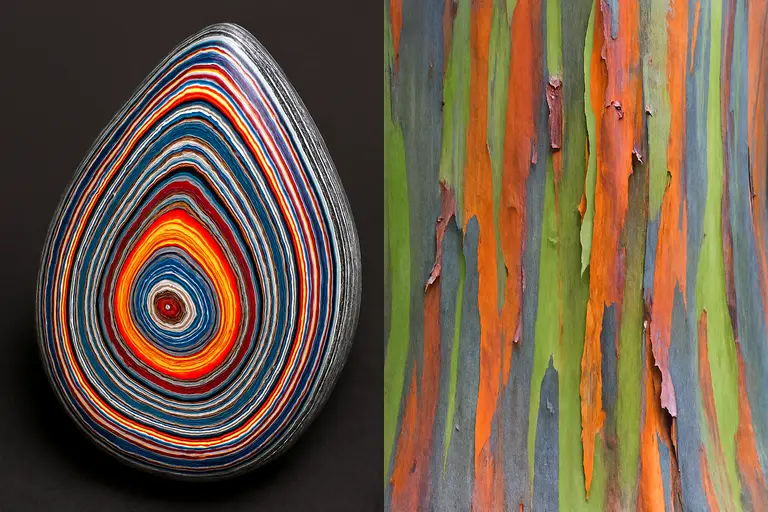
At first glance, a piece of polished Fordite and a Rainbow Eucalyptus tree appear to have little in common. One is a hardened byproduct of mid-century automobile factories in Detroit. The other is a towering tropical tree native to the rainforests of Southeast Asia. Yet, when you look closer, Fordite vs Rainbow Eucalyptus share a breathtaking visual identity defined by brilliant, layered color and one-of-a-kind patterning.
Together, they represent one of nature’s (and man’s) most fascinating coincidences: the same kind of beauty arrived at by completely different paths. As a Gemologist who appreciates patterns—whether in Ocean Jasper or in wood—I find this comparison delightful. In this article, we will explore what makes these two so special. Whether you are an artist, a collector, or a gardener in Kerala, understanding their origins adds a new layer of appreciation.
What Is Fordite? The Motor City Agate
To begin with, let’s define the man-made wonder. Fordite—sometimes called “Motor City Agate”—is not a mineral in the traditional sense. Instead, it is an accidental gem formed inside automotive paint booths during the 1940s through the 1970s.
How was it made? As factory workers repeatedly spray-painted car bodies, excess enamel paint accumulated on the metal racks. Over time, these drips built up into thick, multicolored deposits. Crucially, each time workers ran the booth through its industrial curing ovens, the paint hardened into a stone-like substance. Cycle after cycle, layer upon layer, the result was a dense slab of compressed color.
Today, true vintage Fordite is increasingly rare because modern factories use automated painting that wastes almost nothing. Therefore, Fordite is a finite resource, much like Antique Diamonds. When cut and polished, it reveals brilliant ribbons of color—greens, reds, and blues—flowing like a psychedelic Agate.
What Is Rainbow Eucalyptus? The Mindanao Gum
In contrast, Rainbow Eucalyptus (Eucalyptus deglupta) is a living artwork. Originally native to the tropical rainforests of Indonesia, Papua New Guinea, and the Philippines (specifically Mindanao), it holds a unique distinction. It is the only Eucalyptus species indigenous to the Northern Hemisphere.
The secret lies in its bark. Throughout the year, the outer bark peels away in vertical strips, exposing a neon green inner layer. As that exposed layer matures, it transitions through a remarkable sequence of colors:
- Blue
- Purple
- Orange
- Maroon
Because different sections of the trunk shed at different times, a single tree displays all these hues simultaneously. For my readers in Kerala: This tree thrives in our climate. You can find specimens in the high ranges of Wayanad and Munnar, standing tall like colorful sentinels. For more on tropical flora, check my Appuppanthadi and Horsetail Demantoid guide.
Similarities between Fordite vs Rainbow Eucalyptus
Despite their vastly different origins, Fordite vs Rainbow Eucalyptus share remarkable qualities.
Stratified Color
First and most obviously, both are defined by vibrant, layered color.
- Fordite’s stripes come from the sequential application of car paint colors (Mustang Red, Corvette Blue).
- Eucalyptus hues arise from the biological process of bark shedding and oxidation. In both cases, the result is a stratified visual experience where no single color dominates.
Uniqueness
Furthermore, both are unique. Because Fordite formed organically within paint booths—shaped by random drips—no two pieces are ever identical. Similarly, because each Rainbow Eucalyptus sheds its bark on its own schedule, no two trees look the same. This one-of-a-kind quality is what makes them desirable for collectors. Compare this to the patterns in Trapiche Gemstones.
Identifying Fordite vs Rainbow Eucalyptus
How do you know if what you have is real?
Identifying Fordite
Collectors should look for smooth, polished layers with occasional air bubbles. Under magnification, you might see fine paint-droplet textures. Since the paint layers can be brittle, well-made Fordite jewelry is typically sealed with a protective resin. Be careful: Unfortunately, modern “Faux Fordite” made of polymer clay exists. Always verify the source.
Identifying Rainbow Eucalyptus
This is straightforward. Look for a smooth-barked tree with peeling strips revealing vivid green beneath. However, it demands specific growing conditions. According to horticultural guidelines, it thrives only in frost-free climates. If you try to grow it in a cold region, the colors will be dull brown. Therefore, the vibrancy of the bark is proof of the tree’s health.
Uses of Fordite vs Rainbow Eucalyptus
From a practical standpoint, the two differ considerably.
Fordite Uses
Fordite is primarily a material for Lapidary Art. Jewelry designers prize it for rings, pendants, and cufflinks. Likewise, knife makers use it for decorative handles. The goal is to showcase the cross-sections that emerge after cutting. For Indian buyers, Fordite makes for excellent “Conversation Starter” jewelry, distinct from traditional gold.
Eucalyptus Uses
Rainbow Eucalyptus, by contrast, operates at a much larger scale. Landscapers use it in dramatic landscaping in tropical regions. Beyond aesthetics, plantations also cultivate it commercially for Pulpwood (paper production). It is a fast-growing species, capable of reaching over 200 feet. Consequently, it is both a work of art and a workhorse of the timber industry.
Conclusion on Fordite vs Rainbow Eucalyptus
Ultimately, the comparison of Fordite vs Rainbow Eucalyptus teaches us about beauty. Fordite is Accidental Art—created by humans without trying. Rainbow Eucalyptus is Intentional Art—created by nature’s evolution. In summary, whether you wear the paint or plant the tree, you are celebrating the spectrum of color.
FAQ: Fordite vs Rainbow Eucalyptus
Is Fordite vs Rainbow Eucalyptus material a gem?
Technically, no. It is not a mineral. However, it is treated and valued much like an organic semi-precious stone (like Amber or Pearl) within the lapidary community due to its rarity and beauty.
Can Rainbow Eucalyptus grow in India?
Yes. It thrives in the tropical climates of Kerala, Karnataka, and Tamil Nadu. It requires high humidity and rainfall, making the Western Ghats an ideal home.
How do I know if Fordite is authentic?
Look for provenance. Authentic vintage Fordite usually comes from reputable dealers who can trace it to specific factories (e.g., The Corvette Plant in the 1960s). Modern imitations lack the “metallic” flecks often found in vintage car paint.
Why does Rainbow Eucalyptus bark change color?
Oxidation causes the color change. Fresh bark is green (chlorophyll). As it is exposed to air, tannins in the bark react, turning it purple, red, and finally orange.
Where can I buy Fordite jewelry?
Many independent jewelers sell pieces on platforms like Etsy. Always ask if the piece has been stabilized with resin, as old paint can be fragile.