Introduction
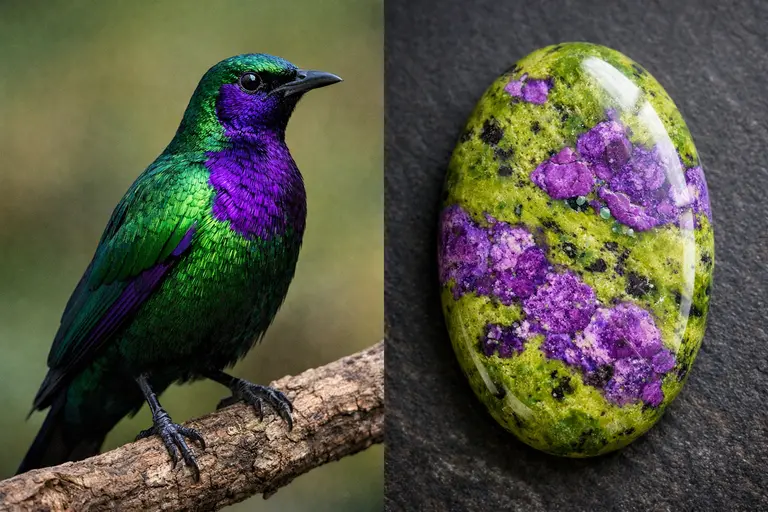
Nature loves to repeat its most beautiful patterns across different kingdoms. If you look closely at the emerald starling and atlantisite, you will notice something truly remarkable: they look almost identical. Both display a vivid, metallic green base covered with splashes of deep purple and violet. Whether you are a birdwatcher, a crystal lover, or a jewelry designer, this comparison will certainly delight you. In this guide, you will learn about their diverse origins, how their colors work, and how to spot a fake Atlantisite. Consequently, you will understand how to appreciate these “color twins” properly. You should also read our guide on gemstone identification to strengthen your knowledge before purchasing rare minerals.
Why the Emerald Starling and Atlantisite Look So Similar
At first glance, most observers assume someone painted the stone to match the bird. However, both get their stunning visual profiles from nature alone. The emerald starling (Lamprotornis iris) lives in the lowlands and savanna woodlands of West Africa. Specifically, you can find them in Côte d’Ivoire, Guinea, and Sierra Leone. Because evolution shaped its feathers over millions of years, the bird developed a brilliant metallic green body. In addition, deep purple patches cover its ear coverts and belly. The color does not come from pigment; instead, the microscopic structure of each feather bends light to create those rich tones. You can learn more about iridescent bird structures at the Cornell Lab of Ornithology.
Meanwhile, atlantisite forms exclusively in Tasmania, Australia. Miners find this material at Stichtite Hill in the Dundas mineral field. It develops when green serpentine rock and purple stichtite mineral combine naturally under extreme pressure. As a result, the stone ends up with an irregular green background and vivid purple patches that flow through it organically. Therefore, both the bird and the stone share the same eye-catching pattern, even though one is a living creature and the other is a mineral formed millions of years ago.
How Their Vivid Colors Work
The emerald starling’s upperparts shine with an electric metallic green. Furthermore, around the neck and across the belly, the feathers shift into a glossy violet glow. Because light hits the feather structure at different angles, the colors seem to move as the bird turns. No two birds look exactly the same in motion, which makes every sighting feel special. This optical phenomenon creates a sense of depth that few other species can match.
Similarly, an atlantisite cabochon shows a pale-to-dark green base with irregular purple blotches. In addition, some stones carry small black specks of chromite, which add texture and contrast to the overall pattern. Moreover, when you hold the stone under natural light and tilt it slowly, the purple stichtite appears to deepen. Both the emerald starling and atlantisite, therefore, create an “electric” visual effect that immediately draws the eye. To understand the geological and mineralogical overview of such minerals, you can refer to the Crystal World Sales.
How to Identify Real Atlantisite Specimens
Because real atlantisite is rare and restricted to one location, you should know what to look for before you buy. First, check that the green and purple areas look natural and uneven. Genuine atlantisite always shows an organic, flowing pattern rather than a perfectly even spread of color. Specifically, the purple stichtite should look like it is “growing” inside the green serpentine.
Second, press a harder stone like quartz gently against a hidden area of the surface. Since real atlantisite rates only 2.5 to 4 on the Mohs hardness scale, harder minerals will scratch it easily. Third, hold the stone under different light angles. Natural pieces shift and glow, whereas fakes tend to look flat. You should also read our article on gemstone buying mistakes to avoid common retail traps.
Spotting Common Market Fakes
Unfortunately, some sellers try to pass off cheaper materials as atlantisite. The most common trick involves dyed serpentine. In this case, sellers use plain green stone and add purple dye to fake the presence of stichtite. However, the dye usually sits only on the surface or inside shallow cracks. As a result, the purple looks painted on rather than grown into the rock.
Another common imitation uses crushed stone powder mixed with resin. These pieces often feel lighter than real rock and look too smooth. Moreover, their inclusions appear too regular and too uniform. Therefore, always trust your instincts; if the price seems too low for something described as rare, it most likely is not the real thing. Buying from a reputable dealer protects you far better than buying on price alone.
Practical Tips for Buying and Caring for Atlantisite
Once you own an atlantisite piece, you must care for it properly. Because the stone is soft, you should avoid wearing it in a ring that you use for daily tasks. Instead, choose pendants or earrings, since these settings experience far less physical impact. Additionally, when cleaning it, use only lukewarm water with a soft cloth. You must avoid harsh chemicals and ultrasonic cleaners, as these can easily damage the delicate surface of the serpentine.
For storage, keep your atlantisite away from harder stones like diamonds or sapphires. Otherwise, those gems can scratch your piece if they rub against it. With proper care, therefore, atlantisite stays vibrant for years and makes a striking conversation starter in any collection. Whether you admire the emerald starling and atlantisite for their beauty or their geological rarity, they remain two of nature’s most impressive “twins.”
FAQ: Emerald Starling and Atlantisite
What makes the emerald starling and atlantisite look alike?
Both feature a bright green base with irregular purple and violet accents. This shared palette creates a vivid, “electric” visual effect that makes them instantly recognizable to the eye.
Where does real atlantisite originate?
It comes exclusively from Stichtite Hill in Tasmania, Australia. This is the only documented location where green serpentine and purple stichtite combine to form true atlantisite.
Is atlantisite durable enough for daily wear?
It is a relatively soft stone, rating 2.5 to 4 on the Mohs scale. Consequently, you should handle it with care and prefer settings like pendants that do not hit hard surfaces.
How do I detect a dyed fake?
Look for color concentration in the cracks. If the purple color looks unusually bright or sits only on the surface, the stone is likely dyed serpentine.
Where does the emerald starling live?
The emerald starling lives in the savanna woodlands of West Africa. Specifically, it thrives in regions across Guinea, Sierra Leone, and Côte d’Ivoire.
Disclaimer
This article provides general information for educational and entertainment purposes only. It does not replace professional gemological or ornithological advice. Always consult a qualified expert for gem identification and value assessment. Colors, patterns, and properties vary among individual specimens.