Introduction
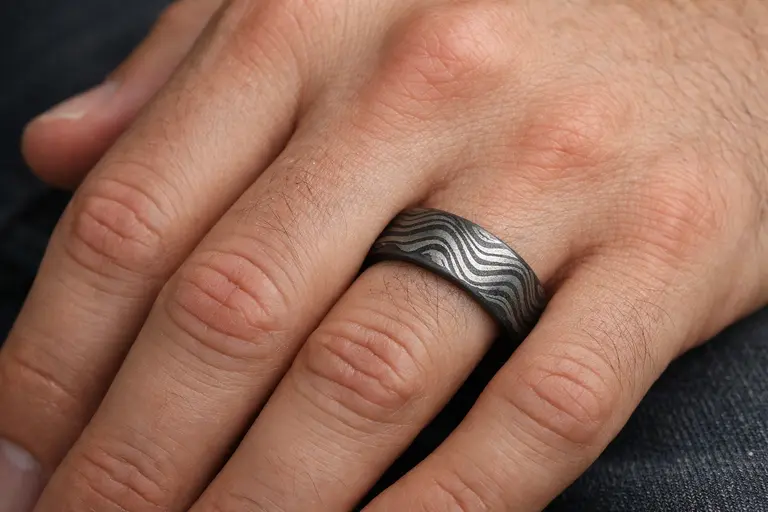
In the modern market, Damascus Steel Jewelry stands among the most visually striking options available today. Its flowing, organic patterns catch the eye immediately, and its deep history adds meaning that goes far beyond aesthetics. Whether you’re shopping for a men’s wedding band, a statement bracelet, or a gift with genuine character, this metal deserves a close look.
As a Gemologist based in Kerala, I am particularly proud to write this guide because the roots of this legendary metal actually trace back to South India. In this article, we will cover everything you need to know about Damascus Steel Jewelry, from its ancient origins to how you can spot a fake laser-etched ring. Ultimately, understanding this craft helps you appreciate why a “simple” steel ring can cost hundreds of dollars.
What Is Damascus Steel?
To begin with, modern Damascus used in jewelry is technically a “Pattern-Welded” material. Skilled smiths create it by forge-welding multiple layers of different steel alloys together. Then, they fold and twist the hot billet repeatedly to build up hundreds of distinct layers.
The process forces contrasting metals to fuse at a molecular level. The result is a material with both mechanical strength and extraordinary visual complexity. Today, most jewelers use 304L and 316L stainless steel as their primary alloys because both grades offer excellent corrosion resistance and biocompatibility. Once the smith dips the finished piece in an acid bath, the two alloys respond differently. Consequently, the hidden, wood-grain pattern rises dramatically to the surface. This acid-etching is very similar to the chemical testing we do in gemology, as I discussed in Rhodochrosite vs Rhodonite.
The South Indian Origins of Wootz
The history of this metal dates back more than 2,000 years. Historically, metallurgists in South India (Kerala and Tamil Nadu) and Sri Lanka first produced a remarkably high-carbon crucible steel known as Wootz around 300 BC. Wootz blades were legendary for their sharpness, toughness, and the wavy surface patterns that appeared naturally during forging.
How did it get its name?
The steel gained the name “Damascus” because the Syrian city of Damascus served as a major medieval trade center where these Indian blades were sold. Crusaders encountered these exceptional weapons there and carried word of them back to Europe. However, by approximately 1750, the original Wootz technique had disappeared entirely, as the specific ore deposits became exhausted. Therefore, today’s jewelers do not attempt to recreate true Wootz. Instead, they use pattern welding to achieve the same striking visual effect. For a deeper look at metallurgy, the American Iron and Steel Institute provides excellent resources.
How Damascus Steel Jewelry Appears
Jewelers apply this metal across a wide range of accessories. The most popular application by far is the men’s wedding band. Many couples choose it specifically because the forge-welding process symbolizes two different metals becoming permanently one—a powerful metaphor for marriage.
Furthermore, designers frequently use it as an inlay material. They pair it with 14K Gold, Wood, Meteorite, or other exotic elements. The contrast between the steel’s grey tones and warmer materials creates a dynamic aesthetic. You can compare this fusion of materials to the bespoke designs I discussed in Sartory Billard Watches.
How to Identify Authentic Damascus Steel Jewelry
Because genuine pattern-welded metal commands a premium price, the market is flooded with cheap, laser-etched imitations. Fortunately, several reliable tests allow buyers to distinguish the real article from a fake copy.
- Pattern Continuity: On authentic pieces, the pattern flows seamlessly across every surface, including the inner bore of a ring and its side edges. Conversely, a laser-etched fake shows the pattern only on the outer face.
- Tactile Texture: Acid etching removes material unevenly because the two alloy types respond at different rates. As a result, genuine Damascus develops a faint but detectable 3D texture. A laser-etched surface feels perfectly flat.
- The Magnet Test (With Caveats): If the ring is made from high-carbon Damascus or specific Swedish Damasteel blends, it is ferromagnetic, and a magnet will attract it strongly. However, if the jeweler used pure 304L/316L marine-grade stainless steel (for hypoallergenic reasons), it will be non-magnetic. Therefore, while a magnet test can rule out Titanium or Aluminum fakes in carbon-steel rings, the Acid Test and Visual Texture remain your most reliable tools.
If you are worried about buying fakes, read my general guide on Gemstone Buying Mistakes.
Practical Tips Before You Buy
Before purchasing a piece of Damascus Steel Jewelry, keep the following points in mind.
Sizing is Final
Crucially, Damascus steel is extremely hard, and most jewelers cannot resize it after forging. Always visit a professional jeweler for an accurate measurement rather than relying on a cheap home ring-sizer kit. If you gain or lose weight, you will likely have to buy a new ring.
Care and Maintenance
Avoid exposing your piece to Chlorine (found in swimming pools and bleach). Why? Because chlorine can strip the acid-etched finish and cause rust in the micro-crevices. Clean the piece regularly with mild soap and warm water, then dry it thoroughly.
Pricing Expectations
Quality handcrafted rings typically start around $150 to $400. If you see pieces priced significantly below that range (e.g., $20 on Amazon), they almost certainly carry laser-etched patterns rather than genuine forge-welded layers.
Conclusion: Forged Art
In summary, Damascus Steel Jewelry connects the wearer to a tradition of extraordinary craftsmanship that spans more than two millennia. Whether you value its Indian history, its visual character, or its romantic symbolism, a genuine piece offers something that cast metal simply cannot replicate. Ultimately, take the time to verify authenticity, and you will own something genuinely exceptional.
FAQ: Damascus Steel Jewelry
Is Damascus Steel Jewelry safe to wear every day?
Yes. Jewelers build most high-quality pieces from 304L or 316L stainless steel, both of which resist corrosion exceptionally well and suit daily wear. Just avoid prolonged chlorine exposure in swimming pools.
Can a jeweler resize a Damascus steel ring?
No, resizing is rarely possible. The steel’s hardness makes traditional cutting and soldering techniques ineffective, and any significant heating risks destroying the pattern. Always order your exact measured size.
Does Damascus steel rust?
Modern jewelry made from stainless steel alloys resists rust effectively under normal conditions. However, if the maker used high-carbon steel (like knife makers use), it will rust if not oiled regularly. Always ask the jeweler if it is “Stainless.”
What makes it more expensive than plain stainless steel?
The forge-welding, folding, twisting, and acid-etching process requires considerable skill and time. Consequently, a single billet demands hours of labor before a jeweler even begins shaping the final piece.
What is Damasteel?
Damasteel® is a Swedish company that produces Damascus steel from powder metallurgy rather than traditional forge-welding. Many luxury jewelers source their raw material from them because the powder-based process yields exceptionally fine patterns.